Affiliate Disclosure: This article may contain affiliate links. BuildSafeHome may earn a commission at no extra cost to you.
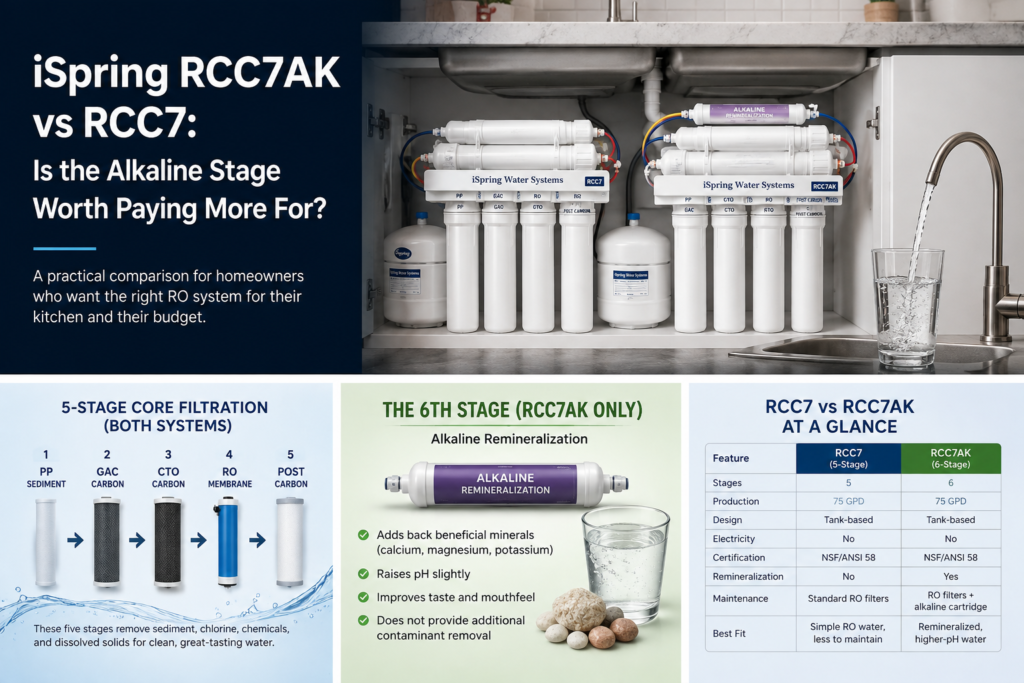
The RCC7 and RCC7AK share the same core RO design, while the RCC7AK adds an alkaline remineralization stage.
When people start comparing iSpring RCC7AK vs RCC7, it’s easy to assume the six-stage RCC7AK is simply a “better” version of the five-stage RCC7; more stages must mean more filtration, right?
That’s not actually what’s happening here.
The iSpring RCC7AK 6-stage reverse osmosis system vs iSpring RCC7 5-stage reverse osmosis system comparison isn’t really a story about one unit removing more contaminants than the other. It’s a story about what happens after the core reverse osmosis process has already done its job.
Both systems are built around the same basic RO platform, rated for the same output, and installed in much the same way under a kitchen sink. The RCC7AK adds a sixth, final stage designed to put minerals back into the water and slightly raise its pH.
That’s a real difference, just not the one the stage count might suggest.
The Short Answer
If you want straightforward RO water without an extra cartridge to think about, the RCC7 is the simpler and generally less expensive choice. It gives you a traditional under-sink reverse osmosis setup with one less consumable part to maintain.
If you’ve tried RO water before and found it tastes flat, or you specifically want water with minerals added back after filtration, the RCC7AK is built for that preference.
You’re not necessarily getting “cleaner” water with the RCC7AK. You’re getting RO water followed by an additional remineralization step.
Neither choice is automatically better. It depends on what you want from the water after filtration.
iSpring RCC7AK vs RCC7 at a Glance
| Filtration stages | 5 | 6 |
| Production rating | 75 GPD | 75 GPD |
| Design | Tank-based, under-sink | Tank-based, under-sink |
| Electricity required | No | No |
| Certification | NSF/ANSI 58 listed | NSF/ANSI 58 listed |
| Remineralization | No | Yes |
| Maintenance | Standard RO filters | Standard RO filters + alkaline cartridge |
| Best fit | Buyers who want conventional RO water with less to maintain | Buyers who prefer remineralized water after RO filtration |
The two systems share most of what matters in the table above.
The biggest difference is the remineralization stage.
What the First Five Stages Actually Do
This is the part that is largely shared between the two systems, and it’s worth understanding before getting into what’s different.
Both the RCC7 and RCC7AK use a conventional multi-stage RO process that includes sediment filtration, carbon filtration, a reverse osmosis membrane, and a final polishing stage before the water reaches your faucet.
The sediment stage helps catch larger particles such as dirt, rust, and sediment.
The carbon stages help reduce chlorine, taste, odor, and other compounds before the water reaches the RO membrane.
The RO membrane performs the primary reduction of dissolved solids.
The post-carbon stage then helps polish the water before dispensing.
That five-stage foundation is the core filtration system in both models.
Both systems are also conventional tank-based designs. Water is filtered and stored in a pressurized tank, so you have water available at the faucet rather than waiting for the membrane to produce it on demand.
Neither the RCC7 nor RCC7AK requires electricity in its standard configuration. They rely on incoming water pressure.
What the RCC7AK’s Sixth Stage Changes
The RCC7AK takes the water produced by that core RO process and routes it through one additional inline cartridge before it reaches your glass.
That cartridge is designed primarily for remineralization and pH adjustment.
Reverse osmosis removes dissolved solids from water, including minerals that naturally contribute to taste and mouthfeel. The RCC7AK’s alkaline stage is intended to add some mineral content back after the RO process.
For some households, that can make the finished water taste more familiar or less “flat.”
What the extra stage should not be viewed as is another major contaminant-removal stage.
Its primary purpose isn’t additional purification. It’s post-treatment adding minerals back and adjusting the character of the finished water.
It’s also worth keeping alkaline-water marketing in perspective. This comparison isn’t making health claims about alkaline water.
The practical reason to choose the RCC7AK is taste and remineralization, not promises of added health benefits.
Does the RCC7AK Produce Cleaner Water?
Not because of the sixth stage.
Both systems share the same core RO filtration design and NSF/ANSI 58 certification, so the extra alkaline cartridge shouldn’t be viewed as an additional contaminant-removal stage.
The RCC7AK’s sixth stage comes after the primary filtration process.
That means the buying decision is less about which one filters “better” and more about whether you want the finished RO water remineralized afterward.
If contaminant reduction is your main priority, the RCC7AK’s extra stage count is not, by itself, a reason to choose it.
Taste: Where the Difference Becomes Personal
This is where the difference between the two systems becomes more noticeable in everyday use.
Some people drink conventional RO water and like it exactly as it is.
Others describe RO water as tasting unusually flat or neutral because much of the dissolved mineral content has been removed.
That doesn’t necessarily mean something is wrong with the water. It’s often just a matter of what someone is accustomed to drinking.
If you already know you prefer water with some mineral character, the RCC7AK’s remineralization stage may be worthwhile.
If you’ve never disliked the taste of RO water, the additional alkaline stage may not matter much to you.
This is one of those cases where personal preference matters more than the specification sheet.
Check current iSpring RCC7AK pricing to see whether the remineralization upgrade makes sense for your budget.
Installation and Cabinet Space
Both systems install in roughly the same way.
You’ll have:
- The RO filtration assembly
- A pressurized storage tank
- A dedicated drinking-water faucet
- Tubing connected to your cold-water supply
- A drain connection
- Multiple replaceable filter cartridges
If you’re comfortable installing a traditional under-sink RO system — or you plan to have someone install it for you — there isn’t a major difference between the two models.
The RCC7AK does have one additional inline cartridge because of the alkaline stage.
That means one more cartridge and a little more tubing to fit under the sink.
For many kitchens, that won’t matter. But if your cabinet is already crowded with a garbage disposal, dishwasher plumbing, cleaning supplies, or other equipment, it’s worth checking how much space you have before buying.
Filter Replacement and Ownership Costs
Maintenance is one of the more practical differences between the RCC7 and RCC7AK.
The RCC7 uses the standard RO filter components: sediment, carbon filters, membrane, and polishing filter, each replaced according to its own service interval.
The RCC7AK uses those same core components and adds an alkaline remineralization cartridge.
That means the RCC7AK gives you one more consumable to keep track of and replace over the life of the system.
The additional expense isn’t necessarily dramatic, but it is real.
Exact filter costs and replacement schedules will vary based on household usage, incoming water quality, and current iSpring replacement-filter pricing.
The RCC7 is simply the lower-maintenance option because there’s one less cartridge in the system.
RCC7 vs RCC7AK Pricing
At the time of this comparison, iSpring listed the RCC7 at a regular price of around $230.99, with sale pricing dropping it to roughly $196.34.
The RCC7AK has recently been priced in the low-to-mid $240 range on iSpring’s site.
These prices can change due to promotions, inventory levels, and retailer pricing, so treat them as a snapshot rather than permanent numbers.
The more useful question isn’t simply:
“Which one costs less today?”
It’s: “Would I actually value remineralized water enough to pay a modest premium and maintain one additional cartridge?”
If the answer is yes, the RCC7AK may make sense.
If you don’t particularly care about remineralization, there’s little reason to pay extra just because the model has six stages instead of five.
Check current iSpring RCC7 pricing and compare current iSpring offers before deciding, since promotions can change the price difference between the two.
Who Should Buy the RCC7?
The RCC7 makes the most sense if:
- You want a conventional under-sink RO system without an additional remineralization stage
- You’d rather keep maintenance as simple as possible
- You don’t mind the taste of standard RO water
- You want to minimize ongoing filter costs
- You want a proven 75 GPD tank-based design without extra features you may not use
For many households, this is the lower-friction choice.
You get the core RO system without paying for a feature that may not matter to you.
Who Should Buy the RCC7AK?
The RCC7AK makes more sense if:
- You’ve tried RO water before and found the taste too flat
- You specifically want minerals added back after filtration
- You prefer water with a slightly higher pH
- You’re comfortable maintaining one additional cartridge
- The modest price premium isn’t a major concern
- Taste and mouthfeel matter enough to make remineralization worthwhile
If those points describe what you actually want from your drinking water, the sixth stage is to address a real preference rather than simply add another number to the product description.
Final Verdict
The RCC7AK isn’t automatically a better reverse osmosis system simply because it has six stages instead of five.
Both systems share the same core RO filtration design and 75 GPD platform. Both are traditional tank-based under-sink systems that operate without electricity in their standard configurations.
The RCC7AK’s sixth stage changes what happens after the core RO process.
It adds remineralization and pH adjustment.
That makes this primarily a preference decision rather than a filtration-performance contest.
If you want straightforward RO water with lower long-term maintenance, the RCC7 is the better fit.
If you specifically want remineralized water and prefer the taste characteristics that come with it, the RCC7AK offers that option at a relatively modest additional cost.
Either way, you’re starting from a very similar RO foundation.
The real question is what you want to happen to the water after that foundation has already done its job.
As an Amazon Associate, BuildSafeHome earns from qualifying purchases
This article may contain affiliate links. BuildSafeHome may earn a commission at no extra cost to you