Affiliate Disclosure: This article may contain affiliate links. BuildSafeHome may earn a commission at no extra cost to you. As an Amazon Associate, BuildSafeHome earns from qualifying purchases.
A small water leak can become an expensive problem surprisingly quickly. A slow drip under a kitchen sink or a failing water heater can go unnoticed for days, and by the time water is visible on the floor, it may already have damaged the flooring, subfloor, or cabinetry.
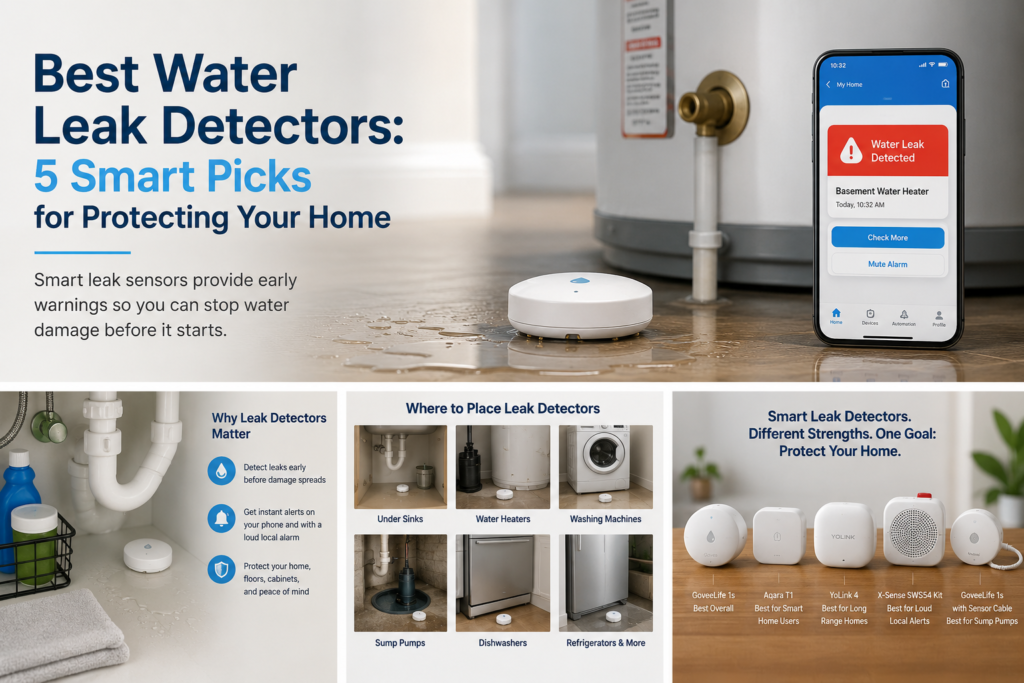
Smart water leak detectors are small, battery-powered sensors placed near an appliance or fixture that sound a local alarm, send a smartphone notification, or both, as soon as they detect moisture. That early warning can give a homeowner time to shut off the water before the damage spreads.
BuildSafeHome has not physically tested these products. Our Best Water Leak Detectors recommendations are based on manufacturer specifications, manuals, published documentation, features, and suitability for different homeowner needs.
This guide compares five point-of-use leak detectors built around different priorities, from complete smart-home kits to long-range coverage for larger properties to a simple, loud local alarm. It also covers two distinctions worth understanding first: hub-based systems versus direct Wi-Fi, and leak detection versus automatic water shutoff.
Quick Picks
| Product | Best For | Hub Required? | Local Alarm | Key Advantage |
| GoveeLife Water Leak Detector 1s | Best Overall | Yes, H5044 Gateway | Yes, 105 dB | Long stated range, long battery life, strong value |
| Aqara Water Leak Sensor T1 | Best for Smart-Home Users | Yes, Aqara Hub | No built-in siren | Zigbee smart-home automation |
| YoLink Water Leak Sensor 4 | Best for Long Range / Large Homes | Yes, YoLink Hub or SpeakerHub | Yes, 105 dB | LoRa communication suited to large properties |
| X-Sense SWS54 Kit | Best for Loud Local Alerts | Yes, SBS50 Base Station | Yes, 110 dB | Very loud, hard-to-miss alarm |
| GoveeLife 1s with Sensor Cable | Best for Sump Pumps / Hard-to-Reach Areas | Yes, H5044 Gateway | Yes | Extension cable reaches difficult spots |
How We Chose These Water Leak Detectors
We compared each model on remote alerts, local alarm capability, battery life, wireless range, hub requirements, smart-home usefulness, placement flexibility, and overall practical value for a typical homeowner rather than a smart-home enthusiast.
The goal isn’t to declare one sensor perfect for every house. A homeowner who needs coverage in a detached garage may have very different priorities from someone who already uses an Aqara smart-home system or wants a loud alarm next to a water heater.
GoveeLife Water Leak Detector 1s – Best Overall
The GoveeLife Water Leak Detector 1s combines the features most homeowners actually want: a loud local alarm, remote smartphone alerts, long battery life, and multi-sensor kit options.
It pairs H5059 sensors with the H5044 gateway, which is required for app notifications and remote alerts. The gateway connects to a home’s 2.4 GHz Wi-Fi network, while the sensors communicate with it over a proprietary Sub-1 GHz signal rather than directly over Wi-Fi.
GoveeLife states a communication range of up to 550 meters (1,804 feet). That’s a manufacturer-stated maximum, and actual indoor performance can be shorter once walls, floors, and other obstructions are factored in.
Each sensor includes a 105 dB adjustable local alarm in addition to app and email notifications, so a leak can still trigger an audible warning even if a phone alert is missed. Sensors run on two AAA batteries, with a stated battery life of up to 5 years, and carry an IP67 rating.
Kits come in multiple sizes, allowing you to cover several vulnerable spots without buying separate systems for each location.
The main limitation is that the gateway is required for smart functionality. Without it, you lose the remote notification features that make the system especially useful when you’re away from home.
For most homeowners who want a single system with local alarms, remote notifications, long battery life, and the ability to cover multiple areas, the GoveeLife 1s is a strong starting point.
Aqara Water Leak Sensor T1 – Best for Smart-Home Users
The Aqara Water Leak Sensor T1, model WL-S02D, is built for homeowners who already use or plan to build a Zigbee-based smart home setup.
It uses Zigbee 3.0 and requires an Aqara Hub. On its own, it cannot provide the connected app functionality that makes it useful as a smart sensor. Once paired with the appropriate hub, the system can send an app notification when water is detected.
The sensor is compact, measuring about 50 x 50 x 15 mm, and runs on a CR2032 battery. Aqara lists an operating temperature of 0°C to 55°C (14°F to 131°F) on its current product specifications page.
One important difference from several other products in this comparison is that the Aqara sensor lacks a built-in siren. Audible alerts can instead come through the Aqara hub or connected automations, depending on the setup.
Where this sensor earns its place is automation. Paired with the right Aqara hub and compatible devices, a leak event can become part of a broader smart-home routine rather than functioning only as a standalone alarm.
Homeowners already invested in Aqara or Zigbee are the best fit here. Someone who simply wants a self-contained sensor with a loud built-in alarm may be better served by another option on this list.
See Current Amazon Availability
YoLink Water Leak Sensor 4 – Best for Long Range / Large Homes
The YoLink Water Leak Sensor 4, model YS7906, is built around LoRa wireless communication. This long-range, low-power radio technology can be particularly useful for larger properties, detached structures, basements, and other locations where shorter-range wireless systems may struggle.
The sensor does not connect directly to your home’s Wi-Fi. It requires a YoLink Hub or SpeakerHub for full remote functionality and app alerts.
Detection is handled by electrodes that detect water pooling below and water coming from above. The Sensor 4 also includes a low-temperature or freeze warning, which can be useful in basements, garages, utility spaces, and other areas where freezing pipes are a concern.
A built-in 105 dB piezo alarm provides a local warning in addition to remote alerts, and the sensor can participate in YoLink’s device-to-device automation system.
It runs on two AAA batteries, with YoLink stating that five or more years can pass between battery changes under typical standby conditions.
The main tradeoff is the same as with other hub-based systems: homeowners who aren’t already using YoLink will need to add a compatible hub to get full remote functionality.
For a larger home, detached garage, basement, or another area where wireless range is a concern, the YoLink Sensor 4 is one of the most interesting options in this comparison.
X-Sense SWS51 / SWS54 Kit – Best for Loud Local Alerts
The X-Sense SWS54 kit pairs three SWS51 leak detectors with an SBS50 base station and is built around one clear priority: making sure a leak is difficult to miss.
Each detector has a 110 dB alarm, and the base station adds another audible warning. That combination can be useful when sensors are installed in basements, utility rooms, or other areas where a quieter alarm might not be heard elsewhere in the house.
The SBS50 base station is required for app connectivity and smartphone notifications. It connects over 2.4 GHz Wi-Fi and relays alerts when a leak is detected.
X-Sense states an open-air connection distance of up to 500 meters (1,640 feet). As with other manufacturer-stated wireless ranges, actual indoor performance will vary depending on walls, floors, building materials, and other obstructions.
The detectors run on two AAA batteries with a stated three-year battery life, carry an IP66 rating, and have an operating temperature range of 32°F to 122°F (0°C to 50°C).
One notable limitation is that the system does not support Apple HomeKit, so homeowners building specifically around Apple’s smart-home ecosystem should factor that into the decision.
For a household that prioritizes a loud, unmistakable local warning while still wanting remote smartphone notifications, the X-Sense kit is a solid fit.
Compare Current Pricing
GoveeLife Water Leak Detector 1s with Sensor Cable – Best for Sump Pumps / Hard-to-Reach Areas
This version of the GoveeLife 1s system uses the H5830 sensor with a 4.9-foot (1.5-meter) extension sensing cable. It relies on the H5044 gateway for connected functionality over 2.4 GHz Wi-Fi.
The extension cable is the reason to choose this model.
A flat puck-style sensor works well on an open floor, but it can be awkward to position around sump pumps, pipes, washing machines, or plumbing in tight spaces. The extension cable gives homeowners more flexibility in positioning the sensing area while keeping the main sensor body accessible.
GoveeLife lists applications including pumps, water pipes, washing machines, pools, fish tanks, and other similar areas. The sensor supports leak detection and water-level monitoring modes.
The system can provide email, SMS, app push notifications, audible alarms, and Alexa alerts. GoveeLife also states a communication range of up to 550 meters (1,804 feet), an IP67 rating, and standby battery life exceeding five years using two AAA batteries.
As with the standard GoveeLife model, the stated communication distance is a manufacturer maximum rather than a guarantee of that range inside every home.
This is more of a specialized choice than a general-purpose pick. For a sump pump area, tight plumbing location, or another spot where a standard floor sensor is difficult to position, the extension cable can be a useful advantage.
Smart Water Leak Detectors Compared
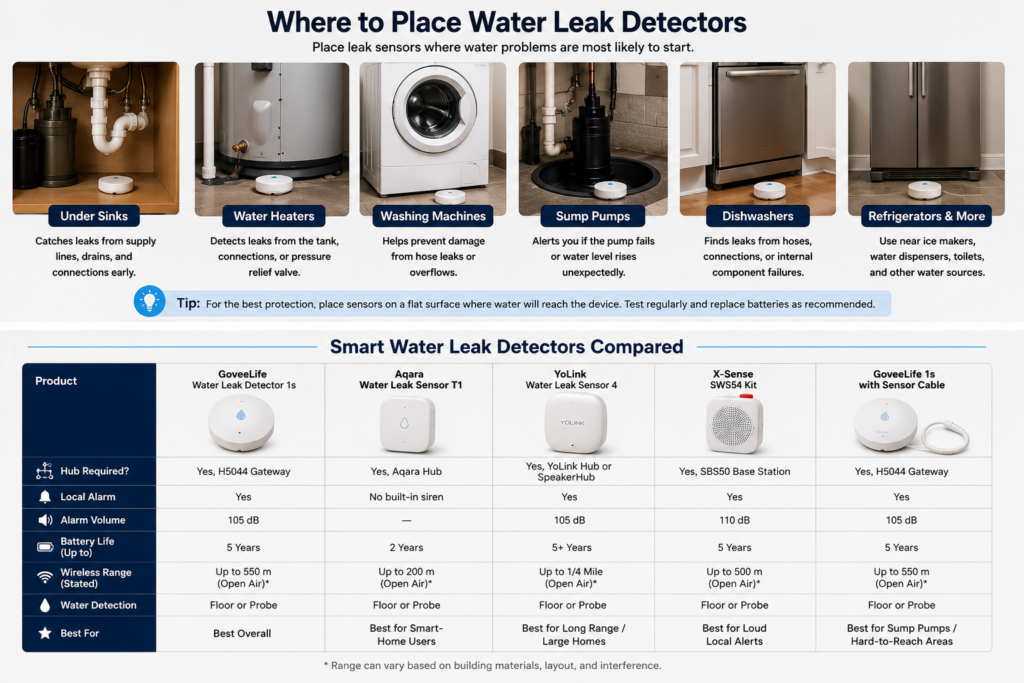
| Product | Hub Required | Communication | Alarm | Battery Life | Water Resistance | Best For |
| GoveeLife 1s (H5059) | Yes, H5044 Gateway | Gateway: 2.4 GHz Wi-Fi; Sensor: proprietary Sub-1 GHz | 105 dB, adjustable | Up to 5 years, stated | IP67 | Best overall |
| Aqara T1 (WL-S02D) | Yes, Aqara Hub | Zigbee 3.0 | No built-in siren | CR2032 battery | Indoor use | Smart-home users |
| YoLink Sensor 4 (YS7906) | Yes, YoLink Hub/SpeakerHub | LoRa | 105 dB piezo | 5+ years, stated | Indoor use | Long range / large homes |
| X-Sense SWS51/SWS54 | Yes, SBS50 Base Station | Base station: 2.4 GHz Wi-Fi | 110 dB | 3 years, stated | IP66 | Loud local alerts |
| GoveeLife 1s (H5830, cable) | Yes, H5044 Gateway | Gateway: 2.4 GHz Wi-Fi | Local alarm plus remote alerts | 5+ years standby, stated | IP67 | Sump pumps / hard-to-reach areas |
What to Look for in a Water Leak Detector
Local Alarm vs. Remote Alerts
A local audible alarm provides an immediate warning when someone is home. Remote alerts via an app, email, or text can be just as important, as many leaks occur when homeowners are at work, asleep, or away.
A system that provides both gives you two ways to learn that something is wrong.
Hub Required vs. Direct Wi-Fi
Every product in this comparison requires a hub, gateway, or base station for its connected remote-notification features.
GoveeLife uses the H5044 gateway; Aqara requires an Aqara Hub; YoLink requires a YoLink Hub or SpeakerHub; and X-Sense uses the SBS50 base station.
That doesn’t necessarily mean the individual sensor communicates over Wi-Fi.
For example, GoveeLife sensors communicate with their gateway using Sub-1 GHz technology, Aqara uses Zigbee 3.0, and YoLink uses LoRa. The hub or gateway then provides the connection needed for remote alerts.
This distinction matters because the wireless connection between the sensor and hub can be more important than your home’s general Wi-Fi coverage.
Wireless Range
Manufacturer-stated ranges, such as GoveeLife’s 1,804 feet or X-Sense’s 1,640 feet, represent maximum communication distances under favorable conditions.
Walls, floors, appliances, concrete, metal, and other obstructions can significantly reduce real-world range.
These figures are useful for comparing the potential reach of different systems, but they shouldn’t be treated as a guarantee for a particular home.
Battery Life
Battery life matters most when a sensor is placed in an inconvenient location.
GoveeLife and YoLink advertise particularly long battery life, while other systems may require more frequent battery changes. Regardless of the stated battery life, it’s smart to check sensors periodically and respond promptly to low-battery warnings.
Where You Plan to Put the Sensor
A standard puck-style sensor works well on an open floor near a water heater, dishwasher, washing machine, or sink.
It may be less convenient around a sump pit or tightly packed plumbing. That’s where an extension-cable design like the GoveeLife H5830 can make more sense.
Consider where water is most likely to appear and whether a flat sensor can be positioned there before choosing a system.
Smart-Home Integration
Homeowners already using a Zigbee or Aqara ecosystem may get more value from the Aqara T1 because leak detection can be integrated into existing smart-home automations.
YoLink users can similarly take advantage of the Sensor 4’s device-to-device automation capabilities.
If you don’t already use a smart-home platform, a complete kit such as GoveeLife or X-Sense may be more straightforward.
Leak Detection vs. Automatic Water Shutoff
A leak detector and an automatic water shutoff system are not the same thing.
The products in this comparison are primarily designed to detect water and alert the homeowner. Some smart-home ecosystems can be paired with compatible valves or other hardware, but you should not assume that buying a leak sensor on its own will automatically stop the flow of water.
Homeowners who specifically want automatic main water shutoff should consider whole-home monitoring and shutoff systems, which are a different product category, installation type, and price class.
Where Should You Put Water Leak Sensors?
Placement matters almost as much as the product itself.
Good locations for water leak sensors include:
- Near the base of the water heater
- Behind or underneath the washing machine
- Near the dishwasher
- Under kitchen and bathroom sinks, close to supply lines and drains
- Behind or underneath the refrigerator, especially near an ice-maker supply line
- Around a sump pump or sump pit
- In basement utility areas near exposed plumbing
- Near plumbing fixtures where a small leak could otherwise go unnoticed
A sensor should generally be positioned where leaking water is likely to reach it quickly. Look for low points near the appliance or plumbing connection rather than placing the sensor far from the likely source.
Final Verdict
There isn’t one objectively correct choice among these five because they’re built around different priorities.
For a well-rounded kit that doesn’t require an existing smart-home ecosystem, the GoveeLife Water Leak Detector 1s is the strongest all-around choice.
Homeowners already using Aqara or a compatible Zigbee setup may get more value from the Aqara T1 and its automation possibilities.
For a larger home, detached area, basement, or another location where wireless range is a concern, the YoLink Water Leak Sensor 4 stands out.
If a loud local warning is the priority, the X-Sense SWS54 kit offers a 110 dB detector alarm along with smartphone notifications.
And for a sump pump area or another difficult-to-reach location, the GoveeLife version with an extension sensor cable offers placement flexibility the standard puck-style sensors don’t.
The best water leak detector is ultimately the one that fits the locations you need to monitor and alerts you quickly enough to act.
FAQ
Are smart water leak detectors worth it?
For many homeowners, yes. A leak detector can provide early warning of water where it shouldn’t be, giving you an opportunity to investigate and shut off the water before the problem gets worse.
They are especially useful near appliances and plumbing connections that aren’t checked regularly.
Do water leak detectors shut off the water automatically?
Not by themselves.
The products covered here are designed primarily to detect leaks and provide alerts through a local alarm, remote notification, or both. Automatic shutoff requires compatible additional hardware or a whole-home water monitoring and shutoff system.
Where is the best place to put a water leak detector?
Place sensors near common leak sources, including water heaters, washing machines, dishwashers, sinks, refrigerators with ice-maker lines, sump pumps, and basement plumbing.
Ideally, position the sensor at a low point where leaking water is likely to reach it quickly.
Do smart water leak detectors need Wi-Fi?
Many smart leak-detection systems need an internet-connected hub or gateway for remote notifications, but the individual sensors don’t necessarily communicate directly over Wi-Fi.
For example, the products in this comparison use technologies including Sub-1 GHz, Zigbee, and LoRa to communicate between the sensor and its hub or gateway.
How many water leak sensors does a home need?
It depends on the number of potential leak sources in the home.
A good starting point is to cover higher-risk areas such as the water heater, washing machine, dishwasher, kitchen sink, and bathroom sinks. Homes with sump pumps, finished basements, multiple refrigerators, or additional plumbing equipment may benefit from more sensors.
Can I put a water leak detector near a sump pump?
Yes. A sump pump area is a common place for leak or water-level monitoring.
A standard flat sensor can be positioned near the sump pit where unexpected water would reach it. In contrast, a sensor with an extension cable, such as the GoveeLife 1s with sensor cable, offers greater flexibility for monitoring around the pit and other hard-to-reach areas.
As an Amazon Associate, BuildSafeHome earns from qualifying purchases
This article may contain affiliate links. BuildSafeHome may earn a commission at no extra cost to you