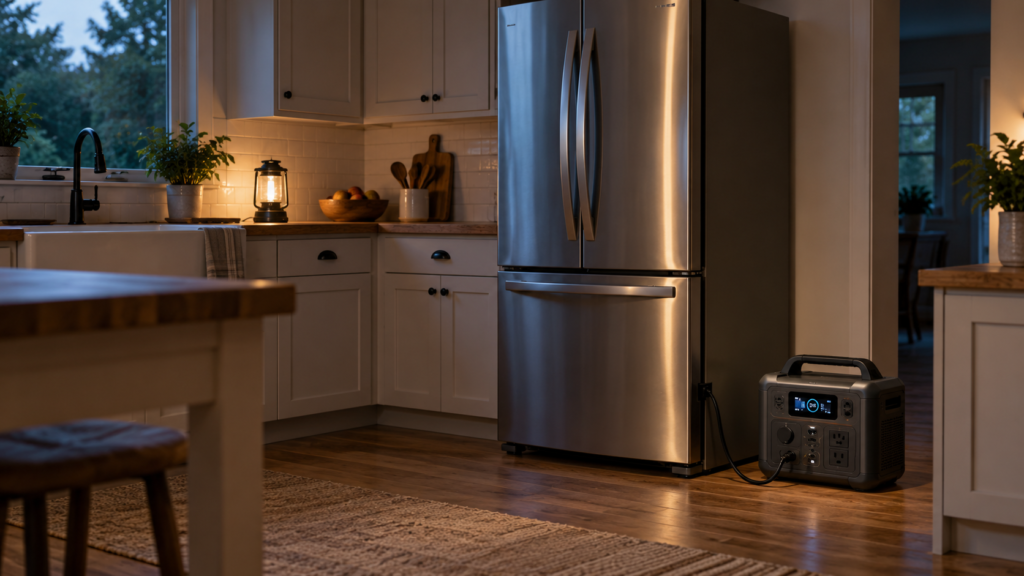
There is no single answer. Runtime depends on the refrigerator, the power station, and how much usable energy the station can deliver.
The answer depends on two things: whether the station can start and operate your refrigerator, and how long its available battery energy can support the refrigerator’s actual electricity use.
You can estimate runtime with a simple calculation, but first you need to understand which specifications matter.
Can Your Power Station Run Your Refrigerator?
Before calculating battery life, check two separate requirements.
1. Power compatibility
Your power station must supply enough continuous AC power to run the refrigerator and handle the extra power it may need when the compressor starts.
A station can have a large battery capacity but still be unable to start a particular refrigerator.
2. Energy and runtime
Once you confirm the station can run the refrigerator, you can estimate how long it will last.
That depends on the energy available through the station’s AC outlet and the refrigerator’s average electricity consumption.
A station might start your refrigerator successfully but have too little usable energy to operate it for as long as you need.
Both requirements matter when choosing a portable power station for refrigerator backup.
Understanding Watts and Watt-Hours
Power station specifications often include watts and watt-hours. These measurements answer different questions.
Watts (W) measure the rate at which electricity is used or supplied. A station’s continuous AC output rating tells you how much power it is designed to deliver while operating.
Watt-hours (Wh) measure an amount of energy. A power station’s battery capacity is commonly expressed in watt-hours.
Think of watts as the rate at which water flows from a tank and watt-hours as the amount of water available in the tank.
A station’s watt-hour capacity helps you estimate operating time, but it does not tell you whether the station can handle the refrigerator’s startup requirements.
How to Calculate Refrigerator Runtime
Use this formula to estimate how long a portable power station can operate your refrigerator:
Estimated runtime (hours) = Usable AC energy (Wh) ÷ Average refrigerator demand (W)
For this calculation, two figures need particular attention.
Usable AC Energy Is Not the Same as Battery Capacity
A station’s advertised battery capacity is not necessarily the amount of energy available to a refrigerator through its AC outlet.
Energy conversion, the station’s own electricity consumption, operating conditions, and model-specific limits can affect how much energy reaches the appliance.
When available, use a manufacturer-documented or independently measured usable AC energy figure that is relevant to your intended use. Check the conditions under which that figure was obtained.
If you use an assumed allowance for energy losses, treat it as a planning estimate, not a guaranteed performance figure.
Average Refrigerator Demand Is Not the Same as Running Watts
A refrigerator’s electricity use changes as its compressor and other components cycle on and off.
Its average demand over time is therefore different from the power it draws while the compressor is running.
To calculate average demand from measured energy use:
Average demand (W) = Energy use (kWh) × 1,000 ÷ Measurement period (hours)
This gives you a more useful figure for estimating battery runtime than relying on a running-watt specification alone.
How Long Will a Portable Power Station Run a Refrigerator? A 1,000Wh Example
The following example demonstrates the calculation using hypothetical figures. It is not a product test or a claim about the typical runtime of a particular power station.
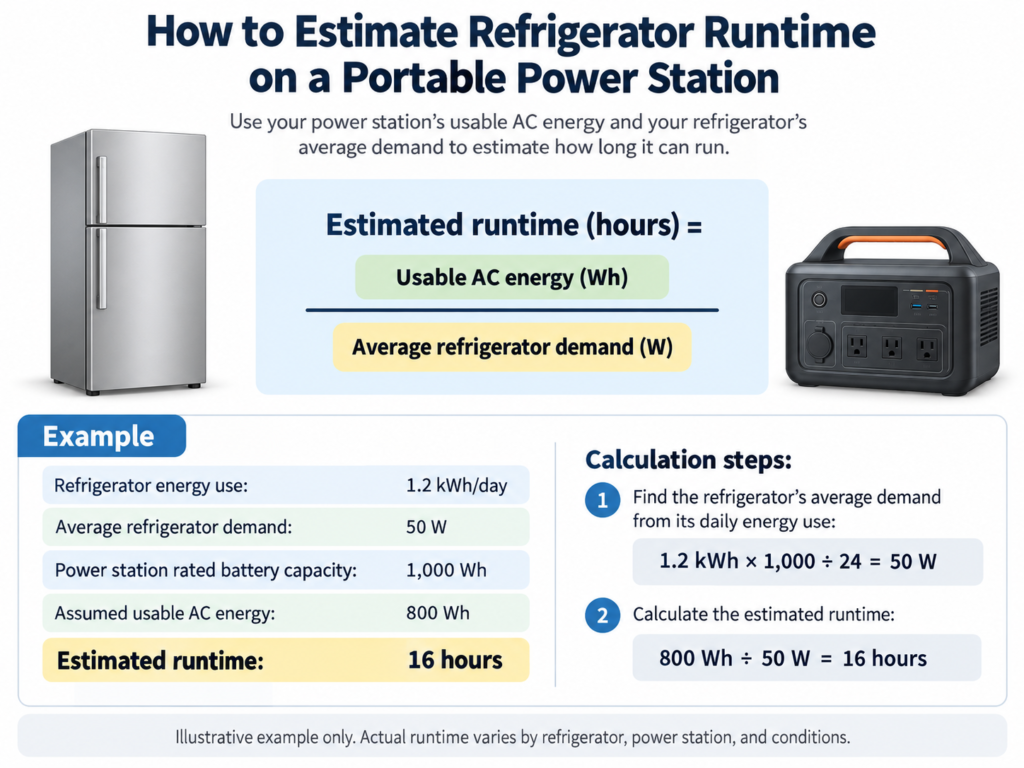
| Measurement | Illustrative value |
| Refrigerator energy consumption | 1.2 kWh per day |
| Average refrigerator demand | 50 W |
| Station’s rated battery capacity | 1,000 Wh |
| Assumed usable AC energy | 800 Wh |
| Estimated runtime | 16 hours |
First, convert the refrigerator’s daily electricity consumption into average demand:
1.2 kWh × 1,000 ÷ 24 hours = 50 W
Next, divide the assumed usable AC energy by the refrigerator’s average demand:
800 Wh ÷ 50 W = 16 hours
In this hypothetical example, the estimated runtime is 16 hours.
The 800Wh usable-energy figure is an assumption, not a measured result for a particular station. The calculation also assumes the station can start and run the refrigerator and that the refrigerator’s average electricity use stays similar during the outage.
Your actual runtime may be different.
How to Estimate Runtime for Your Own Refrigerator
You can make a more useful estimate by gathering information about your refrigerator and the power station you plan to use.
Step 1: Find Your Refrigerator’s Energy Consumption
Start with your refrigerator’s EnergyGuide label or the manufacturer’s documentation for your specific model.
The EnergyGuide label provides an estimated annual electricity consumption figure in kilowatt-hours (kWh). This figure is based on standardized testing and is intended to help consumers compare appliances. It is not a measurement of how much electricity your refrigerator will use during a particular outage.
Source: U.S. Department of Energy — EnergyGuide and Appliance Energy Use
You can convert the annual estimate into average demand with this formula:
Average demand (W) = Annual energy use (kWh) × 1,000 ÷ 365 ÷ 24
For a more personalized estimate, you can use an appropriately rated plug-in electricity meter to measure your refrigerator’s energy consumption over a representative period.
Choose a measurement period that includes normal compressor cycling and other operating behavior, rather than relying on a brief reading while the compressor is running.
Keep in mind that an ordinary plug-in energy meter may not capture the refrigerator’s brief startup demand. Measuring energy consumption and checking startup compatibility are separate tasks.
Step 2: Check Whether the Station Can Start Your Refrigerator
Find the refrigerator’s operating and startup requirements in its model-specific documentation, where available.
Compare those requirements with the power station’s documented continuous AC output and startup or surge capability.
Do not assume that a station with a large battery capacity can start every refrigerator. Battery capacity and AC output capability are different specifications.
If the refrigerator’s startup requirements are unavailable or unclear, do not treat the combination as confirmed compatible.
Step 3: Determine the Station’s Usable AC Energy
Look for a manufacturer-documented or independently measured usable AC energy figure, paying attention to the test conditions.
If you cannot find a suitable figure, you can use an explicitly labeled planning assumption for energy losses.
Avoid treating any single efficiency percentage as a universal rule for all portable power stations.
Step 4: Calculate Your Estimated Runtime
Divide the station’s usable AC energy in watt-hours by your refrigerator’s average demand in watts.
The result is a planning estimate, not a guaranteed operating time.
If the estimated runtime is close to the backup power you need, allow for uncertainty rather than assuming the refrigerator will run for exactly the calculated number of hours.
What Can Change Your Actual Runtime?
Several conditions can make your refrigerator use more or less electricity than your estimate suggests.
Room temperature: A refrigerator may need to work harder in a warm room than in a cooler environment.
Door openings: Opening the refrigerator introduces warmer air and can increase the energy needed to maintain its internal temperature.
Defrost operation: Automatic defrost cycles can contribute to the refrigerator’s electricity consumption.
Power station consumption: The station uses some energy to operate its electronics and supply AC power. Actual performance depends on the connected load and operating conditions.
AC-output settings: Depending on the model, automatic shutoff or timeout settings can affect whether the station continues supplying power when the refrigerator’s demand drops between compressor cycles.
These factors make actual runtime difficult to predict precisely. There is no single percentage adjustment that reliably accounts for every refrigerator, power station, and operating environment.
Will the Power Station Stay On Between Refrigerator Cycles?
A refrigerator does not draw the same amount of power continuously. Its electrical demand changes as the compressor and other components operate.
Some portable power stations have an AC-output timeout or automatic shutoff feature. Depending on the station’s settings, its AC output may turn off after detecting little or no load for a specified period.
For example, EcoFlow’s DELTA 2 manual explains that its AC timeout feature can be triggered by intermittent loads such as refrigerators. The manual provides model-specific instructions for maintaining AC output when you need continuous power.
Source: EcoFlow DELTA 2 User Manual — AC Output and Timeout
This doesn’t mean every power station behaves the same way.
Before relying on a station for refrigerator backup, check its manual to understand how its AC output operates and whether any relevant settings need attention.
Follow the manufacturer’s instructions before changing those settings.
Refrigerator Food Safety During a Power Outage
Estimated battery runtime and food safety are separate considerations.
FoodSafety.gov advises that an unopened refrigerator can keep food cold for about four hours during a power outage. This guidance assumes the refrigerator door remains closed and does not guarantee the same result under every condition.
If your refrigerator loses power, keep its door closed as much as possible to help maintain the internal temperature.
An appliance thermometer can help you monitor the refrigerator’s temperature. FoodSafety.gov recommends keeping refrigerators at 40°F (4°C) or below.
For a refrigerator that has been without power for four hours or more, FoodSafety.gov advises discarding refrigerated perishable foods such as meat, poultry, fish, eggs, and leftovers. Its guidance also advises discarding perishable food that has been above 40°F for two hours or more, or one hour when temperatures are above 90°F.
These are food-safety guidelines, not a way to calculate battery runtime. A refrigerator receiving power does not automatically maintain a safe food temperature, and the current thermometer reading alone cannot determine whether food was previously held at an unsafe temperature.
If you are unsure whether a food item is safe, follow the official guidance for that type of food rather than relying on appearance, smell, or taste.
Sources:
FoodSafety.gov — Food Safety in a Disaster or Emergency
FoodSafety.gov — Food Safety During a Power Outage
How to Connect a Refrigerator to a Portable Power Station
For the direct-connection setup discussed in this article, use a compatible refrigerator and portable power station according to both manufacturers’ instructions.
Before relying on the setup:
- Check that the station’s AC output is compatible with the refrigerator’s operating and startup requirements.
- Follow the station’s instructions for suitable operating conditions and keep its ventilation openings clear.
- Check whether the AC output will remain enabled while the refrigerator cycles between higher and lower electrical demand.
- Monitor the station’s remaining battery capacity and the refrigerator’s internal temperature during use.
Do not connect a portable power station to a household outlet to supply power through your home’s wiring.
Connecting backup power equipment to household circuits is a separate installation question that requires appropriate equipment and qualified electrical guidance. It is outside the scope of this direct-plug setup.
Bottom Line
To estimate how long a portable power station will run your refrigerator, answer two questions:
Can the station start and operate your refrigerator?
Check the model-specific operating and startup requirements against the station’s documented AC output capabilities.
How long can the station’s usable energy support your refrigerator’s actual electricity consumption?
Divide usable AC energy in watt-hours by average refrigerator demand in watts to calculate an estimated runtime.
That gives you a practical starting point for planning refrigerator backup without relying on a universal runtime claim. Monitor the refrigerator’s temperature during an outage, and follow the relevant food-safety guidance regardless of how much battery power remains.
As an Amazon Associate, BuildSafeHome earns from qualifying purchases
This article may contain affiliate links. BuildSafeHome may earn a commission at no extra cost to you