Affiliate Disclosure: This article may contain affiliate links. BuildSafeHome may earn a commission at no extra cost to you.
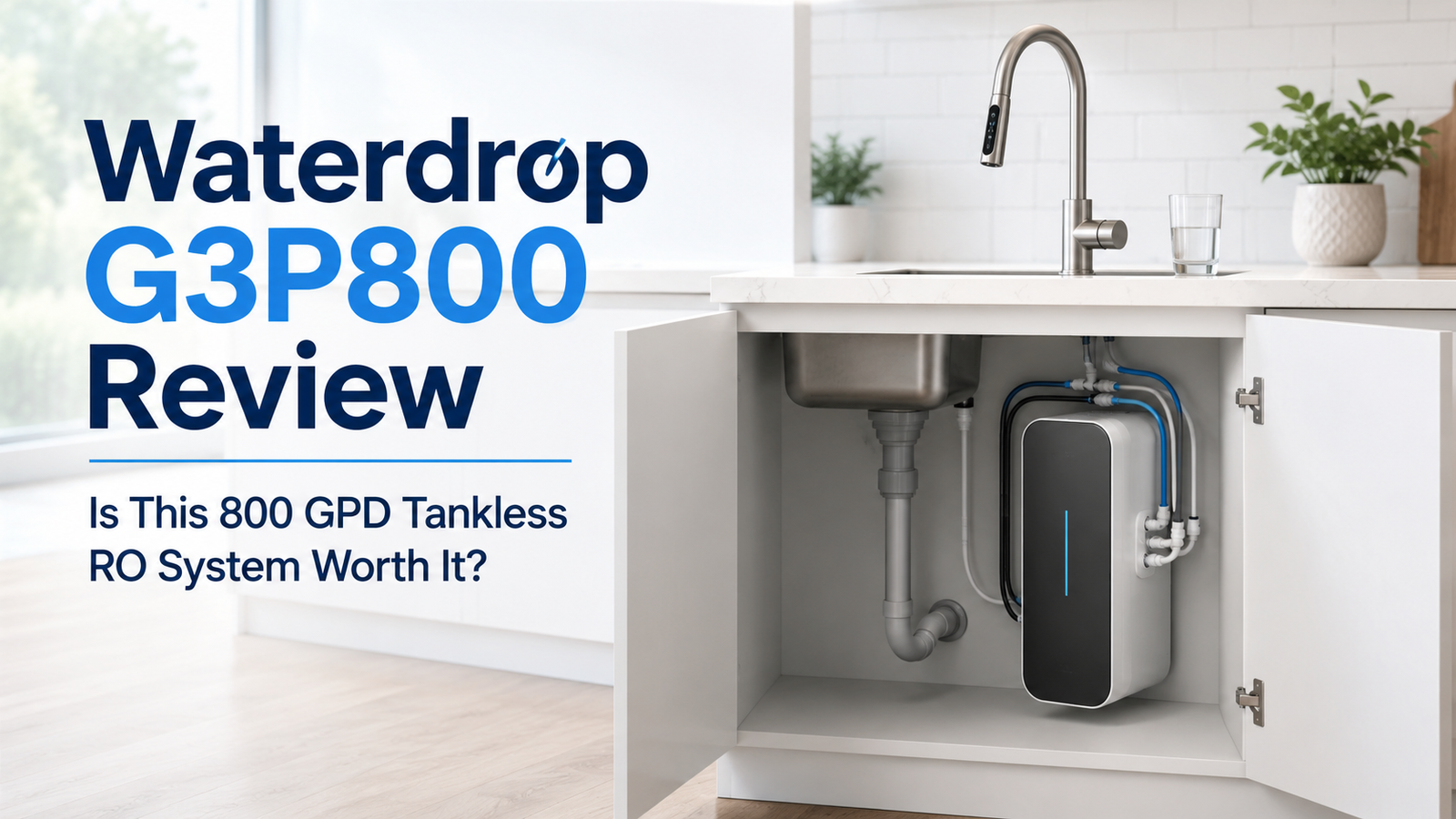
For years, choosing an under-sink reverse osmosis system usually meant giving up cabinet space to a storage tank and accepting slower water delivery once that tank ran low. Tankless systems change that trade-off by filtering water on demand, and the Waterdrop G3P800 is one of the better-known premium options in this category. It combines an 800-gallon-per-day rated membrane, a tankless under-sink design, a smart faucet, and an advertised 3:1 pure-water-to-drain-water ratio.
This Waterdrop G3P800 review looks at whether those features justify the cost for a typical homeowner. It covers published specifications, certification language, installation requirements, replacement filter costs, water source limitations, and the households this system is most likely to suit. This review is based on current product documentation and publicly available information rather than hands-on testing by BuildSafeHome.
Waterdrop G3P800 Quick Verdict
| Best for | Larger households on compatible municipal water that want fast dispensing, a tankless footprint, smart monitoring, and better drain efficiency than many older tank-style systems. |
| Not ideal for | Untreated private wells, very hard or high-TDS water without pretreatment, kitchens without nearby electrical power, or shoppers focused mainly on the lowest purchase price. |
| Main advantage | Fast on-demand RO water without a bulky storage tank. |
| Main drawback | A premium price combined with proprietary replacement filters and feed-water limitations. |
Waterdrop G3P800 Specifications
| Specification | Details |
| Model | WD-G3P800-W |
| Rated capacity | 800 GPD under rated test conditions |
| Advertised dispensing speed | About one 8-ounce cup in roughly 6 seconds |
| Dimensions | Approximately 18.1 x 5.7 x 17.7 inches; official listings vary slightly, so verify before ordering |
| Weight | Approximately 32–33 pounds; verify the exact current SKU |
| Design | Tankless under-sink reverse osmosis |
| Filters | CF prefilter, CB carbon block filter, and RO membrane |
| Pure-to-drain ratio | 3:1 advertised |
| Power | Nearby grounded electrical outlet required |
| Smart faucet | TDS display and filter-life indicators |
| Feed-water pressure | About 14.5–87 psi |
| Feed-water temperature | About 41–100°F |
| Conservative TDS guidance | Below 750 ppm |
| Conservative hardness guidance | Below 7 grains per gallon |
| Warranty | Standard one-year warranty; optional extended plans may be available |
| Price checked on July 19, 2026 | $849 sale price, with a regular listed price of $999; pricing can change |
What Makes the Waterdrop G3P800 Different?
800 GPD Rated Capacity
The 800 GPD rating describes the membrane’s production capacity under defined test conditions. It does not mean a household will receive or use 800 gallons every day. Incoming pressure, temperature, TDS, hardness, and other source-water conditions all affect real-world output. The practical benefit is faster dispensing than many conventional tank-based RO systems, especially when filling bottles, pitchers, and cooking pots.
Tankless Under-Sink Design
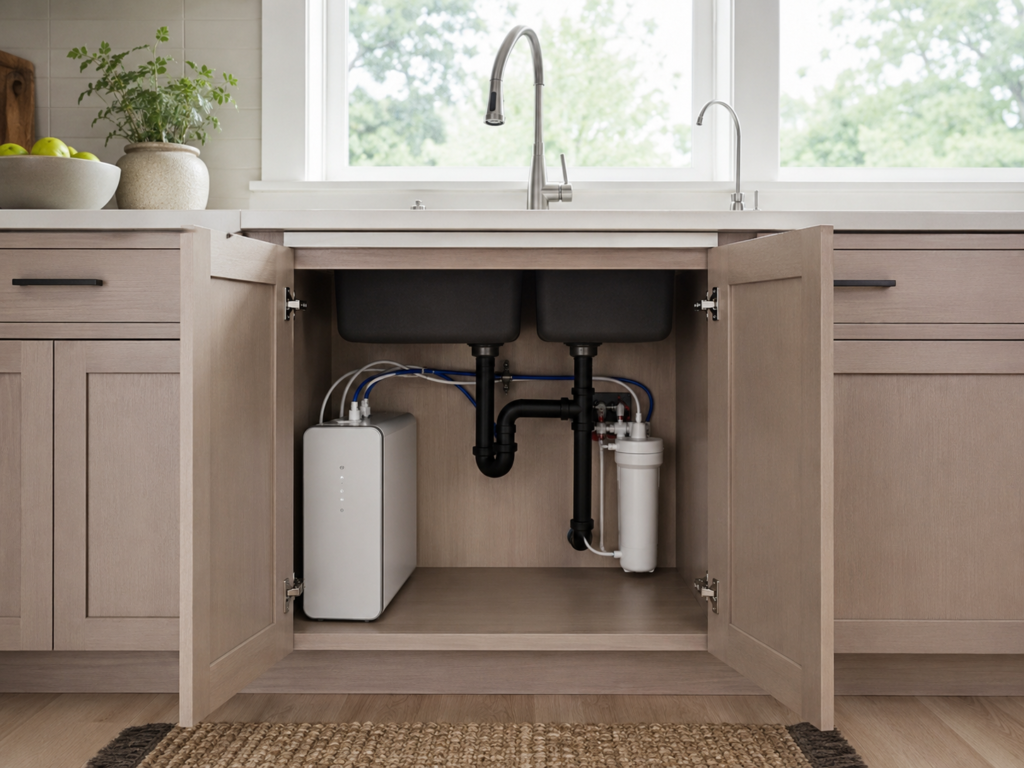
Because the system does not rely on a pressurized storage tank, it frees up more usable cabinet space and avoids storing several gallons of filtered water between uses. The trade-off is that the filtration unit itself is relatively wide and tall, so homeowners should measure the cabinet carefully and allow room for tubing, shutoff valves, the drain connection, and future filter changes.
Smart Faucet and Filter Monitoring
The included faucet displays a TDS reading and estimated filter life. This is useful for monitoring system operation, but TDS is only a broad measure of dissolved solids. It does not identify individual contaminants or prove that every contaminant of concern is absent. Homeowners dealing with a known water-quality issue should rely on appropriate water testing, not the faucet display alone.
Advertised Wastewater Efficiency
The advertised 3:1 pure-to-drain ratio means that, under favorable operating conditions, the system may produce about three cups of filtered water for every cup sent to the drain. That is substantially more efficient than the 1:3 or 1:4 pure-to-waste ratios associated with many older RO systems. Actual efficiency can vary with water pressure, temperature, membrane condition, and feed-water quality.
Filtration Performance and Certifications
Waterdrop states that the G3P800 is certified by IAPMO R&T to NSF/ANSI 42, 53, and 58 for the specific claims listed on its Performance Data Sheet, and to NSF/ANSI 372 for low-lead material compliance. That qualification matters: certification applies to the claims documented for the exact model and product revision, not automatically to every contaminant mentioned in marketing materials.
| Standard | What it generally addresses | How to interpret it here |
| NSF/ANSI 42 | Aesthetic effects such as chlorine, taste, and odor | Use only the exact reductions listed on the current Performance Data Sheet. |
| NSF/ANSI 53 | Health-effect contaminant reductions | Certification is claim-specific; do not assume every health-related marketing claim is certified. |
| NSF/ANSI 58 | Reverse osmosis performance, including TDS reduction | Supports the listed RO performance claims for the certified model. |
| NSF/ANSI 372 | Low-lead material compliance | Addresses lead content in product materials, not lead reduction from water. |
Waterdrop also publishes reduction claims for substances such as fluoride, lead, PFOA, PFOS, arsenic, and other contaminants. Some may be supported by third-party laboratory testing rather than by the same certification listing. Before publication or purchase, verify the current Performance Data Sheet for the exact SKU and keep certified claims separate from broader manufacturer-tested claims.
Does the Waterdrop G3P800 Reduce PFAS?
PFAS is a large family of chemicals, not one single contaminant. Waterdrop specifically markets reduction of PFOA and PFOS, two well-known PFAS compounds. That should not be rewritten as “removes all PFAS.” A homeowner with a documented PFAS problem should review the current Performance Data Sheet, confirm the specific compounds covered, and consider testing both the incoming and filtered water.
Waterdrop G3P800 Installation
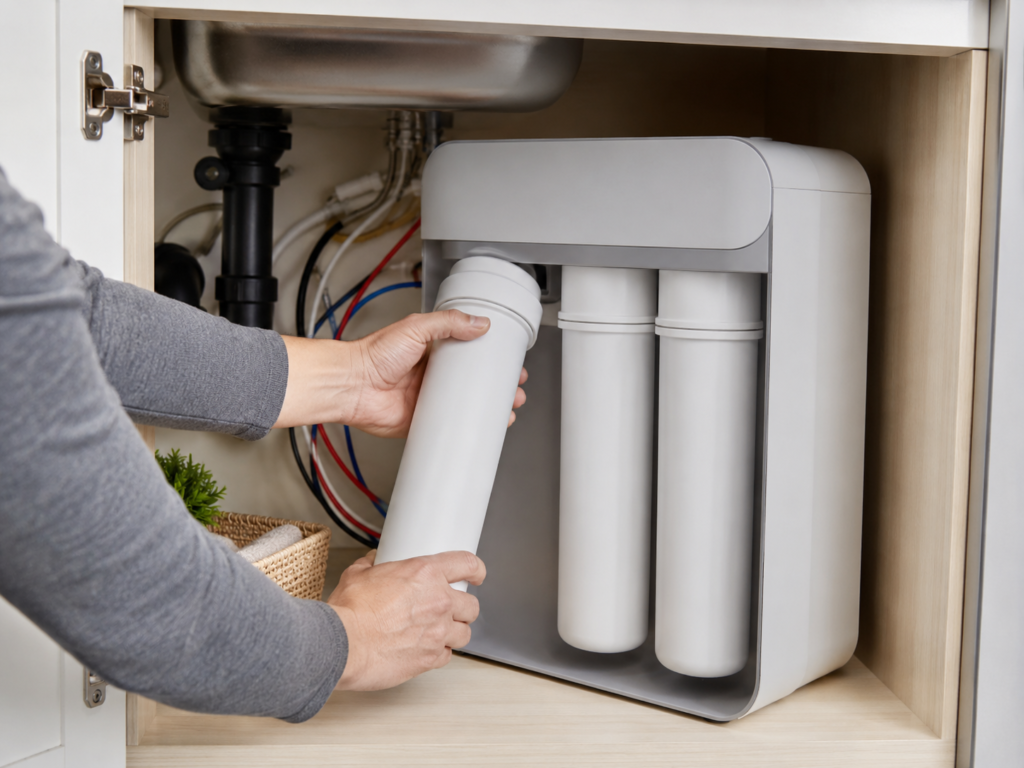
Installation involves connecting the unit to the cold-water supply, attaching a drain saddle, installing the dedicated smart faucet, routing the tubing, inserting the filters, connecting electrical power, and completing the initial flushing procedure. Push-to-connect fittings make the plumbing more approachable, but the project is not effortless.
- Measure the cabinet before buying, including clearance for filter removal.
- Confirm that a grounded electrical outlet is available under or near the sink.
- Plan for a dedicated faucet hole. An unused soap-dispenser or sprayer hole may work; otherwise, drilling may be required.
- Use extra care with granite, quartz, or other solid-surface countertops. Professional drilling may be worthwhile.
- A plumber may be appropriate when shutoff valves are old, plumbing is nonstandard, or the homeowner is uncomfortable making a drain connection.
- An electrician is needed if a safe outlet must be installed.
The official instructions also call for an initial flush before normal use. Installation time will depend heavily on the cabinet layout and whether an existing faucet opening and electrical outlet are already available.
Waterdrop G3P800 Filter Replacement and Annual Cost
The G3P800 uses proprietary Waterdrop filters. That makes replacement simple and clean, but it also limits the ability to shop among generic cartridges. Current official prices and replacement intervals produce an estimated annual filter cost of about $160 before tax, shipping, subscription discounts, or future price changes.
| Filter | Model | Typical interval | Price checked on July 19, 2026 | Annualized cost |
| CF | WD-G3-N1CF | 6 months | $29.99 | $59.98 |
| CB | WD-G3-N3CB | 12 months | $29.99 | $29.99 |
| RO membrane | WD-G3P800-N2RO | 24 months | $139.99 | About $70.00 |
| Estimated total | $159.97 |
Actual filter life can be shorter or longer depending on household usage, sediment, hardness, TDS, and overall source-water quality. The smart faucet’s filter indicator is helpful, but replacement planning should still account for changing water conditions and current filter prices.
Price note: Product and replacement filter prices may change due to sales, bundles, retailer differences, and manufacturer updates. Prices in this review were checked July 19, 2026. Confirm current pricing before buying or publishing.
Can the Waterdrop G3P800 Be Used With Well Water?
The G3P800 is primarily positioned for treated municipal water. Waterdrop guidance indicates that well water requires prefiltration, and private wells may present conditions that an under-sink RO unit is not expected to handle on its own. Sediment, iron, manganese, bacteria, hardness, and high TDS can foul the filters or require separate treatment.
A proper well-water test should come first. Depending on the results, the home may need sediment filtration, iron or manganese treatment, softening, disinfection, or another whole-house process before the G3P800. The system may be usable with a well only when the incoming water is already safe and falls within the manufacturer’s operating limits. It should not be presented as a complete, untreated well water solution.
Is the Waterdrop G3P800 Suitable for Hard Water?
Reverse osmosis reduces dissolved minerals in the filtered water, but hard water can scale the membrane before filtration occurs. Scale buildup can reduce flow, increase drain water, and shorten membrane life. Waterdrop pages have shown differing limits, so this review uses the more conservative guidance of hardness below 7 grains per gallon and TDS below 750 ppm. Buyers should confirm the limits for the exact model and consider a water softener or other pretreatment when their incoming water exceeds those levels.
Waterdrop G3P800 Pros and Cons
Pros
- High 800 GPD rated membrane capacity
- Fast dispensing compared with many traditional RO systems
- No bulky storage tank
- Smart faucet with TDS and filter-life indicators
- Advertised 3:1 pure-to-drain ratio
- Simple twist-style filter replacement
- Third-party certification for specific claims listed on the Performance Data Sheet
Cons
- Premium purchase price
- Proprietary replacement filters
- Requires electrical power
- No stored filtered-water reserve during an outage
- Installation may require drilling a faucet hole
- Not a complete solution for untreated well water
- Hard or high-TDS water may require pretreatment
- Product pages and bundles may show different specifications, prices, and included features
Waterdrop G3P800 vs. a Traditional Tank RO System
| Feature | Waterdrop G3P800 | Traditional tank RO system |
| Rated production | 800 GPD | Often 50–100 GPD |
| Faucet delivery | Fast, pump-driven, on demand | Strong while the tank has water; slows after depletion |
| Storage tank | No | Yes |
| Cabinet space | Slim tankless unit | Filters plus a 3–4 gallon tank |
| Electricity | Required | Usually not required |
| Drain efficiency | 3:1 pure-to-drain advertised | Often less efficient, depending on model |
| Purchase price | Premium | Usually lower |
| Replacement filters | Proprietary | Often more widely available |
| Water during an outage | No filtered output without power | Stored tank water may remain available |
A traditional tank system may still be the better value for a smaller household, a kitchen without an outlet, or a homeowner who wants inexpensive and widely available filters. The G3P800 makes more sense when fast dispensing, cabinet space, smart monitoring, and drain efficiency are worth paying extra for.
Related guide: Best Reverse Osmosis Systems for Home Use — https://buildsafehome.com/best-reverse-osmosis-system/
Who Should Buy the Waterdrop G3P800?
- Larger households that use substantial filtered water for drinking and cooking
- Homes on compatible treated municipal water
- People who frequently fill bottles, pitchers, and pots
- Buyers who want faster RO dispensing without a storage tank
- Homeowners who value filter-life monitoring and a visible TDS reading
- Buyers comfortable paying more for a premium tankless design
Who Should Consider Another System?
- Owners of untreated private wells
- Homes with very hard or high-TDS water and no pretreatment plan
- Kitchens without a practical electrical outlet
- Budget-focused shoppers
- Small households with modest filtered-water demand
- Buyers who prefer generic replacement filters
- Anyone who wants stored filtered water available during a power outage
Waterdrop G3P800 Review: Final Verdict
The Waterdrop G3P800 appears to be a strong premium tankless RO option for households with compatible municipal water and high demand for filtered water. Its fast dispensing, tankless footprint, smart faucet, and advertised drain efficiency are meaningful advantages. The current certification language also provides useful third-party support, as long as buyers understand that it applies only to the specific claims listed on the Performance Data Sheet.
The drawbacks are equally important. The purchase price is high, replacement filters are proprietary, electrical power is required, and hard water or private-well conditions may call for pretreatment. For the right household, those trade-offs may be reasonable. For a smaller home, a tight budget, or difficult source water, a simpler tank-based system or a more complete water-treatment plan may be the smarter choice.
Frequently Asked Questions
Does the Waterdrop G3P800 require electricity?
Yes. The internal pump and smart faucet require a nearby grounded electrical outlet.
Can the G3P800 work with well water?
Possibly, but only when the water is tested, found to be safe, and appropriately pretreated. It should not be used as the only treatment for an untreated private well.
How often do the filters need to be replaced?
Waterdrop currently recommends about 6 months for the CF filter, 12 months for the CB filter, and 24 months for the RO membrane. Actual life depends on water quality and usage.
Does the G3P800 remineralize water?
Not in the standard configuration. Waterdrop offers separate remineralization options and bundles.
Does it work during a power outage?
No. The tankless pump requires electricity, and the system does not have a storage tank of filtered water.
As an Amazon Associate, BuildSafeHome earns from qualifying purchases
This article may contain affiliate links. BuildSafeHome may earn a commission at no extra cost to you