Affiliate Disclosure: This article may contain affiliate links. BuildSafeHome may earn a commission at no extra cost to you.
If you’ve spent any time comparing whole-house water filters, you’ve probably noticed how quickly the terminology gets confusing. Some product descriptions use words like “certified” and “tested” interchangeably, while broad claims about contaminants can make it difficult to determine exactly what a system is designed to reduce.
That distinction matters with the Aquasana Rhino.
This Aquasana Rhino review is based on Aquasana’s current published specifications, performance data sheets, certification information, and owner documentation—not hands-on testing in a BuildSafeHome staff home.. Our goal is to explain what the documentation supports, where important limitations exist, and who this system is actually designed for.
Quick Verdict
The Aquasana Rhino is a point-of-entry whole-house filtration system designed primarily to reduce chlorine—and, with certain models, chloramines—before water travels to the faucets and fixtures throughout your home.
It makes the most sense for homeowners on municipally treated water who want filtration throughout the house instead of only at the kitchen sink.
However, the Rhino is not a traditional water softener or reverse osmosis system. Standard configurations are also not intended to address the different treatment needs associated with private well water.
If your primary concern is chlorine in municipal water and you want to treat water before it reaches showers, faucets, and appliances, the Rhino is worth considering. If your problem is hard water, dissolved substances, or a private well with microbiological concerns, you may need different or additional treatment equipment.
Compare current Aquasana Rhino models and configurations.
What Is the Aquasana Rhino?
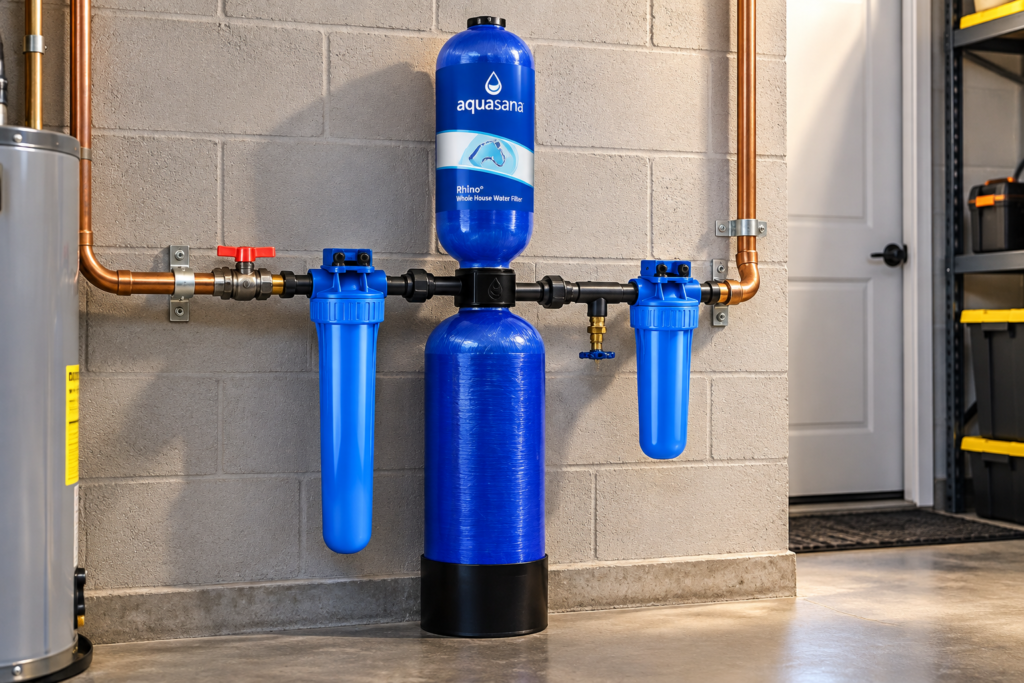
The Rhino is installed where the main water line enters your home, before the water heater. This is known as a point-of-entry system.
That differs from a point-of-use filter installed beneath a single sink.
An under-sink filter can be an excellent choice when you only want to filter drinking and cooking water. But it cannot treat the water going to showers, bathroom faucets, the washing machine, or other fixtures.
That is where whole-house filtration comes in.
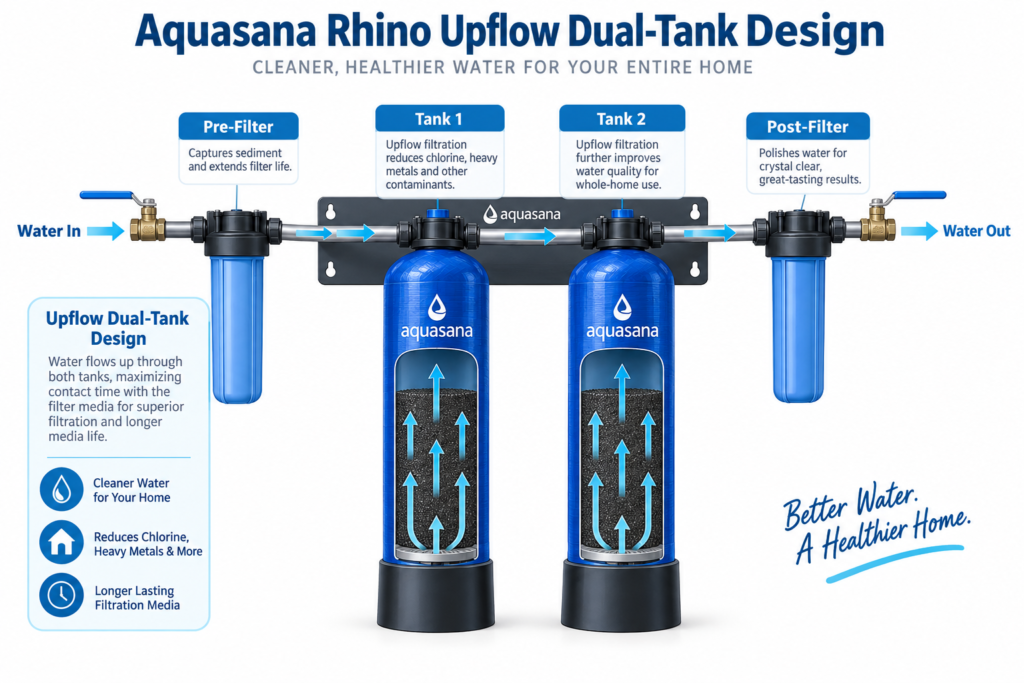
The Rhino uses several filtration stages. A sediment pre-filter helps capture dirt, rust, silt, and other debris before water reaches the main tank. The system then uses filtration media that includes activated carbon and copper-zinc media, commonly referred to as KDF.
Activated carbon is used primarily for chlorine reduction and improvements in taste and odor. The copper-zinc media helps inhibit bacterial and algal growth within the filtration system itself.
Aquasana also uses an upflow design intended to increase contact between the water and filtration media while reducing media channeling.
Standard Rhino systems operate using household water pressure. They do not require electricity, a drain line, or backwashing. UV-equipped configurations are an exception because the UV component requires power.
Independently Tested vs. Certified
This is one of the most important distinctions to understand when evaluating the Rhino.
The Rhino tank has WQA certification to NSF/ANSI/CAN Standard 61 for material safety requirements. Aquasana documentation also references structural integrity requirements.
That is different from certification for contaminant reduction.
The Rhino’s claims for chlorine and chloramine performance are described as independently tested in accordance with NSF/ANSI Standard 42.
Independent testing to an NSF standard and formal certification of a complete filtration system are not the same thing.
That does not mean the performance claims should be dismissed. It simply means buyers should distinguish between a product that is independently tested according to a standard and one that carries formal certification for a particular contaminant-reduction claim.
This distinction is especially important when comparing water filtration systems because certification language can look very similar at first glance.
What Does the Aquasana Rhino Reduce?
Aquasana’s published performance information focuses primarily on chlorine and, for specific models, chloramines.
According to the published performance data:
- Chlorine reduction is rated at up to 97% on applicable Rhino systems.
- Chloramine-rated models are designed specifically for municipalities that use chloramines for water disinfection.
- UV-equipped configurations add treatment aimed at microorganisms.
The key point is that you should evaluate the Rhino based on its documented capabilities, not on the assumption that “whole-house filtration” means removing every possible contaminant.
If you have a specific water-quality concern, check your local water-quality report or have your water tested before choosing a treatment system.
What the Rhino Does Not Do
Understanding what the Rhino does not do may be just as important as understanding what it does.
It Is Not Reverse Osmosis
The Rhino uses filtration media rather than a reverse osmosis membrane.
Reverse osmosis is designed to reduce many dissolved substances in drinking water. The Rhino serves a different purpose: treating incoming water throughout the home, particularly for chlorine and related taste and odor concerns.
Some homeowners may choose to use both approaches—a whole-house filter for incoming water and an under-sink reverse osmosis system specifically for drinking and cooking water.
It Is Not a Traditional Water Softener
The Rhino does not remove calcium and magnesium through ion exchange like a conventional salt-based water softener.
Aquasana offers an optional salt-free water conditioner intended to help reduce scale buildup.
That is an important distinction.
A conditioner and a traditional water softener address hardness differently. If your home has significant hard-water problems, such as persistent mineral buildup, determine whether scale conditioning is enough or whether you need actual hardness-mineral removal.
UV Treatment Is Not Standard
Standard Rhino systems do not include UV treatment unless you add that component to your configuration.
Aquasana offers UV-equipped options for buyers who need that additional treatment stage.
Standard Rhino Systems Are Intended for Municipal Water
Aquasana separates its standard municipal-water Rhino systems from its well-water configurations.
Private wells can present very different treatment challenges, including microorganisms and naturally occurring minerals. Well owners should start with a water test and choose equipment specifically designed around those results.
Understanding the Rhino Model Lineup
Aquasana has used both older “EQ” model names and newer “WH” designations, so shoppers may encounter different model numbers while researching.
The current family includes standard Rhino systems, as well as versions designed for higher flow, chloramine treatment, and well water applications.
Older product documentation may also reference models such as the EQ-300, EQ-600, and EQ-1000.
This makes it especially important to compare the exact model number rather than assuming every product carrying the Rhino name has identical specifications.
Aquasana also markets Max Flow configurations for households that need greater flow capacity. However, published flow specifications can vary across product documentation.
If flow rate is a major concern—particularly in a larger home where several showers and appliances may operate simultaneously—confirm the current specifications for the exact model you are considering before purchasing.
Installation: What to Expect
Whole-house installation is a much larger commitment than installing a pitcher, countertop filter, or typical under-sink system.
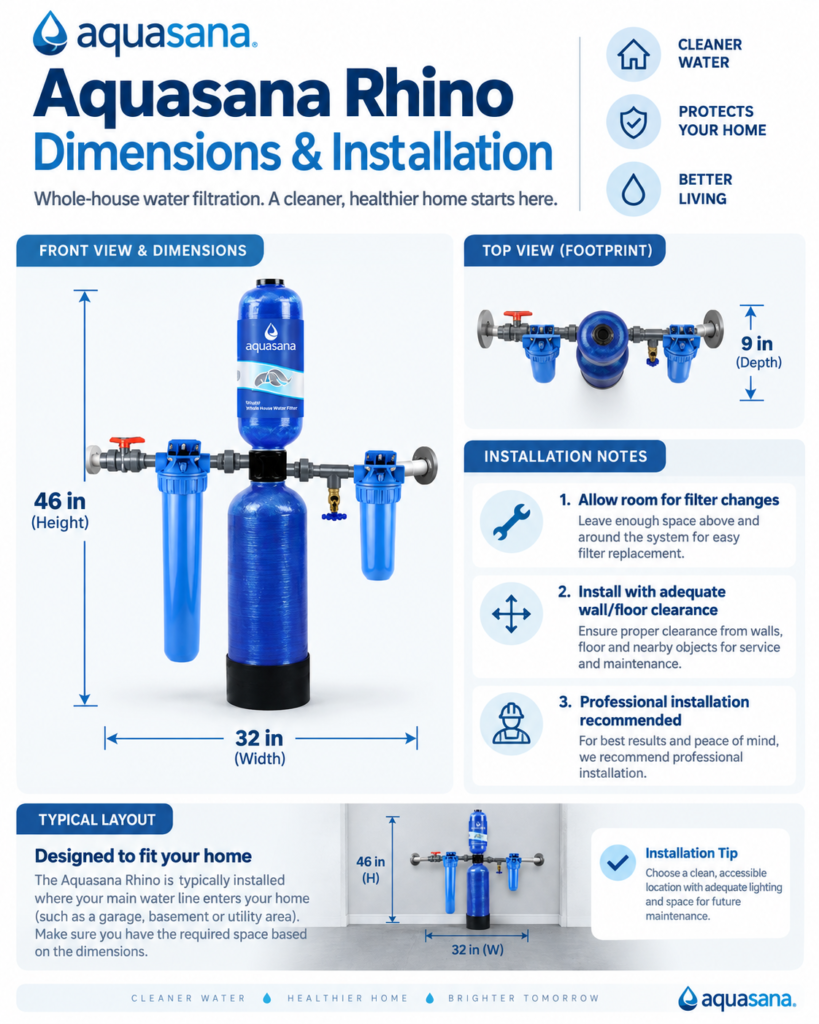
The Rhino connects directly to the home’s main water supply.
Aquasana documentation specifies 1-inch plumbing connections, with reducer bushings available for 3/4-inch plumbing. Installation can accommodate common residential plumbing materials such as copper, PEX, and CPVC.
The system must be installed on the cold-water supply before the water heater and positioned upright in an appropriate location.
Professional installation is recommended, and local plumbing codes may require a licensed plumber.
Even if you are comfortable with DIY projects, this is worth considering carefully. You are modifying the main water line serving the entire house, and installation requirements can also affect warranty coverage.
Standard Rhino systems do not require a drain or electricity. Configurations with UV treatment require an electrical connection for the UV component.
Aquasana also offers a Pro-Grade Bypass Kit. A bypass can make future maintenance easier by allowing water to be routed around the filtration system during servicing.
Review the Rhino installation requirements and available configurations before ordering.
Maintenance and Ongoing Costs
The “1,000,000 gallons” and “up to 10 years” figures associated with the Rhino refer to the main filtration tank—not every component in the system.
Pre-filters and post-filters require more frequent replacement.
Based on current product documentation, the standard maintenance schedule can include:
- Pre-filter replacement approximately every two months or as needed based on sediment levels.
- Post-filter replacement approximately every six months.
- Main Rhino tank replacement at its rated capacity or service-life limit.
Aquasana offers replacement-filter bundles, and its Water for Life subscription program can reduce replacement-filter pricing.
Based on replacement prices identified in our research, routine pre- and post-filter maintenance can cost roughly $90 per year at standard retail prices. However, actual costs will vary with water conditions, replacement frequency, and current pricing.
The main tank’s long service interval remains an advantage, but the Rhino should not be viewed as a system to install and ignore for a decade.
Aquasana’s warranty documentation also notes that water conditions and usage can affect the filter’s functional life.
In other words, treat “up to 10 years” as a rated service-life estimate, not a guarantee that every household will get exactly 10 years from the tank.
Optional Rhino Upgrades
One advantage of the Rhino lineup is the ability to configure the system around different household needs.
The downside is that the price can increase quickly as options are added.
Salt-Free Water Conditioner
The optional conditioner is designed to help reduce scale buildup without relying on the ion-exchange process used in conventional salt-based softeners.
It does not remove hardness minerals from the water.
For households with mild scale concerns, that may be enough. Homes with severe hard water should compare conditioning with traditional softening before deciding.
UV Filter
A UV option adds treatment aimed at microorganisms.
This may be particularly relevant for certain well-water applications or households with a specific need for UV treatment.
It is not automatically necessary for every municipal-water household.
Pro-Grade Bypass Kit
The bypass kit allows water to be routed around the filtration equipment during servicing.
For a system designed to remain installed for years, easier maintenance access can be worth considering during the initial installation.
Low Maintenance Pre-Filter
Aquasana also offers an upgraded pre-filter designed to extend the interval between pre-filter replacements.
Whether the added upfront cost is worthwhile depends partly on sediment levels in your incoming water and how much you value reducing routine maintenance.
Compare the available Rhino packages before paying for upgrades you may not need.
Warranty and Satisfaction Guarantee
Warranty coverage varies by Rhino model.
Aquasana’s documentation provides longer limited warranties for certain high-capacity municipal water systems and different coverage periods for some well water and older models.
The warranty generally addresses defects in materials or workmanship but does not mean every component is covered for the system’s entire estimated service life.
Routine filter cartridges, improper installation, neglected maintenance, and certain types of damage may be excluded.
Aquasana also offers a satisfaction-guarantee period on qualifying systems.
Because warranty terms can change and differ by model, read the current warranty for the exact Rhino configuration you are considering before purchasing.
Aquasana Rhino Pros and Cons
Pros
- Filters water throughout the house rather than at a single faucet.
- Main tank is rated for a long service interval.
- Standard systems require no electricity, drain line, or backwashing.
- Tank carries WQA certification for applicable material-safety requirements.
- Multiple configurations are available for different household needs.
- Optional bypass and pre-filter upgrades can simplify long-term maintenance.
- Whole-house design addresses chlorine before water reaches showers and other fixtures.
Cons
- Significantly higher upfront cost than point-of-use filtration.
- Professional installation may add substantially to the total project cost.
- Does not replace a traditional water softener.
- Does not provide reverse osmosis filtration.
- Standard models are not intended to solve every well-water problem.
- Routine pre- and post-filter maintenance is still required.
- Requires dedicated space near the home’s main water supply.
- Model names and available configurations can make comparison shopping confusing.
Rhino vs. an Under-Sink Water Filter
The biggest difference is coverage.
An under-sink filter treats water at one faucet. That can make it a more economical choice if your only concern is drinking and cooking water.
The Rhino treats incoming water before it is distributed throughout the house.
That means the filtration benefit extends to multiple faucets and showers rather than to a single location.
The tradeoff is cost and installation complexity.
If you only want better drinking water at the kitchen sink, installing an entire whole-house system may be unnecessary. If your goal is reducing chlorine throughout the home, a point-of-use filter cannot provide the same coverage.
Rhino vs. Reverse Osmosis
These systems solve different problems.
Reverse osmosis is generally used at the point of use to reduce a broad range of dissolved substances in drinking water.
The Rhino is designed to treat much larger volumes of incoming water throughout the home.
For some households, the choice does not have to be one or the other. A whole-house filter can address incoming municipal water while an under-sink RO system provides additional treatment specifically for drinking and cooking.
Rhino vs. a Traditional Water Softener
A traditional ion-exchange softener removes hardness minerals such as calcium and magnesium.
The Rhino does not.
Even when paired with Aquasana’s salt-free conditioner, the goal is scale control rather than traditional hardness removal.
If hard water is your main problem, determine the actual hardness level before purchasing. You may need a softener rather than—or in addition to—a whole-house filtration system.
Who Should Consider the Aquasana Rhino?
The Rhino is most compelling for homeowners who:
- Use municipally treated water.
- Want chlorine reduction throughout the house.
- Want filtered water reaching showers and multiple faucets.
- Expect to remain in the home long enough to justify a permanent installation.
- Prefer a long service interval for the primary filtration tank.
- Have adequate space near the main water supply.
- Understand the difference between filtration, conditioning, softening, reverse osmosis, and UV treatment.
Who Should Choose Something Else?
The Rhino may not be the best choice for:
- Renters or people expecting to move soon.
- Buyers who only want filtered drinking water at one faucet.
- Homes primarily struggling with severe water hardness.
- Buyers specifically seeking reverse osmosis treatment.
- Well-water households that have not tested their water and identified their treatment needs.
- Anyone looking for the lowest-cost filtration solution.
Final Verdict
Evaluated according to what the documentation actually supports, the Aquasana Rhino is a well-documented whole-house filtration option for homeowners who want to address chlorine in municipally treated water before it reaches faucets and fixtures throughout the home.
Its long-rated main-tank life is attractive, and standard configurations avoid some of the complexity associated with systems requiring electricity, drains, or backwashing.
But the Rhino is not an all-purpose water-treatment system.
It does not replace reverse osmosis when that level of drinking-water treatment is needed, and its optional salt-free conditioner should not be confused with a conventional water softener.
That distinction is ultimately what matters most.
This Aquasana Rhino Whole House Water Filter review comes down to matching the equipment to the problem. If whole-house chlorine reduction is the goal, the Rhino deserves a place on your shortlist. If hardness, dissolved substances, or well water contaminants are the primary concern, address those specific treatment needs before deciding which equipment to buy.
Check current Aquasana Rhino configurations and pricing.
Frequently Asked Questions
Is the Aquasana Rhino NSF certified?
The answer requires some clarification.
Aquasana documentation identifies WQA certification of the Rhino tank to NSF/ANSI/CAN Standard 61 for material-safety requirements. Its claims for chlorine and chloramine performance are described as independently tested in accordance with NSF/ANSI Standard 42.
Those are different forms of third-party verification, so it is more accurate to describe them separately rather than say that the entire Rhino system is “NSF certified.”
Does the Aquasana Rhino soften water?
No. The Rhino is a filtration system.
Aquasana offers an optional salt-free conditioner designed to help reduce scale buildup, but it does not remove calcium and magnesium via ion exchange, as a traditional water softener does.
Can I use an Aquasana Rhino with well water?
Aquasana offers configurations specifically intended for well-water applications.
Because private-well water quality varies considerably, testing the water first is important. Choose treatment equipment based on the contaminants and conditions identified in your particular well.
How long does an Aquasana Rhino last?
The high-capacity main Rhino tank is rated for up to 1,000,000 gallons or up to 10 years, depending on the model.
Actual service life can vary according to water conditions and household usage. Pre-filters and post-filters require replacement much more frequently than the main tank.
As an Amazon Associate, BuildSafeHome earns from qualifying purchases
This article may contain affiliate links. BuildSafeHome may earn a commission at no extra cost to you