Reverse osmosis is one of the most effective ways to improve drinking water at home, but the process can seem complicated at first. This guide explains how RO systems work, what they may reduce, where they have limitations, and how to decide whether one fits your home.
If you’ve spent any time comparing water filters, you’ve probably run into reverse osmosis, or RO often described as the top tier of home water treatment.
That reputation is partly earned. RO can reduce a wider range of dissolved contaminants than most pitcher or countertop filters. But it isn’t magic, and it isn’t automatically the right fit for every home.
So, what is reverse osmosis and how does it work, exactly?
This guide explains the mechanics, what a home RO system can and cannot do, and the questions worth answering before you buy one. The right choice always comes back to your actual water not a general assumption about what RO does.
What Is Reverse Osmosis?
Start with ordinary osmosis.
Water naturally moves through a semipermeable membrane from the side with fewer dissolved substances toward the side with more dissolved substances. This movement helps balance the concentration on both sides of the membrane.
Reverse osmosis does the opposite.
Water pressure—from your home’s supply or a built-in pump pushes water through a very fine membrane away from the dissolved particles instead of toward them. Water molecules pass through, while many salts, metals, and other dissolved substances are left behind and flushed away.
That membrane is the key difference between RO and a basic carbon filter.
Carbon is good at reducing chlorine, tastes, odors, and certain organic compounds through adsorption, but it generally does not reduce dissolved salts or lower total dissolved solids, or TDS.
The RO membrane handles many of those dissolved substances. That is why a complete RO system combines carbon filtration with membrane treatment.
How Does a Home Reverse Osmosis System Work?
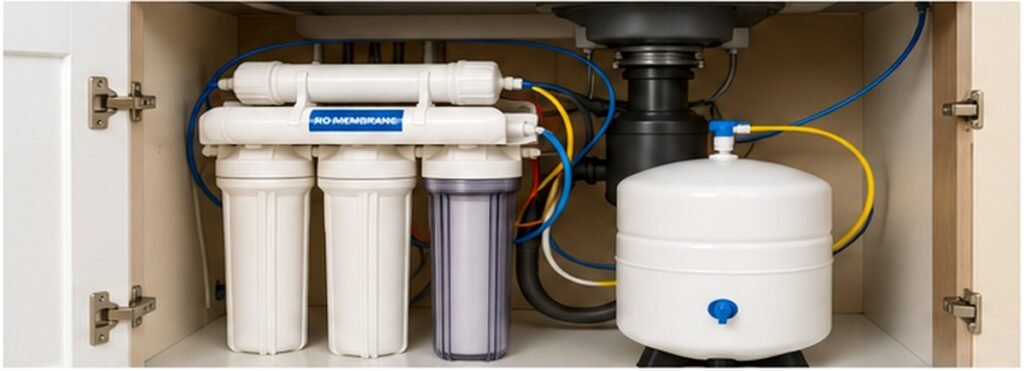
A residential RO system is not just a membrane. It is a series of stages, with each stage performing a different job.
Sediment Prefilter
The sediment prefilter catches sand, silt, rust, and other visible particles before they reach the carbon or membrane stages.
Removing these particles helps protect the more sensitive and expensive components downstream.
Carbon Prefilter
The carbon prefilter reduces chlorine, some chloramines, and compounds responsible for common tastes and odors.
This stage is especially important because chlorine can damage many RO membranes over time. Replacing the carbon filter according to the manufacturer’s schedule helps protect the membrane.
RO Membrane
The membrane is the core of the system.
Water is pushed under pressure through a semipermeable membrane that restricts the passage of many dissolved solids, including salts, metals, and other ions.
Treated water, called permeate, continues toward the storage tank or faucet. Rejected water carries concentrated contaminants away through a drain line.
Storage Tank or Tankless Delivery
Conventional RO systems store treated water in a small pressurized tank so it is available when you open the faucet.
Tankless systems filter water as you use it, usually with help from an internal electric pump. They eliminate the separate storage tank but introduce different flow-rate, electrical, and maintenance considerations.
Post-Carbon Filter
Before the treated water reaches the faucet, it often passes through a final carbon filter.
This post-filter helps polish the taste and reduce any residual flavor introduced by the storage tank or plumbing.
Optional Add-Ons
Depending on the system, optional stages may include:
- A remineralization cartridge
- UV treatment
- An electric booster pump
- A hydraulic permeate pump
- Additional sediment or carbon filtration
These features are not included with every RO system. Always check what comes standard and what must be purchased separately.
What Can Reverse Osmosis Reduce?
This is where marketing often gets ahead of reality.
RO membranes can reduce many dissolved contaminants, but the amount reduced by a particular system depends on several factors:
- Membrane type
- Incoming water pressure
- Water temperature
- Source-water chemistry
- System design
- Maintenance
- Third-party certification
Broad claims such as “removes 99% of everything” are not reliable on their own.
What matters is the system’s Performance Data Sheet, which identifies the contaminants tested, the starting concentrations, and the reductions demonstrated by that specific model.
| Contaminant or category | Important qualification |
| Total dissolved solids | TDS reduction is a core measure of RO performance, but results vary by membrane and design. |
| Sodium and chloride | Commonly reduced; confirm the exact system’s performance claims. |
| Calcium and magnesium | Reduced with other dissolved minerals; very hard water may require pretreatment. |
| Lead and copper | Look for a certified reduction claim for the exact contaminant under NSF/ANSI 58, NSF/ANSI 53, or another applicable standard. |
| Arsenic | Performance can depend on the form of arsenic present. Some water may require oxidation or pretreatment. |
| Nitrate and nitrite | Many RO systems can reduce them, but well-water households should verify the model’s certified claim. |
| Fluoride | May be reduced by many systems; check the Performance Data Sheet. |
| Chromium | Some RO systems carry chromium-reduction claims. Confirm certification for the exact model. |
| Radium | Certain systems are certified for radium reduction as part of radionuclide treatment. |
| PFOA and PFOS | RO may reduce these compounds, but performance varies by system and PFAS type. Look for an applicable certified claim. |
| Potassium | Generally reduced along with other dissolved minerals, although the exact amount varies. |
The honest answer for every contaminant above is that performance depends on the specific system.
Before buying an RO unit to address a particular concern, verify the model’s certified reduction claim rather than relying on a general table or marketing percentage.
What Reverse Osmosis Does Not Handle Well
RO has real limitations, and understanding those limitations matters just as much as understanding its strengths.
Radon and Other Dissolved Gases
Reverse osmosis should not be relied upon as the primary treatment for radon in household water.
EPA guidance points homeowners toward point-of-entry aeration or properly designed granular activated carbon treatment.
VOCs Without Adequate Carbon
Some volatile organic compounds may not be adequately addressed by the RO membrane alone.
Properly sized and maintained carbon stages are important when VOC reduction is a treatment goal.
Chlorine and Chloramine if Carbon Filtration Fails
Many RO membranes are vulnerable to chlorine damage.
That is why the carbon prefilter must be replaced according to the manufacturer’s instructions. A neglected carbon filter can shorten the membrane’s life.
Sediment, Iron, and Manganese
Heavy sediment loads can clog prefilters quickly.
Iron and manganese may also foul the membrane or create buildup inside the system. These conditions often require pretreatment before the water reaches the RO unit.
Untreated Microbiological Contamination
RO membranes can reduce many microorganisms, but an ordinary under-sink system should not be treated as a complete safety plan for an untreated well.
Testing, disinfection, correct installation, and appropriate pretreatment may still be necessary.
Very Hard Water and High TDS
Very hard water can cause scaling on the membrane and shorten its useful life.
Water with unusually high TDS may also require a specialized membrane, higher pressure, or additional pretreatment.
None of these limitations makes RO a poor technology. They simply mean that source-water conditions determine whether RO is sufficient on its own or requires additional treatment methods.
Is Reverse Osmosis Water Healthy?
Reverse-osmosis water is generally suitable for drinking when the system is properly maintained, and the finished water meets applicable drinking-water standards.
Because RO reduces many dissolved solids, it also reduces minerals such as calcium, magnesium, sodium, and potassium.
This raises a common question: Does removing those minerals matter for health?
For most people, food is the primary source of dietary minerals. Although RO may substantially reduce minerals in the water itself, the effect on a person’s total mineral intake is generally much smaller than the contribution from diet.
Remineralization is therefore commonly chosen for taste rather than treated as a universal health requirement.
Some people notice that RO water tastes flatter because it contains fewer minerals and dissolved substances. A remineralization cartridge can change the taste if that matters to you.
People with unusual dietary restrictions or medical conditions that require carefully managed mineral intake should discuss their water treatment plans with a qualified healthcare provider or dietitian.
What Are the Downsides of Reverse Osmosis?
RO systems offer broad treatment capabilities, but they also come with practical trade-offs.
- Reject water: RO systems create a reject-water stream. Older conventional systems may send several gallons to the drain per gallon treated, while newer high-efficiency systems can perform much better. Check the exact model’s recovery or efficiency rating.
- Slower production: Conventional systems gradually fill a storage tank. Tankless systems produce water on demand but may still dispense more slowly than a standard kitchen faucet.
- Storage-tank space: Conventional systems require room under the sink for both the filtration unit and a pressurized tank.
- Electricity: Standard tank systems usually run on household water pressure alone. Tankless systems and systems with electric booster pumps commonly require an outlet, while many permeate pumps operate hydraulically without electricity.
- Filter and membrane costs: Prefilters and post-filters require regular replacement. The RO membrane also has a limited lifespan.
- Mineral reduction: Lower mineral content may affect taste, although optional remineralization is available on many systems.
- Pretreatment needs: Hard water, sediment, iron, or manganese may need to be addressed before the water enters the RO system.
- Pressure and temperature sensitivity: RO systems need adequate incoming pressure, and production can drop when the source water is cold.
None of these issues is necessarily a dealbreaker. Together, however, they explain why RO is not always the simplest or most economical choice for every household.
Reverse Osmosis vs. Other Water-Treatment Methods
No single water-treatment technology solves every problem.
| Technology | Best for | What it does not solve | When it may be better than RO |
| Reverse osmosis | Dissolved solids, metals, salts, and many microorganisms | Dissolved gases and some VOCs without adequate carbon; untreated well-water safety may require additional treatment | Treating dissolved contaminants at a dedicated drinking-water faucet |
| Activated carbon | Chlorine taste and odor, along with certain organic compounds | TDS, dissolved salts, nitrate, and many dissolved minerals | Simple taste and odor concerns, lower cost, and no reject water |
| Gravity filtration | Countertop use, portability, sediment, taste, and contaminants claimed by the specific filter | Performance varies widely and may not include TDS or dissolved-salt reduction | Emergencies, renters, off-grid use, or homes that do not need RO-level dissolved-solids reduction |
| Distillation | Many minerals, metals, and microorganisms | Some VOCs unless the unit is designed to address them; also slow and energy-intensive | Situations where plumbing or water pressure is unavailable |
| Ultrafiltration | Sediment, cysts, bacteria, and turbidity | Dissolved ions, salts, and most TDS | Microbiological and sediment concerns without a need for dissolved-solids reduction |
| Water softener | Calcium and magnesium hardness | Most other contaminants | Hard water problems or pretreatment before an RO system |
| Whole-house filtration | Sediment, chlorine, and certain contaminants throughout the home | Many dissolved contaminants such as nitrate or arsenic unless specially designed | Protecting plumbing, appliances, showers, and every household faucet |
| UV disinfection | Bacteria, viruses, and other microorganisms | Chemicals, metals, and dissolved solids | Microbiological concerns, usually when paired with filtration |
RO is especially useful when the concern involves dissolved contaminants at the point of use.
But if the real problem is hardness, sediment, chlorine taste, or microbiological contamination, another technology or a combination of technologies may be a better starting point.
Who Should Consider a Reverse Osmosis System?
Reverse osmosis may make sense for:
- Homeowners with test-confirmed dissolved contaminants, such as elevated TDS, sodium, nitrate, or certain metals
- Municipal-water households concerned about dissolved solids or taste
- Households wanting dedicated treatment for drinking and cooking water
- Buyers willing to keep up with filter changes and routine maintenance
- People comfortable with the system’s reject-water requirements
Compare the Best Reverse Osmosis Systems for Home Use
Who May Not Need Reverse Osmosis?
RO may not be the best starting point when:
- Your only concern is chlorine taste or odor, which a simpler carbon filter may handle.
- You need treatment throughout the entire house, not just at one drinking-water faucet.
- You have an untreated well with microbiological concerns requiring broader treatment.
- You would rather avoid filter changes, reject water, or slower flow.
- Testing shows that hardness, iron, manganese, or sediment is the primary problem.
In these situations, a carbon filter, softener, iron filter, sediment filter, UV system, or whole-house treatment setup may be more appropriate than RO alone.
Tank, Tankless, or Countertop Reverse Osmosis?
Once you have determined that RO is right for your water, the next question is which type of system makes the most sense.
| Feature | Tank RO | Tankless RO | Countertop RO |
| Upfront cost | Generally lower | Generally higher | Usually mid-range |
| Flow | Strong initial flow from the tank, then slows during refilling | Steadier on-demand flow | Varies, often moderate |
| Cabinet space | Requires room for a storage tank | No separate tank, but still occupies cabinet space | No under-sink space needed |
| Electricity | Usually not required | Usually required | Usually required |
| Installation | Standard under-sink plumbing, drain, tank, and faucet | Under-sink installation without a separate tank | Often minimal or no permanent plumbing |
| Portability | Fixed installation | Fixed installation | Portable |
| Maintenance | Filter changes and occasional tank care | Filter changes | Filter changes and possible reservoir cleaning |
| Reject-water efficiency | Varies; may improve with a permeate pump | Often more efficient, but depends on the model | Varies by model |
There is no universally best format.
The right choice depends on your budget, cabinet space, access to an electrical outlet, installation preferences, and expected water use.
As one example of a powered tankless system, see our Waterdrop G3P800 review. Remineralization is available as an add-on or as part of certain bundles, rather than as a standard feature on every configuration.
How to Read RO Certifications
Certification labels are useful, but only when you understand what they cover.
- NSF/ANSI 58 is the primary standard for reverse-osmosis drinking-water treatment systems. TDS reduction is a core part of the standard, while additional contaminant-reduction claims are specific to the tested model.
- NSF/ANSI 42 generally addresses aesthetic effects such as chlorine taste and odor.
- NSF/ANSI 53 generally covers specific contaminant-reduction claims related to health effects.
- NSF/ANSI 372 addresses lead content in the materials used to manufacture the product. It does not mean the system is certified to reduce lead from drinking water.
Certification means a system was independently tested against a defined standard. It does not mean that every marketing statement on the box was verified.
The most important document is the Performance Data Sheet for the exact model.
A statement such as “removes up to 99% of contaminants” is not a substitute for model-specific certified results.
Frequently Asked Questions
Is reverse osmosis water healthier?
RO water is generally suitable for drinking when the system is properly maintained, but it is not automatically healthier than other clean water.
Its main benefit is reducing particular dissolved contaminants at the point of use.
What is the main downside of reverse osmosis?
For many households, the primary trade-offs are reject water, slower production, equipment cost, and ongoing filter maintenance.
Does reverse osmosis remove potassium?
Many RO systems can reduce potassium along with other dissolved minerals.
The exact reduction depends on the system and operating conditions, so check the Performance Data Sheet when potassium reduction is important.
Can reverse osmosis remove radon?
Reverse osmosis should not be relied upon as the primary treatment for radon in household water.
EPA guidance points homeowners toward point-of-entry aeration or properly designed granular activated carbon treatment.
Is anything better than reverse osmosis?
That depends on the contaminant.
Carbon filtration is simpler for chlorine taste and odor. UV is designed to address microorganisms. Water softeners treat hardness. Gravity filters offer portability and do not require plumbing.
RO is one useful tool among several not a universal upgrade for every home.
Does reverse osmosis waste water?
Yes. RO systems produce a reject-water stream.
Efficiency varies considerably, so buyers should compare each model’s recovery or efficiency rating rather than assuming every system wastes the same amount.
Does reverse osmosis need electricity?
Standard tank systems usually do not require electricity.
Tankless systems and systems with electric booster pumps usually do. Many permeate pumps operate hydraulically and do not require an electrical connection.
Does reverse osmosis work with well water?
It can, but well water should be tested first.
Sediment, hardness, iron, manganese, and microbiological contamination may require treatment before the water enters the RO system. An ordinary under-sink RO unit should not be treated as a complete safety plan for an untreated well.
Final Thoughts
Reverse osmosis is a capable technology for reducing many dissolved contaminants, but it is not automatically the right or complete answer for every water problem.
It works best when chosen deliberately:
- Test your water.
- Identify what you need to reduce.
- Compare treatment technologies.
- Confirm the exact system’s certified claims.
- Choose a format that fits your space, budget, and maintenance preferences.
A proper Performance Data Sheet matters more than a broad marketing percentage.
And the right format tank, tankless, or countertop depends on how your household uses water from day to day.
See How the Waterdrop G3P800 Compares
As an Amazon Associate, BuildSafeHome earns from qualifying purchases
This article may contain affiliate links. BuildSafeHome may earn a commission at no extra cost to you