Affiliate Disclosure: This article may contain affiliate links. BuildSafeHome may earn a commission at no extra cost to you.
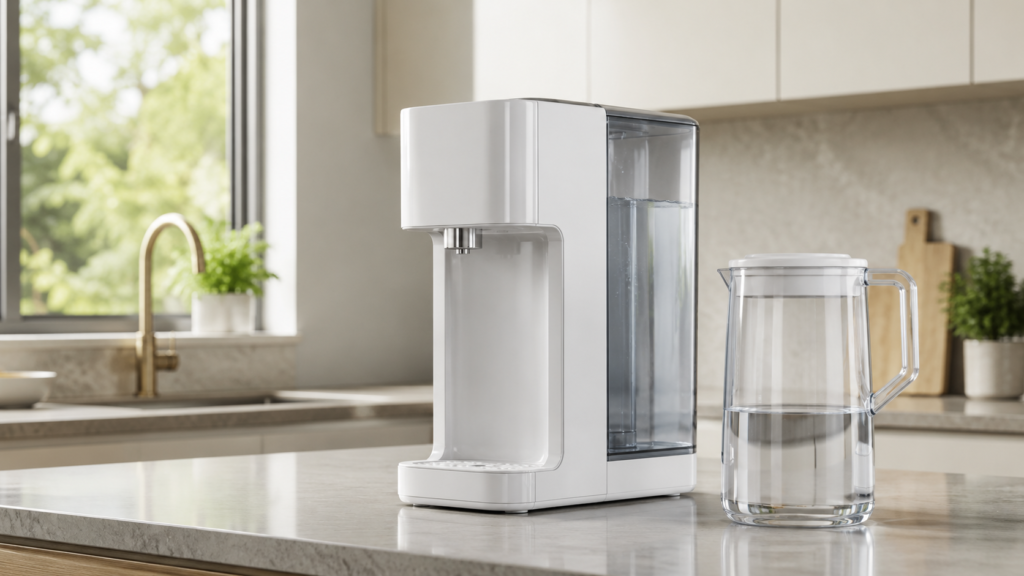
Countertop reverse osmosis systems can provide better-tasting, more thoroughly filtered drinking water without drilling into a countertop, changing the plumbing, or giving up under-sink storage.
This guide explains how countertop RO systems work, who they suit best, what they may reduce in tap water, and how to compare models without relying on vague marketing claims.
What Is a Countertop Reverse Osmosis System?
A countertop reverse osmosis drinking system packages the same filtration process into a unit that sits on the counter. Countertop reverse osmosis systems vary in how they are filled, how they dispense water, and how they handle reject water. For the full mechanical explanation, see our guide What Is Reverse Osmosis and How Does It Work?
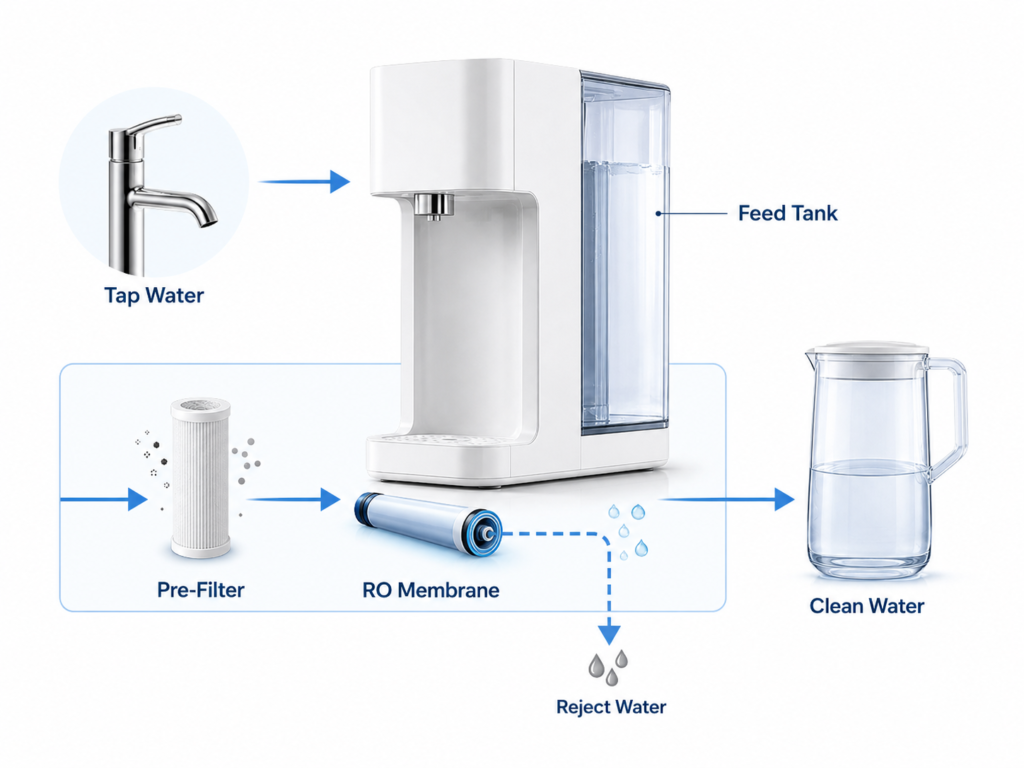
Manually Filled Countertop Appliances
Many newer countertop appliances use this format. They typically include:
- A source-water reservoir you fill by hand from a tap, pitcher, or jug.
- An electric pump that pushes water through the RO membrane.
- A purified-water tank, carafe, or dispensing reservoir.
- Concentrated reject water that stays in the feed reservoir and must be poured out manually.
These units generally need an electrical outlet but no plumbing connection, which can make them attractive to renters and anyone who wants a portable system.
Faucet-Connected Countertop Systems
Another category connects to a compatible kitchen faucet, usually through a diverter valve:
- Faucet compatibility can be a real limitation; pull-down, pull-out, sprayer, and some low-profile faucets may not accept a standard diverter.
- Some models route reject water back down the drain through a separate line instead of leaving it in a tank.
- Because they draw from the faucet, they don’t need manual refilling the way a reservoir-based appliance does.
Both formats have advantages and limitations. Before comparing specifications, confirm whether a unit is manually filled, faucet-connected, or directly plumbed.
Stored Water vs. On-Demand Dispensing
Some products are marketed as “tankless” or “on-demand,” but those terms do not necessarily mean the unit has an unlimited water supply. A unit can be tankless in the sense that it doesn’t hold a large standing reserve of purified water, while still requiring you to manually fill its source-water reservoir. Unless a specific model is actually plumbed into your water line, “tankless” describes how water is dispensed, not where the incoming water comes from. When reading a product listing, separate four details: the feed-water reservoir, purified-water storage, dispensing method, and whether the unit has a direct plumbing connection.
Who Is a Countertop RO System Best For?
- Renters who can’t or don’t want to modify plumbing.
- Apartment and condo residents with limited under-sink access.
- Homeowners who want purified water without a plumbing project.
- Small households with modest daily drinking-water needs.
- Offices, dorm rooms, and other spaces without easy access to plumbing.
- People in temporary housing who may move within a year or two.
- Anyone with little to no free space under the kitchen sink.
Who May Be Better Served by Another System?
Another type of system may be a better fit if you:
- Have a large household with high daily water use.
- Frequently fill large stockpots or multiple pitchers at once.
- Need whole-house treatment rather than drinking-water-only treatment.
- Have very limited counter space to spare.
- Want fast, continuous flow rather than tank-limited output.
- Are dealing with untreated microbial contamination in well water, which needs to be addressed before any point-of-use polishing step.
What Can a Countertop RO System Reduce?
RO membranes can reduce a wide range of dissolved substances, including total dissolved solids. Depending on the system design and verified performance claims, a model may also reduce contaminants such as lead, fluoride, arsenic, PFAS, nitrate, and certain particles. That describes the technology in general, not a guarantee for every product. RO technology can reduce many dissolved contaminants, but shoppers should verify the exact model’s independently certified reduction claims before assuming it addresses a specific concern.
| Contaminant or concern | Treatment stage commonly involved | What the shopper should verify |
|---|---|---|
| Total dissolved solids (TDS) | RO membrane | Typically the core NSF/ANSI 58 requirement; confirm the tested percentage |
| Lead | RO membrane, sometimes a dedicated pre- or post-filter | Model-specific certification against a lead-reduction standard, not just “uses RO” |
| Fluoride | RO membrane | Not automatic; check the performance data sheet |
| Arsenic | RO membrane | Confirm which arsenic form is addressed, if tested at all |
| PFAS | RO membrane, sometimes carbon pre-filtration | Look for a specific reduction claim and certifying body |
| Chlorine and chloramine | Usually a carbon pre-filter stage | Verify the exact chlorine or chloramine claim; they are not interchangeable |
| Nitrate | RO membrane | Confirm independent testing; varies by membrane |
| Microplastics | RO membrane and prefiltration, depending on particle size | Look for model-specific testing rather than assuming a universal claim |
Understanding NSF and Other Certifications
Third-party certification is one of the more reliable ways to evaluate a claim, but the labels aren’t interchangeable:
- NSF/ANSI 58 — the primary standard for reverse osmosis drinking-water systems; specific reduction claims still depend on the model’s certification listing.
- NSF/ANSI 42 — aesthetic effects like chlorine taste and odor, not health-related contaminants.
- NSF/ANSI 53 — health-effect claims (such as lead or certain cysts), but only for contaminants actually tested.
- NSF/ANSI 401 — a set of “emerging” contaminants, including some pharmaceuticals and pesticides, where applicable.
- NSF/ANSI/CAN 372 — lead-free material compliance in the product’s construction, not lead removal from water.
Certification to NSF/ANSI 58 does not automatically mean a system is certified to reduce every contaminant covered by the standard. Look at whether a claim is backed by accredited certification (NSF, WQA, IAPMO), independent lab testing, a vaguer “tested to” or “designed to meet” a standard, or simply a manufacturer claim with no third-party verification; these carry very different levels of assurance.
Can You Use Countertop RO With Well Water or Hard Water?
A countertop RO system is a point-of-use drinking-water device, not a whole-house well-water treatment solution. If your water comes from a private well, testing before choosing any treatment is strongly recommended:
- Sediment and turbidity can quickly clog prefilters.
- Iron and manganese can stain and shorten filter life.
- Sulfur odor typically needs its own treatment step.
- Hardness and scale can affect membrane performance over time.
- Microbial contamination is a safety issue that needs to be resolved upstream, not treated as an afterthought by a countertop unit.
If testing identifies a microbiological safety concern, do not rely on a countertop appliance as the primary safeguard. The source problem and any required disinfection or pretreatment should be addressed first. A countertop unit may then serve as a final drinking-water treatment step.
Countertop vs. Under-Sink Reverse Osmosis
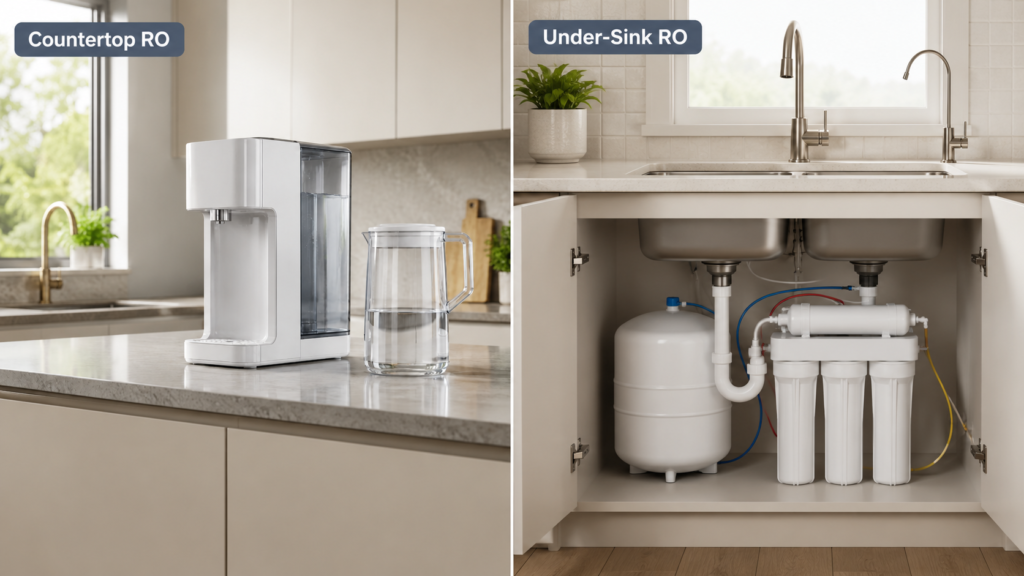
| Factor | Countertop RO | Under-Sink RO |
|---|---|---|
| Plumbing installation | None for manual-fill models; a faucet diverter for some others | Usually requires a supply-line and drain connection |
| Electrical requirement | Often required for the pump | Varies; many unpowered, some pumped models need power |
| Portability | High — moves with you | Low — installed in place |
| Counter space | Uses visible counter space | Uses none |
| Cabinet space | Little to none | Uses under-sink cabinet space |
| Ready-water capacity | Usually limited to tank or carafe volume | Often a larger storage tank |
| Refill requirements | Manual, for reservoir-based models | Continuous from the plumbing line |
| Dispensing speed | Can be slower, tank-limited | Generally faster, more continuous |
| Wastewater handling | Feed tank (manual) or diverter line (faucet-connected) | Typically routed to the drain automatically |
| Maintenance | Filter changes, reservoir cleaning, and possible descaling | Filter changes and periodic system sanitizing |
| Filter availability | Frequently proprietary to the model | Varies; some use standard cartridges, while others are proprietary |
| Typical best user | Renters, small households, limited plumbing access | Homeowners wanting higher volume, hands-off operation |
If a higher-capacity, plumbed-in option looks like a better fit, our roundup Best Reverse Osmosis Systems for Home Use: 6 Top Picks Compared covers both formats, and the Waterdrop G3P800 Review looks at one under-sink model in more depth.
Main Advantages of Countertop RO
- Little to no plumbing work required.
- Portable enough to take with you when you move.
- Easy access for filter changes.
- Well suited to rental agreements that restrict plumbing modifications.
- Point-of-use treatment without taking over the under-sink cabinet.
Main Drawbacks and Ownership Frustrations
- Takes up visible counter space.
- Reservoir-based models require manual refilling for every batch.
- Reject water in the feed tank has to be emptied by hand.
- Refill and dispensing speed can feel slow next to a plumbed-in system.
- Some pumps produce noticeable operating noise.
- Replacement filters are often brand-specific.
- Cleaning and descaling are the owner’s responsibility.
- Output volume is limited compared to a continuously supplied system.
- Most models depend on a working electrical outlet.
How to Choose a Countertop Reverse Osmosis System
Certification and verified contaminant claims: Start with what’s actually certified for the specific model, not just the technology category.
Manual-fill vs. faucet-connected design: Decide whether to avoid the faucet entirely or accept a diverter, and check faucet compatibility first if you choose the latter.
Feed-tank and clean-water capacity: Compare how much the unit holds with how often your household needs to refill it.
Production and dispensing speed: Check how long a full cycle actually takes, not just headline “on-demand” language.
Wastewater efficiency: Manufacturers state efficiency as a ratio, but direction matters. A “4:1 pure-to-drain” ratio means four parts purified water per one part reject water, while a “4:1 wastewater-to-pure water” ratio means the opposite. Confirm which number is purified water before comparing products.
Filter life and annual replacement cost depend on the model, feed-water quality, household use, and hardness. Follow the specific manual rather than a general rule of thumb.
Replacement-filter availability: Confirm filters are easy to reorder before committing to a brand.
Remineralization options: These are mainly a taste preference. RO reduces dissolved minerals along with unwanted dissolved substances, and some people prefer the flavor after a small amount of minerals is added back.
Cleaning and descaling: Check how often the manufacturer recommends cleaning the feed tank and clean-water container.
Dimensions and overhead clearance: Measure available counter space and cabinet clearance before ordering.
Noise: If the unit will run near a bedroom or shared space, check pump noise level in reviews.
Warranty and customer support: Confirm coverage and duration directly from current manufacturer documentation.
Buyer checklist:
- ☐ Confirmed manual-fill or faucet-connected design.
- ☐ Verified certification and specific contaminant claims for this model.
- ☐ Measured available counter space and clearance.
- ☐ Compared feed-tank and clean-water capacity to household needs.
- ☐ Checked wastewater ratio wording directly from the manufacturer.
- ☐ Calculated estimated annual filter cost.
- ☐ Confirmed filter availability and reorder process.
- ☐ Reviewed warranty and support terms.
Maintenance and Long-Term Cost
Follow the manufacturer’s exact schedule for your specific model rather than a generic interval, since filter life varies with feed-water quality and household use:
- Clean the feed tank and clean-water container periodically.
- Run any manufacturer-prescribed cleaning or descaling cycles.
- Monitor taste, flow rate, and TDS readings where the unit supports it.
- Calculate expected annual filter cost before purchasing, not after.
- Confirm replacement filters remain readily available for the model you choose.
Compare certified models based on your water concerns and household use, and calculate replacement-filter costs before selecting a system; the sticker price rarely tells the whole story of ownership.
Frequently Asked Questions
Is countertop RO as effective as under-sink RO?
It can be, depending on the membrane and certification, but countertop units generally store and produce less water at a time.
Do all countertop RO systems connect to a faucet?
No. Many are manually filled appliances with no plumbing connection at all; faucet-connected designs are a separate category with their own compatibility considerations.
Where does the wastewater go?
It depends on the design: manually filled appliances leave reject water in the feed tank, while some faucet-connected systems drain it through a separate line. Check the specific model.
Does countertop RO require electricity?
Most manually filled appliances use an electric pump and need an outlet. Some faucet-connected designs may rely on water pressure instead.
Can it be used with well water?
Possibly, but test the water first. Sediment, iron, manganese, sulfur, hardness, or microbial contamination may need separate treatment before the water reaches a countertop RO unit.
Does RO remove minerals from water?
Yes. RO reduces dissolved minerals along with unwanted dissolved substances. This can change the taste of the water. Remineralization is optional and is mainly a matter of preference.
Is remineralization necessary?
No. It’s primarily a matter of taste and preference, not a requirement.
Can countertop RO remove PFAS?
Some membranes can reduce certain PFAS compounds, but this isn’t automatic or universal. Verify the specific model’s independently certified claim.
How often are the filters replaced?
It depends on the model, feed-water quality, and household use. Follow the manufacturer’s specific schedule and filter-life indicators rather than a general timeframe.
Final Verdict
A countertop RO system can be a strong option for someone who values portability and wants to avoid plumbing work, and who can accept limited capacity, limited counter space, and manual maintenance often a reasonable trade-off for renters, apartment residents, and smaller households.
For larger households or anyone seeking continuous, higher-volume output without manual refilling, an under-sink RO system may be a better fit. Homes with broader water-quality problems may need separate whole-house treatment. Read the broader RO buying guide before deciding.
As an Amazon Associate, BuildSafeHome earns from qualifying purchases
This article may contain affiliate links. BuildSafeHome may earn a commission at no extra cost to you