Affiliate Disclosure: This article may contain affiliate links. BuildSafeHome may earn a commission at no extra cost to you.
Newer reverse osmosis systems arrive with tankless cabinets, digital displays, booster pumps, and filter-life alerts. The APEC ROES-50 does none of that.
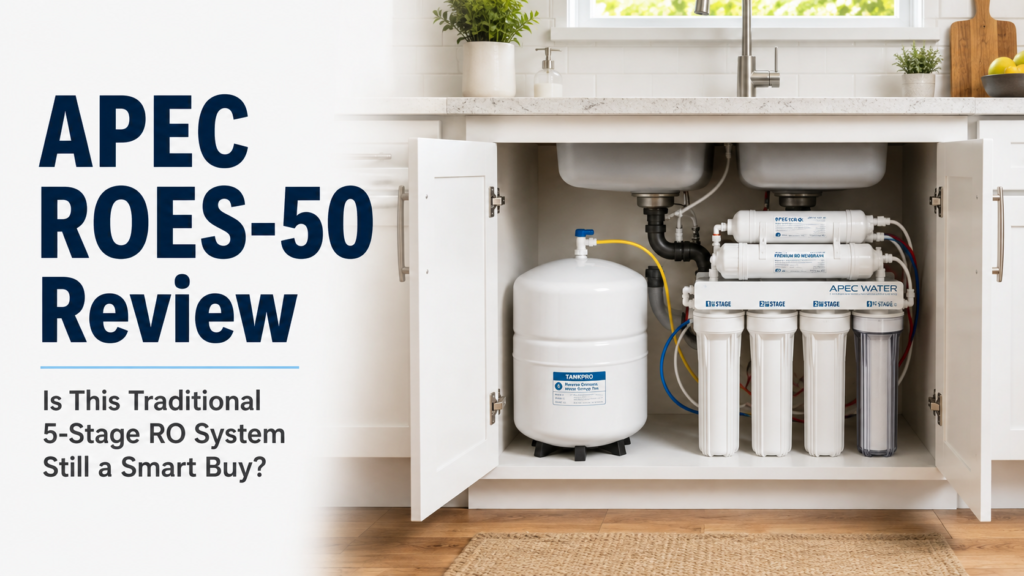
It is a traditional five-stage, tank-based reverse osmosis system that requires no electricity and relies on the owner, rather than electronics, to track maintenance.
That contrast is the real question behind this APEC ROES-50 review: Does a slower, more basic 50-GPD system still make sense when newer designs promise more speed, smaller footprints, and smart monitoring?
Based on the current specifications, the answer depends less on flashy features and more on what kind of system you want to own.
The ROES-50 makes the most sense for homeowners who value straightforward operation, standard components, and lower long-term complexity more than speed, compact packaging, or built-in electronics. Buyers who prioritize higher output or smart monitoring will probably find it behind the curve—and that is precisely the tradeoff worth examining.
For a broader look at the category, our Best Reverse Osmosis Systems for Home Use guide compares several different approaches.
Check current APEC ROES-50 pricing
What You’re Actually Buying
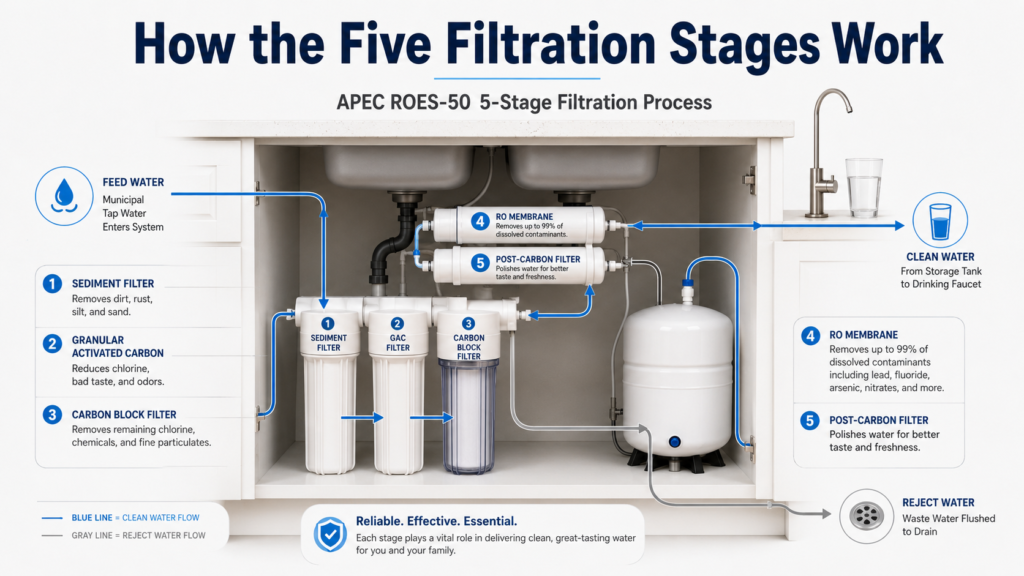
Strip away the marketing language and the ROES-50 is a fairly straightforward hardware package.
Under the sink, five filtration stages connect to the cold-water supply through tubing and fittings. A separate pressurized storage tank holds finished water so it is ready when you open the dedicated drinking-water faucet. A drain connection carries reject water away during the reverse osmosis process.
There is no electrical cord, digital display, app, or powered pump on the base model.
Current specifications list the filter assembly at approximately 15.5 inches long by 5.25 inches wide by 17 inches high. The separate storage tank is roughly 11 by 11 by 15 inches.
That means cabinet space matters.
The filter assembly itself is not unusually large, but the storage tank occupies a noticeable amount of room. Homeowners with garbage disposals, pull-out organizers, cleaning supplies, or crowded plumbing should measure the cabinet before ordering rather than assuming everything will fit.
The ROES-50 includes a dedicated faucet, so installation also requires either an available sink or countertop opening or the ability to create one.
The Real Appeal: Nothing Fancy to Depend On
The ROES-50’s design reflects a simple idea: fewer electronic components mean fewer electronic components to depend on.
There is no booster pump to power, no digital display, no filter-life monitor, and no control board managing the system.
The prefilter housings use standard-sized cartridges, the tubing uses conventional push-connect fittings, and the overall layout is easier to understand and service than many tightly integrated systems.
That matters more after several years of ownership than it does on installation day.
A modern tankless system may offer faster water production, a smaller footprint, and more convenient monitoring. But those benefits often come with powered pumps, sensors, electronics, and proprietary replacement cartridges.
The ROES-50 takes the opposite approach.
You give up some convenience in exchange for a system that is comparatively mechanical and straightforward.
That simplicity is not automatically better. Owners must track filter changes themselves. There is no warning when maintenance is overdue and no integrated leak detector watching the cabinet.
For some homeowners, that is an acceptable trade. For others, it will feel outdated.
Is 50 GPD Enough?
The ROES-50 carries an advertised production rating of 50 gallons per day at specified operating conditions.
APEC also publishes a lower production figure under reduced-pressure conditions, which provides another useful reference point for understanding how strongly incoming water pressure can affect RO output.
Neither figure tells you exactly how quickly water will pour from the faucet.
That is because a traditional RO system gradually produces water and stores it in a pressurized tank. During normal use, you are usually drawing from stored water rather than waiting for the membrane to make every glass on demand.
For drinking and everyday cooking, the storage tank helps buffer the membrane’s slower production rate, so many households may rarely notice the 50-GPD rating during routine use.
Higher demand changes the equation.
A larger household that repeatedly fills stockpots, large water containers, coffee equipment, or other high-volume applications may eventually draw down the tank faster than the membrane can replenish it.
Incoming pressure and water temperature also affect production. Lower pressure and colder source water can reduce membrane output.
That means the ROES-50 is better viewed as a drinking-and-cooking system than as a source of unlimited purified water on demand.
If high output is a priority, a higher-capacity tank-based system or a modern tankless design may be the better fit.
Certification: Where the Marketing Ends and Verification Begins
Certification language deserves careful attention with any water filtration system.
The ROES-50 is marketed as WQA Gold Seal Certified to NSF/ANSI 58, the standard that applies to reverse osmosis drinking-water treatment systems.
That wording is more precise than simply calling the product “NSF certified.”
The independently verified performance claim we are comfortable relying on for the exact model is TDS reduction.
APEC also markets the ROES-50 for reduction of a broader range of contaminants, including substances such as lead, arsenic, fluoride, chromium, and VOCs.
Those broader claims should not automatically be treated as identical to the independently certified TDS claim.
If you are buying an RO system because of one specific contaminant, review the current WQA listing and model-specific performance documentation before purchasing.
That distinction matters most for households dealing with a known water-quality problem.
For example, someone concerned about elevated arsenic in private-well water should verify that exact performance claim rather than assuming every contaminant mentioned in manufacturer literature carries the same independent certification.
Testing your source water first can also help determine which filtration claims actually matter for your home.
Installation Is Straightforward—But It Still Involves Plumbing
APEC markets the ROES-50 as DIY-friendly, and the installation process follows the familiar layout of a traditional under-sink RO system.
The basic steps include:
- Connecting the system to the cold-water supply
- Installing a drain saddle
- Mounting the dedicated drinking-water faucet
- Positioning the storage tank
- Routing tubing between the components
- Flushing the system before use
- Checking connections carefully for leaks
The tubing and fittings are designed to simplify assembly, but this is still a plumbing project rather than a plug-in countertop appliance.
A faucet hole can be one of the bigger considerations.
If your sink already has an unused soap-dispenser or accessory opening, installation may be easier. Otherwise, drilling stainless steel, composite material, stone, or another countertop surface may be required.
Cabinet clearance is equally important.
The tank and filter assembly need enough room not only to fit but also to allow future filter changes and access to the plumbing.
After installation, homeowners should check all connections carefully for leaks and inspect again during early use.
Homeowners comfortable with basic plumbing may find the project manageable. Anyone uncomfortable modifying a drainpipe, drilling a countertop, or working around supply fittings may prefer professional installation.
What Ownership Looks Like After Installation
Once installed, the ROES-50 becomes a maintenance routine rather than a complicated appliance.
Current APEC guidance calls for replacing the Stage 1 through Stage 3 prefilters approximately every 6 to 12 months, depending on source-water quality and usage.
The RO membrane and post-carbon stage typically have longer service intervals of approximately 2 to 4 years.
Those are guidelines, not guarantees.
A home with heavy sediment, high chlorine exposure, or higher-than-average water use may need filters sooner.
Current official replacement pricing observed during research was approximately:
- $30 for the Stage 1–3 prefilter set
- $40 for a replacement 30–50 GPD membrane
- $80 for a complete Stage 1–5 replacement set
Prices change, so check current replacement costs before estimating long-term ownership expenses.
The bigger advantage is the conventional filter format.
Standard-sized prefilters can make replacement sourcing easier and reduce dependence on a single sealed cartridge design. The system also avoids the pumps, displays, and electronics found in many tankless units.
Ownership still involves more than simply changing filters.
Traditional tank-based RO systems may also require periodic sanitation, inspection of tubing and fittings, and attention to tank pressure if water delivery starts to decline.
APEC currently backs the ROES-50 with a 1-year limited warranty and advertises lifetime customer and technical support.
Where the ROES-50 Feels Dated
The ROES-50 is not cutting-edge, and buyers should not pretend otherwise.
The storage tank consumes cabinet space that tankless systems can reclaim.
Its 50-GPD rating is modest compared with systems advertising 75 GPD, 100 GPD, or considerably higher output.
There is no:
- Smart filter-life tracking
- TDS display
- Integrated leak detector
- App
- Powered high-flow delivery
- Digital status monitoring
Water efficiency is another area where older RO architecture can look less attractive.
Under specified conditions, APEC has published a purified-to-reject-water ratio of roughly 1:3. Actual efficiency can vary with incoming pressure, temperature, source-water quality, and membrane condition, so that figure should not be treated as a guaranteed household ratio.
Many newer tankless systems advertise improved wastewater efficiency.
That matters for homeowners who place a high priority on reducing reject water.
None of these shortcomings automatically make the ROES-50 a poor system. They simply make it an older-architecture product being evaluated for what it is rather than pretending its limitations are hidden advantages.
Compare the ROES-50 with our top RO picks
APEC ROES-50 vs. iSpring RCC7
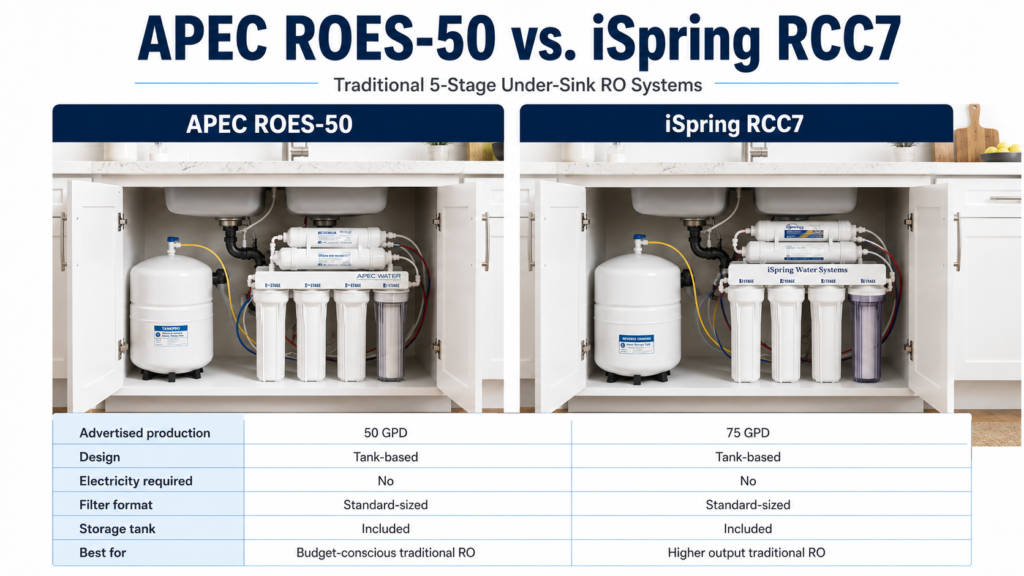
The iSpring RCC7 is one of the most natural alternatives because it follows the same basic philosophy: traditional tank, no electricity, standard filtration components, and an owner-serviceable layout.
| Advertised production | 50 GPD | 75 GPD |
| Design | Tank-based | Tank-based |
| Electricity required | No | No |
| Filter format | Standard-sized | Standard-sized |
| Storage tank | Included | Included |
| Smart features | None | None |
| Serviceability | High | High |
| Main strength | Simplicity and conventional ownership | Higher advertised output |
APEC’s strongest case here is not higher output. The RCC7 wins that comparison on its advertised membrane capacity.
Instead, the decision comes down to the details of ownership, pricing, support, and which exact system better fits the household.
The RCC7 is attractive for buyers who want a higher advertised production rating without moving to a powered tankless design.
The ROES-50 appeals to someone comfortable with a slower, conventional system and who values APEC’s straightforward approach.
See our full iSpring RCC7 Review for a closer look at that system.
APEC ROES-50 vs. Tankless RO
The bigger contrast is not necessarily APEC versus iSpring. It is traditional tank-based RO versus the newer tankless approach.
The ROES-50 sits firmly on the mechanical side of that divide.
It offers:
- No electrical requirement
- A pressurized storage tank
- Standard-sized prefilters
- No digital electronics
- Relatively simple serviceability
- A comparatively modest purchase price
Tankless systems typically pursue a different set of priorities:
- Smaller cabinet footprint
- Powered membrane operation
- Faster on-demand production
- Digital filter indicators
- TDS monitoring on some models
- More efficient reject-water ratios on many designs
- Proprietary cartridge systems in many cases
Not every tankless RO system follows the same design, but the general choice is clear.
The ROES-50 prioritizes mechanical simplicity.
Modern tankless systems prioritize speed, compactness, and convenience.
Our Waterdrop G3P800 Review looks more closely at what the premium tankless approach offers.
The Buyer I’d Point Toward the ROES-50
The ROES-50 makes the most sense for someone who has adequate cabinet space and wants an under-sink RO system without adding another powered appliance to the kitchen.
This buyer is comfortable changing filters on a schedule and does not need phone notifications or a digital display to manage maintenance.
Typical drinking and cooking demand is the priority rather than continuous high-volume purified water.
It is also a good match for someone who prefers conventional components and wants to understand how the system works rather than depending heavily on electronics and proprietary controls.
For that homeowner, the ROES-50’s simplicity may feel reassuring rather than outdated.
The Buyer I’d Steer Elsewhere
A cramped cabinet is one of the clearest reasons to look elsewhere.
There is no getting around the separate storage tank, and homeowners already fighting for space under the sink may be happier with a compact tankless design.
High-volume households may also find 50 GPD limiting.
Buyers who want smart monitoring, filter-life alerts, faster continuous flow, or more efficient reject-water performance should compare newer designs.
Low incoming water pressure is another consideration because membrane production depends heavily on adequate feed pressure.
Renters who cannot modify plumbing or drill a faucet opening may prefer a countertop reverse osmosis system instead.
Finally, anyone buying specifically for one known contaminant should confirm that exact contaminant against the current certification and performance documentation before choosing the ROES-50.
Pros and Cons
Pros
- No electricity required
- Straightforward five-stage design
- Standard-sized prefilters
- WQA Gold Seal certification to NSF/ANSI 58
- Conventional, serviceable layout
- Dedicated faucet and storage tank included
- Lower complexity than many powered tankless systems
- Lifetime customer and technical support advertised
Cons
- 50-GPD advertised production is modest by current standards
- Storage tank consumes meaningful cabinet space
- No smart monitoring or filter-life display
- No integrated leak detector
- Traditional reject-water efficiency may be less attractive than newer systems
- Requires a separate faucet and drain connection
- 1-year limited warranty
- Higher-volume households may prefer faster production
Final Verdict
The APEC ROES-50 is not compelling because it is advanced. By current standards, it plainly is not.
Its appeal is that very little about it is complicated.
Five filtration stages, a storage tank, a dedicated faucet, and no power cord add up to a system a homeowner can understand and maintain without depending on an app, digital display, or control board.
For households that value a conventional RO system with straightforward maintenance and standard components, that simplicity remains genuinely useful.
Buyers prioritizing faster production, a smaller footprint, better reject-water efficiency, or built-in smart features should look toward newer designs and accept the added cost and complexity that can come with them.
The ROES-50 asks for something different: cabinet space, routine maintenance, and patience with a traditional 50-GPD system.
For the right household, that remains a reasonable trade.
For the wrong one, there are better options.
As an Amazon Associate, BuildSafeHome earns from qualifying purchases
This article may contain affiliate links. BuildSafeHome may earn a commission at no extra cost to you