Affiliate Disclosure: This article may contain affiliate links. BuildSafeHome may earn a commission at no extra cost to you.
Shopping for an under-sink water filtration system usually brings up two very different approaches: sleek tankless systems built around compact housings, electric pumps, and smart features, and traditional tank-based systems designed around mechanical simplicity and lower upfront cost.
The iSpring RCC7 is an established option in that second category. It continues to attract homeowners looking for a more affordable alternative to newer tankless systems.
This iSpring RCC7 review focuses specifically on the base RCC7 model, not the AK, UV, pump-equipped, or finish variants that may have different features and certifications. The goal is to evaluate what the RCC7 actually offers: a serviceable under-sink RO system with standard filters, a pressurized storage tank, a dedicated faucet, and no electrical requirement.
The quick verdict is that the RCC7 best suits homeowners who value a lower purchase price, standard replacement filters, and mechanical simplicity more than compact size, fast continuous flow, or smart monitoring. Whether that tradeoff makes sense depends on your cabinet space, comfort with installation and maintenance, and willingness to accept the limitations of a traditional storage tank.
Quick Verdict
Best for: Homeowners with adequate under-sink space who want an affordable, serviceable RO system and do not mind a traditional tank-based design.
Skip it if: you have very limited cabinet space, want a countertop or tankless installation, or need certified reduction for a particular contaminant beyond TDS.
Main strength: Standard, widely available replacement filters and a mechanically simple design that can be easier to service than sealed proprietary systems.
Main drawback: The pressurized tank and separate filter housings consume considerably more cabinet space than many modern tankless units.
Approximate price category: Budget-to-mid-range for a five-stage under-sink RO system. Check current iSpring RCC7 pricing before buying, as prices can change.
What Exactly Is the iSpring RCC7?
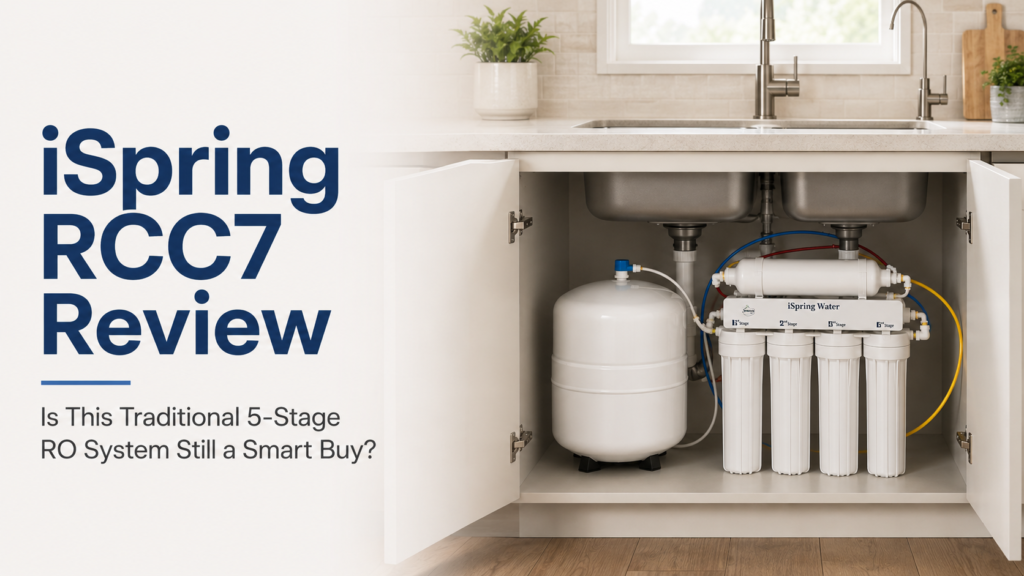
The RCC7 follows a traditional under-sink RO layout. It uses a vertical filter assembly, a separate pressurized storage tank, and a dedicated drinking-water faucet mounted at the sink or countertop.
Current product specifications list dimensions of approximately 15.5 by 5.1 by 18 inches and a listed product weight of about 25 pounds. Because the storage tank is separate, measure the complete cabinet space rather than relying only on the filter assembly dimensions.
The system operates through incoming water pressure and does not require an electrical outlet. That can be helpful in kitchens without power under the sink, though it also means the base model does not include an electric pump to compensate for low feed water pressure.
Model numbers matter with this product family. iSpring sells several related versions, including:
- RCC7AK: Adds a remineralization stage
- RCC7UV: Adds ultraviolet treatment
- RCC7P: Adds a booster pump
- RCC7-BLK and RCC7-BN: Finish-specific variations
These models may share the same basic filtration layout, but their hardware, features, and certification claims are not necessarily identical. Check the exact model number before ordering.
How the Five Filtration Stages Work
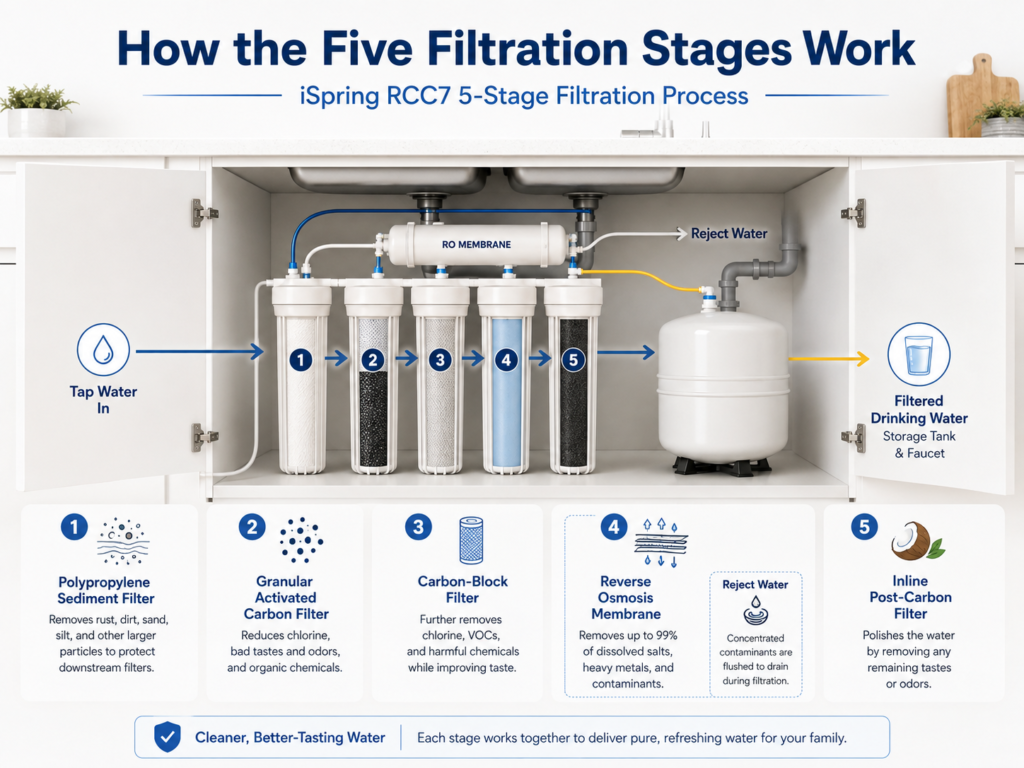
The RCC7 uses a conventional five-stage filtration process. Each filter serves a different purpose.
1. Polypropylene Sediment Filter
The first filter captures larger particles, such as sand, rust, silt, and sediment, before they reach the finer filtration stages.
2. Granular Activated Carbon Filter
The granular activated carbon, or GAC, stage helps reduce chlorine taste and odor while protecting the reverse osmosis membrane from chlorine exposure.
3. Carbon-Block Filter
A denser carbon-block filter provides another layer of chlorine, taste, and odor reduction before the water reaches the membrane.
4. Reverse Osmosis Membrane
The RO membrane is the core filtration stage. It is advertised with a production capacity of up to 75 gallons per day under specified operating conditions and is primarily responsible for reducing dissolved solids.
5. Inline Post-Carbon Filter
Water leaving the storage tank passes through a final carbon polishing filter before reaching the faucet. This final stage is intended to improve taste and odor.
In simple terms, the sediment and carbon filters protect the membrane and address particles, chlorine, taste, and odor. The membrane performs the primary dissolved-solids reduction.
Build Quality and Serviceability
Serviceability is one of the RCC7’s strongest practical advantages.
The system uses standard 10-by-2.5-inch replacement prefilters rather than sealed cartridges designed for only one proprietary housing. Its clear first-stage housing also lets homeowners visually inspect sediment buildup without opening the system.
Individual parts—including filter housings, O-rings, tubing, fittings, valves, and filters—can be serviced or replaced separately. That is different from some integrated tankless systems, in which more components are enclosed in a proprietary cabinet.
Standard sizing can also reduce dependence on one manufacturer for replacement filters. However, homeowners should still use filters that match the system’s specifications. Using unapproved third-party components may affect filtration performance or warranty expectations.
The RCC7’s design is not especially sleek or compact, but it is straightforward. For a homeowner who values replaceable parts and long-term serviceability, that simplicity can be an advantage.
Installation: DIY-Friendly, but Not Effortless
The RCC7 is not a plug-and-play appliance.
A typical installation includes:
- Connecting the system to the cold-water supply
- Installing a drain saddle on the sink drainpipe
- Routing tubing between the filters, membrane, tank, and faucet
- Mounting a separate drinking-water faucet
- Drilling a sink or countertop hole when no spare opening is available
- Positioning both the filter assembly and storage tank
- Flushing the system before use
- Checking each connection carefully for leaks
Installation can take considerably longer than a countertop setup, especially when a new faucet hole must be drilled, or cabinet access is tight.
Common trouble spots can include:
- Tubing that is not inserted fully
- Tubing cut at an angle instead of squarely
- Pinched, dry, or poorly seated O-rings
- Filter housings tightened unevenly
- An incorrectly positioned drain saddle
- Insufficient clearance for future filter changes
Homeowners who are comfortable with basic plumbing may find the installation manageable. Those who are uncomfortable drilling, modifying a drainpipe, or working in a cramped cabinet may prefer professional installation.
Filtration Performance and Certification
The RCC7’s advertised membrane production rating is 75 gallons per day under specified conditions. However, the current NSF listing for the exact base model reports a certified daily production rate of approximately 21.04 gallons per day under formal NSF test conditions.
Those two figures should not be treated as directly interchangeable. Different testing conditions can produce significantly different results.
Actual household production can vary with:
- Feed-water pressure
- Water temperature
- Incoming TDS
- Membrane condition
- Filter condition
- Tank pressure
The current NSF listing reviewed for the exact base RCC7 verifies TDS reduction under NSF/ANSI 58.
That does not necessarily mean the system does not affect other substances. It means those additional reductions were not verified by the specific certification listing reviewed for the base model.
iSpring markets the RCC7 as reducing a broad range of contaminants, but homeowners purchasing a system for lead, fluoride, arsenic, PFAS, microplastics, chloramine, or another specific concern should review the current model-specific performance data before buying.
Testing your water first is the safest way to determine which filtration claims matter for your household.
Living With a Pressurized Storage Tank
The storage tank is both one of the RCC7’s conveniences and one of its most significant compromises.
While the tank contains filtered water, the faucet can provide water immediately. As the tank empties, flow declines and the system must produce additional water through the membrane before full delivery returns.
For routine drinking water, coffee, and cooking, this setup may work well. It is less convenient to repeatedly fill several large pots or containers because household demand can outpace the tank’s and membrane’s recovery rates.
The tank and filter assembly also occupy a meaningful portion of the cabinet. Homeowners should measure around garbage disposals, drainpipes, cleaning supplies, pull-out shelves, and other obstacles before ordering.
Traditional RO tank ownership also involves:
- Periodic tank sanitation
- Checking tank air pressure when performance declines
- Inspecting tubing and fittings
- Replacing filters on schedule
- Watching for changes in taste, odor, flow, or TDS
These tasks are manageable, but the system is not maintenance-free.
Maintenance and Long-Term Cost
The primary ongoing expense is filter replacement.
Sediment and carbon filters generally require replacement more frequently than the membrane. Actual replacement intervals depend on incoming water quality, chlorine levels, sediment loading, and household water use.
When researched, iSpring’s official one-year replacement pack without the membrane was priced at approximately $49. A complete five-filter replacement set, including the RO membrane, was approximately $75.
Replacement-pack pricing changes, so verify current costs before estimating long-term ownership expenses.
The advantage is that the RCC7 uses standard-sized filters, which can make ongoing costs more predictable than with systems that require proprietary sealed cartridges.
Maintenance may also include:
- Inspecting and lubricating O-rings
- Cleaning filter housings
- Sanitizing the storage tank and system
- Checking connections for slow leaks
- Monitoring changes in water flow
- Testing filtered-water TDS when performance is in question
For homeowners comfortable performing routine maintenance, the RCC7 can be economical to keep operating.
iSpring RCC7 vs. a Modern Tankless RO System
Neither design is universally better. The right choice depends on which compromises matter most in your kitchen.
Our Waterdrop G3P800 review covers a premium tankless design built around a very different set of priorities.
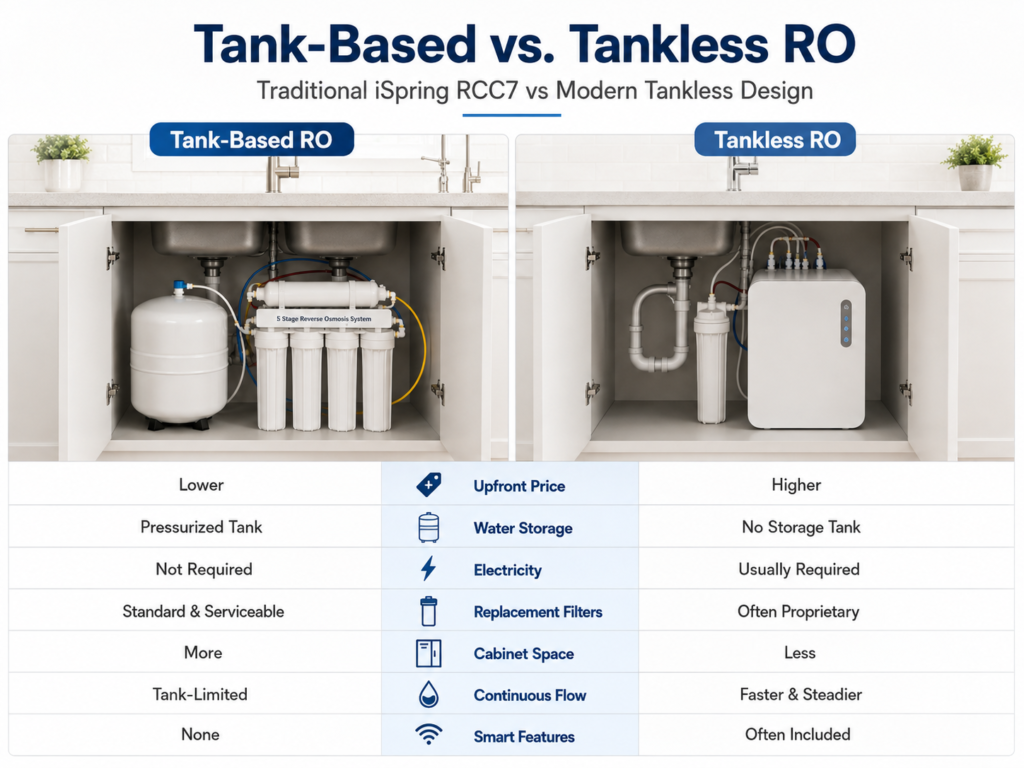
| Factor | iSpring RCC7 | Modern Tankless RO |
| Upfront price | Generally lower | Generally higher |
| Water storage | Pressurized tank | Usually no storage tank |
| Electricity | Not required | Usually required |
| Replacement filters | Standard-sized and serviceable | Often proprietary |
| Cabinet space | Tank plus filter assembly | Usually a slimmer integrated housing |
| Continuous flow | Limited by tank and recovery | Usually faster and steadier |
| Smart features | None | Often includes indicators or displays |
| Repair complexity | Mechanically simple | May include pumps, sensors, and electronics |
| Wastewater efficiency | Varies with operating conditions | Often marketed as more efficient |
A tankless system may be worth the higher price when cabinet space, continuous flow, filter-life indicators, and convenience matter most.
The RCC7 has the advantage when purchase cost, mechanical simplicity, standard filters, and freedom from an electrical outlet are more important.
Compare the RCC7 with our top reverse osmosis picks before deciding which layout best fits your home.
Pros and Cons
Potential Pros
- Comparatively affordable purchase price
- NSF-certified for TDS reduction on the exact base model
- No electrical outlet required
- Standard, widely available replacement filters
- Conventional, repairable layout
- Transparent first-stage housing
- Replaceable tubing, fittings, housings, and O-rings
- Established manufacturer support resources
Potential Cons
- Consumes considerable under-sink cabinet space
- Requires a separate faucet and drain connection
- Installation is more involved than a countertop system
- No smart indicators or filter-life tracking
- No integrated leak detector
- Limited high-volume delivery after the tank is depleted
- Exact base-model certification is narrower than some broader marketing language may suggest
- Reject-water efficiency was not clearly documented in the current official sources reviewed
Who Should Buy the iSpring RCC7?
The RCC7 makes the most sense for homeowners who:
- Want an affordable under-sink RO system
- Have sufficient room for the tank and filter assembly
- Have adequate incoming water pressure
- Are comfortable changing filters
- Prefer standard parts over proprietary cartridges
- Do not need a digital display or smart monitoring
- Primarily need filtered water for drinking and everyday cooking
- Value repairability and predictable maintenance
For this buyer, the RCC7’s older design can be a strength rather than a drawback.
Who Should Skip It?
The RCC7 may not be the best option for:
- Renters who cannot alter plumbing or drill a faucet hole
- Kitchens with very limited cabinet space
- Homeowners who want fast continuous flow
- Buyers who prefer automatic filter-life tracking
- Homes with inadequate water pressure and no booster-pump plan
- People who want simple countertop installation
- Buyers needing certification for a specific contaminant not listed for the base RCC7
- Anyone unwilling to perform periodic filter changes and tank sanitation
Renters or homeowners who cannot modify plumbing may prefer a countertop reverse osmosis system instead.
Final Verdict
The iSpring RCC7 remains a strong value for homeowners who prioritize affordability, standard replacement filters, mechanical simplicity, and repairability.
It is less compelling for buyers who place a higher value on compact packaging, continuous high flow, smart features, documented wastewater efficiency, or minimal installation work.
The system’s biggest strength is not that it offers the newest technology. It is that its conventional design is understandable, serviceable, and relatively inexpensive to maintain.
That makes the RCC7 a sensible choice for the right kitchen—but not the best choice for every homeowner.
Readers still comparing their options can review our guide to the best reverse osmosis systems for home use. Those new to the technology can also read “What Is Reverse Osmosis and How Does It Work?”
Frequently Asked Questions
Is the iSpring RCC7 NSF certified?
The current NSF listing reviewed for the exact base RCC7 verifies TDS reduction under NSF/ANSI 58. The listing reviewed does not provide certification for every contaminant mentioned in broader marketing materials.
What is the difference between the RCC7 and RCC7AK?
The RCC7AK adds a remineralization stage that is not included in the standard five-stage RCC7. Always verify the exact model number before purchasing.
Does the RCC7 require electricity?
No. The base RCC7 operates through incoming water pressure and does not require an electrical outlet.
Does the RCC7 reduce fluoride?
The exact base-model NSF listing reviewed verifies TDS reduction, not fluoride reduction specifically. Check the current model-specific performance data when fluoride reduction is the primary reason for purchasing the system.
How often do the filters need to be replaced?
Replacement timing depends on source-water quality and household use. Sediment and carbon filters generally require replacement more frequently than the RO membrane.
Is the RCC7 difficult to install?
It may be manageable for someone comfortable with basic plumbing, but it is not effortless. Installation requires a cold-water connection, drain saddle, dedicated faucet, tubing connections, system flushing, and possibly drilling.
Does it require a separate faucet?
Yes. The RCC7 supplies filtered water through a dedicated drinking-water faucet installed beside the main kitchen faucet.
Is a tankless RO system better?
Not for every household. Tankless systems usually provide a smaller footprint, faster continuous flow, and more convenience features. The RCC7 offers a lower upfront cost, no electrical requirement, standard filters, and simpler mechanical components.
As an Amazon Associate, BuildSafeHome earns from qualifying purchases
This article may contain affiliate links. BuildSafeHome may earn a commission at no extra cost to you