Affiliate Disclosure: This article may contain affiliate links. BuildSafeHome may earn a commission at no extra cost to you.
Product Update: The AQ-5200 is an earlier version of Aquasana’s Claryum 2-Stage under-sink system. Aquasana now sells the updated AQ-6200 generation. If you’re shopping for a new system today, the current Claryum 2-Stage is the model to consider.
View the Current Aquasana Claryum 2-Stage System
If you’ve spent any time comparing under-sink water filters, you’ve probably noticed that reverse osmosis systems dominate the conversation. They’re effective, but they also come with a storage tank, a wastewater line, extra cabinet space, and in some models an electrical connection. That’s a lot of commitment for someone who wants cleaner water at the kitchen sink.
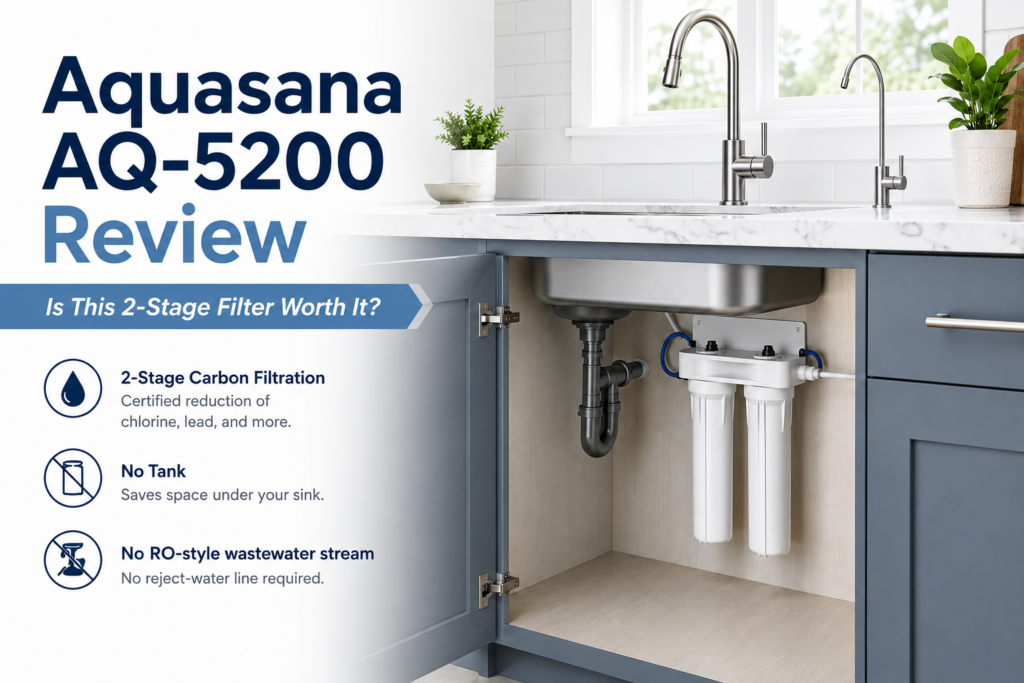
The Aquasana AQ-5200 takes a different approach. It’s a non-RO, two-stage under-counter filter built around Aquasana’s Claryum filtration media, designed to reduce a wide range of common municipal water contaminants without a tank, a drain line, or added complexity.
This Aquasana AQ-5200 under-counter water filter review looks at what the system actually does, where it falls short compared with reverse osmosis, and who it makes sense for.
The Short Answer
The AQ-5200 is a solid choice for households on municipal water that want certified contaminant reduction — think lead, chlorine, PFOA/PFOS, and similar concerns without taking on the footprint and maintenance of a reverse osmosis setup. It installs relatively simply, doesn’t create an RO-style reject-water stream, and doesn’t need electricity.
It may not be the right tool if your main concern is dissolved solids, fluoride, nitrates, arsenic, or water hardness. Those concerns may require reverse osmosis or another treatment method designed for dissolved contaminants. The decision mostly comes down to what’s actually in your water and what you’re trying to address.
Aquasana AQ-5200 at a Glance
| Feature | AQ-5200 |
| Filter type | Claryum 2-Stage: activated carbon, catalytic carbon, ion exchange, sub-micron filtration |
| System type | Non-reverse-osmosis |
| Electricity required | No |
| Storage tank | None |
| Wastewater/drain line | None |
| Dedicated faucet | Yes, included |
| Filter replacement | Up to 6 months or 500 gallons, whichever comes first |
| Certification | WQA tested and certified to applicable NSF/ANSI standards |
| Best fit | Municipal-water households wanting certified reduction without RO complexity |
Check Current Aquasana Claryum 2-Stage Pricing
How the AQ-5200 Filters Water
The AQ-5200 is part of Aquasana’s Claryum 2-Stage line, and filtration occurs as water flows through to the dedicated faucet. There’s no RO membrane, no pressurized storage tank, and no waiting for a tank to refill before filtered water is available.
Inside the two filter stages, the system combines several filtration approaches rather than relying on a single method. Activated carbon and catalytic carbon help reduce chlorine, chloramine, and certain organic contaminants. Ion-exchange media help reduce specific contaminants, while the carbon and sub-micron media handle other certified targets.
None of this involves a reverse osmosis membrane, so the system isn’t forcing water through a semi-permeable barrier under pressure. That’s the core reason it doesn’t need electricity, doesn’t produce an RO-style reject-water stream, and doesn’t require a storage tank.
It’s also why it doesn’t reduce dissolved solids the way reverse osmosis does.
What Does the Aquasana AQ-5200 Reduce?
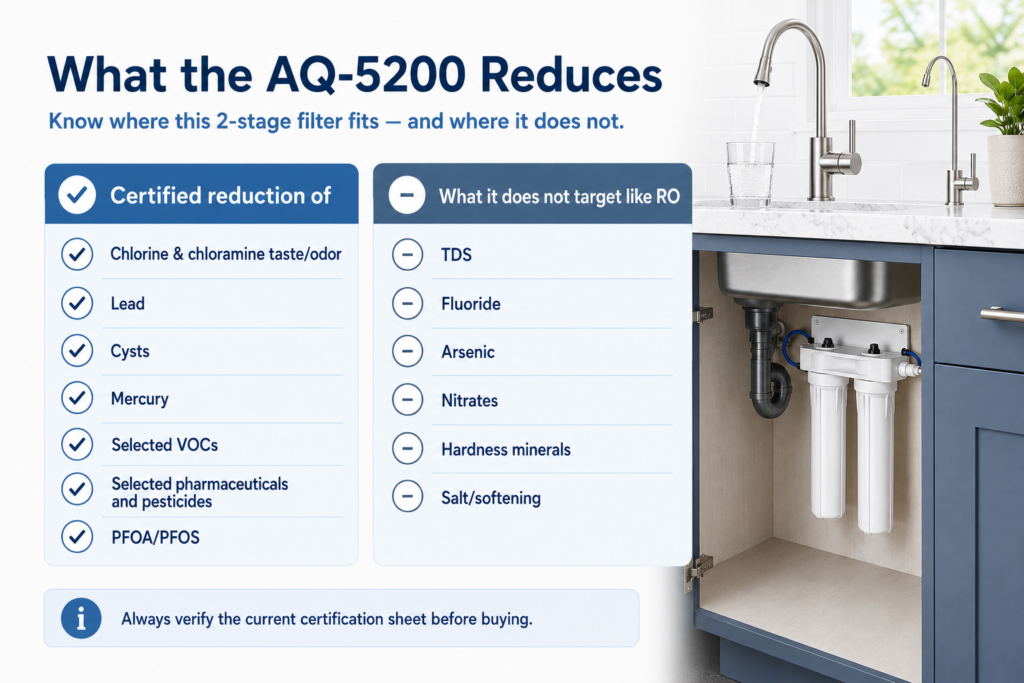
Aquasana’s Claryum 2-Stage system is WQA tested and certified to applicable NSF/ANSI standards covering a mix of aesthetic, health-effect, and emerging-contaminant categories.
In practical terms, certified reduction claims include contaminants such as:
- Lead
- Chlorine and chloramine
- PFOA/PFOS
- Mercury
- Cysts
- Selected volatile organic compounds (VOCs)
- Selected pharmaceuticals
- Selected pesticides and herbicides
- Microplastics
That’s a meaningful list, and it covers many of the contaminants homeowners on municipal water systems commonly think about, including taste and odor from chlorine, lead from older plumbing, and certain PFAS compounds.
It’s worth being precise about what “certified” means, though.
Certification applies to specific contaminants under specific test conditions, not to an entire broad category. A claim covering selected pharmaceuticals doesn’t mean every pharmaceutical compound is reduced, and a PFOA/PFOS claim doesn’t extend to every PFAS chemical.
If one contaminant matters to you in particular, it’s worth checking Aquasana’s current performance data sheet for the exact substance and reduction claim.
What the AQ-5200 Does NOT Do
This is one of the most useful parts of the review because it’s where buyers can easily form the wrong expectations.
Because the AQ-5200 isn’t reverse osmosis, it isn’t designed for substantial reduction of:
- Total dissolved solids (TDS)
- Fluoride
- Nitrates
- Arsenic
- Hardness minerals such as calcium and magnesium
It’s also not a water softener, so if hard water is your main problem — scale buildup, spotting on dishes, or soap performance — this isn’t the product designed to solve it.
That doesn’t make the AQ-5200 a lesser product. It means it’s solving a different problem than reverse osmosis.
RO membranes work by forcing water through a barrier that can reduce many dissolved solids, salts, and other contaminants. That’s what gives RO systems their broader dissolved-solids reduction profile, and it’s also why they usually involve more components and a wastewater stream.
The AQ-5200 takes a simpler approach using carbon, ion exchange, and mechanical filtration. Those methods can be effective for the contaminants they’re designed and certified to reduce, but they don’t treat dissolved solids in the same way.
The practical takeaway is simple: know what’s actually in your water before deciding between the two.
Your municipal water report can help show whether fluoride, nitrates, arsenic, hardness, chlorine, or other contaminants are relevant concerns in your area.
AQ-5200 vs Reverse Osmosis
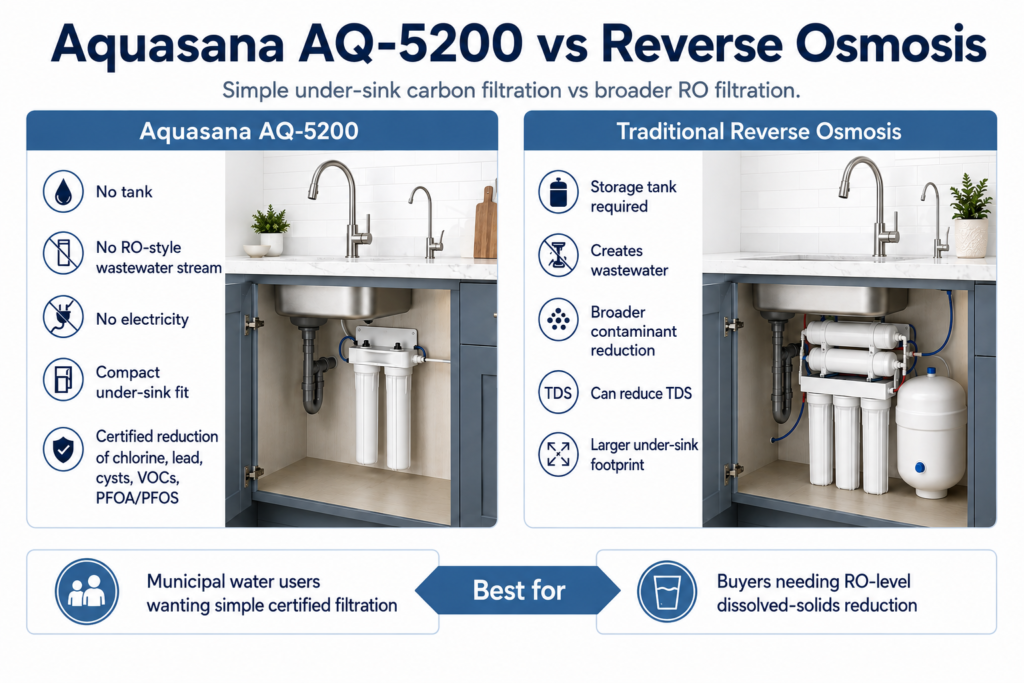
Rather than declaring one type of system better, it’s more useful to look at what each one is designed to do.
Where the AQ-5200 Has the Advantage
- No storage tank, so less cabinet space is used
- No RO-style reject-water stream
- No electricity required
- Simpler under-sink footprint overall
- Dissolved mineral content generally remains in the water
- Certified reduction of many common municipal-water contaminants
Where Reverse Osmosis Has the Advantage
- Broader reduction of dissolved solids
- Better suited when fluoride, nitrates, TDS, arsenic, or similar dissolved contaminants are a primary concern
- A different level of treatment when the source water requires more extensive dissolved-contaminant reduction
More filtration isn’t automatically the better choice if you don’t need it.
If your water report doesn’t show dissolved contaminants that require RO-style treatment, the extra components and wastewater of a conventional RO system may not provide much benefit for your specific situation.
If those contaminants are present, RO may be the more appropriate tool.
If you’re weighing the two approaches more seriously, a guide to the best reverse osmosis systems for home use, or an explanation of what reverse osmosis is and how it works, can help clarify the trade-offs.
Installation: How Difficult Is It?
The AQ-5200 connects to your cold-water line under the sink, and routes filtered water to its own dedicated faucet.
Because there’s no storage tank or RO membrane assembly to fit, the overall footprint under the sink is smaller than a typical tank-based RO system. There’s also no drain-line connection required for reject water.
That said, simpler than RO doesn’t mean effortless.
The dedicated faucet needs somewhere to go. If your sink or countertop doesn’t already have an unused opening from a sprayer, soap dispenser, or similar fixture, you may need to drill one.
That’s worth confirming before you buy.
Cabinet space and plumbing access also matter. A crowded cabinet with tight plumbing runs can make even a relatively straightforward installation more time-consuming.
Homeowners who are comfortable with basic plumbing may be able to handle the installation themselves. If drilling a new faucet hole or working around tight plumbing isn’t something you’re comfortable doing, hiring a plumber may be the easier route.
Is the AQ-5200 Good for Renters?
It can be, but it depends on the setup.
If your sink already has an unused hole for the dedicated faucet and the installation can be reversed when you move, the AQ-5200 can be a reasonable option for a rental.
It gets more complicated when drilling is required.
Adding a new hole to a sink or countertop isn’t easily reversible, so that may require landlord permission.
This isn’t a universally renter-friendly system. It depends on the plumbing, the available faucet openings, and what changes your landlord allows.
Filter Replacement and Long-Term Cost
The AQ-5200’s two filters are rated for up to 6 months or 500 gallons, whichever comes first, and they’re replaced together as a set.
For many households, that means planning on roughly two replacement cycles per year.
Aquasana has recently priced the Claryum 2-Stage replacement filter set at roughly $70, and its Water for Life subscription program offers a discount for recurring shipments.
Pricing can change, so it’s better to treat that as a current range rather than a permanent number.
The bigger issue is total cost of ownership.
Replacing filters twice a year adds a recurring expense on top of the original system price. Over two or three years, that can become a meaningful part of the AQ-5200’s actual ownership cost.
Before buying any under-sink filter, it’s worth looking beyond the initial purchase price and considering the replacement filter schedule in your decision.
Pros and Cons
Pros
- Certified reduction of many high-priority municipal-water contaminants, including lead, chlorine/chloramine, PFOA/PFOS, and microplastics
- No RO wastewater stream
- No storage tank taking up cabinet space
- No electricity required
- Compact, relatively simple under-sink footprint
- Includes a dedicated filtered-water faucet
- Retains more dissolved mineral content than an RO system typically would
Cons
- Replacement filters are a recurring expense
- Requires installing a dedicated faucet, which may mean drilling
- Not designed for substantial TDS reduction
- Not the right fit for buyers focused on fluoride, nitrates, arsenic, or hardness
- Filters need replacement every 6 months or 500 gallons, whichever comes first
Who Should Buy the Aquasana AQ-5200?
The AQ-5200 makes the most sense for:
- Municipal-water households looking for certified reduction of contaminants such as lead, chlorine, and PFOA/PFOS
- Buyers who want under-sink filtration without the complexity of reverse osmosis
- Households that specifically want to avoid an RO wastewater stream
- Homeowners comfortable keeping up with scheduled filter replacement
Who Should Skip It?
Consider a different system if you are:
- Specifically trying to reduce fluoride, nitrates, arsenic, TDS, or water hardness
- Looking for broader dissolved-solids reduction
- Not interested in ongoing replacement-filter costs
- Renting where drilling for a dedicated faucet isn’t allowed
- Looking for whole-house filtration rather than a single point-of-use faucet
Final Verdict
The Aquasana AQ-5200 is a practical option for homeowners who want strong, certified filtration at the kitchen sink without taking on the tank, wastewater line, and added footprint that come with conventional reverse osmosis systems.
Its biggest strengths are simplicity: no electricity, no RO-style reject-water stream, a smaller under-sink footprint, and certified reduction of contaminants that matter to many municipal-water households.
Its limitations are just as important.
Replacement filters represent a recurring cost, and the system isn’t designed for broad reduction of dissolved solids, fluoride, nitrates, arsenic, or hardness. If those are your priorities, reverse osmosis or another treatment method may be the better fit.
Whether the AQ-5200 is worth it comes down to what’s in your water and what you’re trying to address.
For concerns such as lead, chlorine, PFOA/PFOS, and other certified municipal water contaminants, it’s a practical, lower-complexity option.
For dissolved solids or hardness, it’s simply the wrong tool for the job.
Check Current Aquasana Claryum 2-Stage Pricing
As an Amazon Associate, BuildSafeHome earns from qualifying purchases
This article may contain affiliate links. BuildSafeHome may earn a commission at no extra cost to you