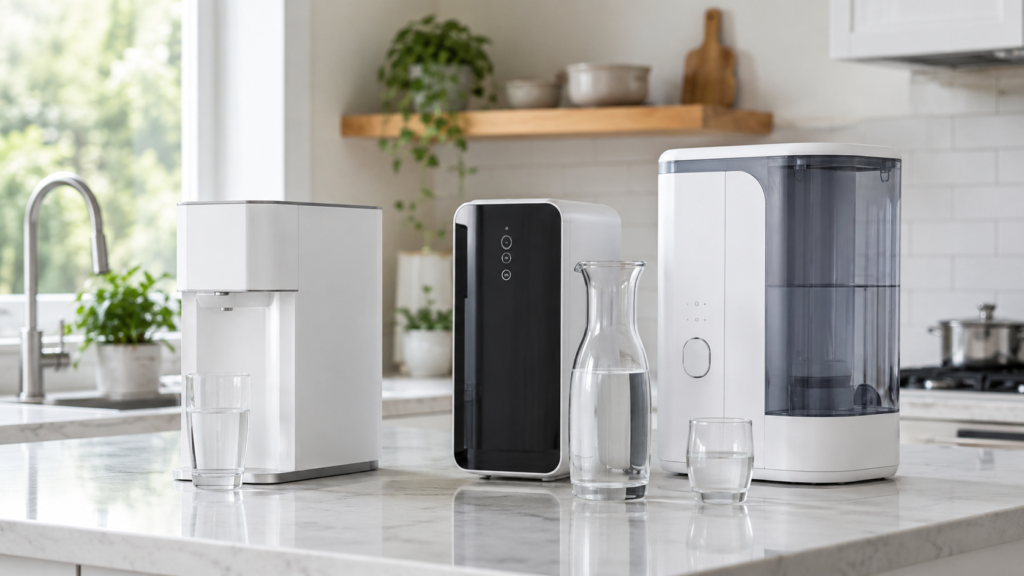
A countertop reverse osmosis drinking system provides RO-filtered water without permanent plumbing work, making it appealing to renters and homeowners who don’t want to modify a kitchen supply line. Instead of installing a unit under the sink, you fill a reservoir, plug in the unit, and let it process water into a separate clean-water tank or carafe.
This guide compares six countertop RO systems using manufacturer specifications, certification information, and available third-party testing. We focused on verified performance, evidence of contaminant reduction, filter costs, capacity, and practical fit rather than on stage counts or marketing claims alone.
Quick verdict: The AquaTru Classic is our overall recommendation for its strong third-party certification and practical balance of capacity and countertop convenience. It isn’t the best choice for every household, though. The SimPure Y7P-BW is worth considering if value and independent laboratory testing are priorities. The Waterdrop A1 stands out for hot and cold dispensing, while the AquaTru Carafe is a strong choice for smaller households that prefer a glass carafe.
Quick Comparison
| Model | Best For | Capacity / Output | Filtration | Certification / Testing |
| AquaTru Classic | Best overall | ~0.75-gal clean tank, ~1-gal feed tank | Multi-stage carbon + RO | Strong IAPMO certification evidence |
| SimPure Y7P-BW | Best value | 100 GPD rated | 5-stage + UV | Independent SGS testing using NSF/ANSI 58-related protocols |
| Waterdrop A1 | Best hot & cold | Countertop reservoir system | RO + temperature control | Use model-specific certification documentation |
| AquaTru Carafe | Best compact/glass | ~0.5-gal glass carafe | Multi-stage carbon + RO | IAPMO certification to applicable NSF/ANSI standards for specified claims |
| Bluevua ROPOT-Lite(UV) | Best glass/remineralization alternative | Countertop reservoir system | RO + UV | WQA/NSF/ANSI 58 certification documentation associated with model family |
| iSpring RCD100 | Best instant hot | 100 GPD rated | 5-stage + UV | Independent SGS testing available |
Countertop RO Systems Reviewed
1. AquaTru Classic: Best Overall
Best for: Households wanting strong third-party certification evidence in a countertop format.
The AquaTru Classic is a batch-style countertop RO system that requires no permanent plumbing. You fill its roughly 1-gallon feed tank, plug the unit into an electrical outlet, and the system processes water through multi-stage filtration combining activated carbon with reverse osmosis. Purified water collects in an approximately 0.75-gallon clean-water tank and is dispensed at ambient temperature.
AquaTru states that the Classic reduces 84 contaminants and backs its performance with IAPMO certification. That’s an important distinction from a manufacturer simply making contaminant-reduction claims without third-party certification.
Filter replacement intervals vary by filter type, from roughly six months to as long as two years. That spreads maintenance across different intervals rather than requiring every filter to be replaced at once.
Key considerations: The standard Classic doesn’t include UV or remineralization, and it takes up more counter space than compact carafe-style systems.
Pros
- Strong third-party certification evidence
- No permanent plumbing required
- Practical clean-water capacity
- Staggered filter replacement intervals
Cons
- Higher price than budget alternatives
- Takes up meaningful countertop space
- No remineralization in the standard configuration
2. SimPure Y7P-BW: Best Value
Best for: Buyers looking for a lower-cost countertop RO system backed by independent laboratory testing.
The SimPure Y7P-BW is rated at 100 gallons per day (GPD) and uses 5-stage filtration, including UV. It requires no permanent plumbing and measures approximately 18 x 8 x 16.1 inches while weighing about 14.8 pounds.
SimPure states a purified-to-drain water ratio of approximately 4:1. The Y7P-BW has also been independently tested by SGS using NSF/ANSI 58-related test protocols, with SGS reporting reductions across multiple contaminants.
It’s important to distinguish independent laboratory testing from product certification. SGS test results provide useful third-party evidence, but they aren’t the same as an ongoing certification program in which a certifying organization verifies a specific model and its approved performance claims.
Manufacturer-stated filter costs run around $100 per year, making ongoing maintenance another reason the SimPure deserves consideration as a value option.
Key considerations: If formal third-party certification is a priority, compare SimPure’s independent test documentation with that of models carrying certification to specific NSF/ANSI standards.
Pros
- Competitive stated filter costs
- Independent SGS testing available
- UV included
- No permanent plumbing required
- Strong value-oriented feature set
Cons
- Independent testing isn’t the same as ongoing product certification
- Larger footprint than some compact carafe-style models
3. Waterdrop A1: Best Feature-Rich Hot & Cold System
Best for: Buyers wanting RO filtration plus built-in hot, cold, and ambient water dispensing.
The Waterdrop A1 combines countertop RO filtration with temperature-controlled dispensing. It requires electricity but no permanent plumbing, making it more like a self-contained water appliance than a basic countertop purifier.
Its biggest advantage is convenience. Instead of filtering water and then heating or chilling it separately, the A1 provides hot, cold, and ambient dispensing with multiple temperature and volume controls.
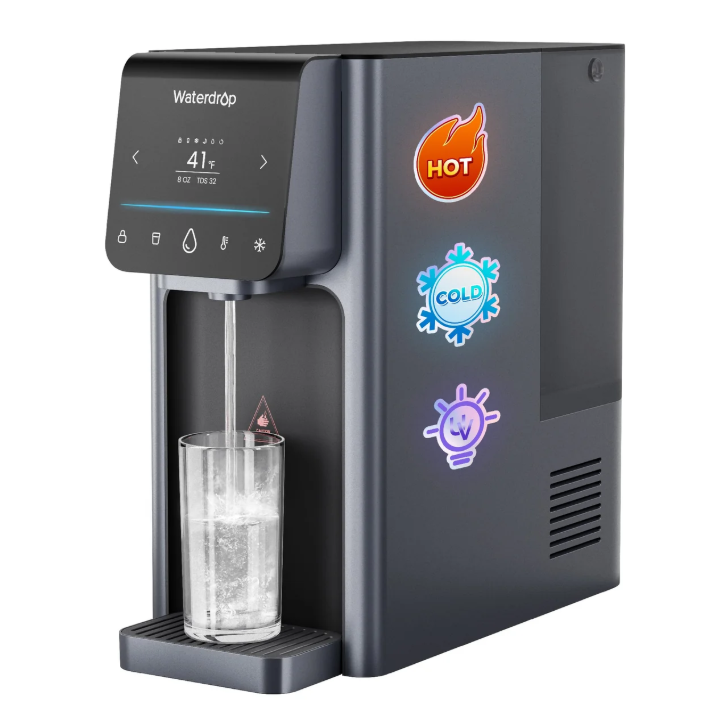
That additional functionality also adds complexity. Pumps, heating and cooling components, electronics, and dispensing controls mean there are more components involved than with a simple ambient-only RO system.
The certification language deserves particular attention in this model. Don’t assume that references to NSF/ANSI/CAN 372 mean the system is certified to remove lead. NSF/ANSI/CAN 372 addresses lead content in the materials that come into contact with water. It doesn’t demonstrate that a filter reduces lead already present in drinking water.
Key considerations: If hot and cold dispensing isn’t important to you, a simpler ambient-only countertop RO system may offer everything you need with less appliance complexity.
Pros
- Hot, cold, and ambient dispensing
- No permanent plumbing required
- Multiple temperature and dispensing options
- Combines filtration and dispensing in one appliance
Cons
- More mechanical and electronic complexity
- Fully dependent on electricity
- Potentially higher long-term maintenance costs
Check Current Waterdrop A1 Pricing
4. AquaTru Carafe: Best Compact Glass-Carafe System
Best for: Smaller households or kitchens with limited counter space that still want strong certification documentation.
The AquaTru Carafe puts the company’s countertop RO system into a smaller package. It measures approximately 13 x 14 x 7.5 inches and weighs about 9 pounds. The system uses a roughly 2.5-liter feed tank and dispenses purified water into a removable 1.9-liter (approximately half-gallon) borosilicate glass carafe.
Like the Classic, it requires no plumbing and operates from a 120V electrical outlet.
AquaTru’s performance documentation identifies IAPMO certification in accordance with the applicable NSF/ANSI 42, 53, 58, 372, and 401 standards for specified claims. The important phrase is for specified claims. Certification to a standard doesn’t automatically mean every possible contaminant covered by that standard is included.
AquaTru also offers an Alkaline Mineral Boost filter option for the Carafe line. That’s an available configuration rather than a feature included with every Carafe, so check the version you’re buying if remineralization matters to you.
Key considerations: The smaller clean-water capacity makes the Carafe easier to fit into a small kitchen, but higher-use households may find themselves processing and refilling water more frequently.
Pros
- Compact countertop footprint
- Strong certification documentation
- Removable borosilicate glass carafe
- Optional Alkaline Mineral Boost filter
- No plumbing required
Cons
- Smaller clean-water capacity than the Classic
- May require more frequent refilling for larger households
5. Bluevua ROPOT-Lite(UV): Best Glass and Remineralization Alternative
Best for: Buyers interested in a countertop RO alternative with glass and remineralization-oriented features.
The Bluevua ROPOT-Lite(UV) offers another approach for shoppers who prioritize a glass-oriented countertop design and remineralization. Bluevua publishes certification information for its RO products, and WQA has associated the ROPOT-Lite (UV) model family with NSF/ANSI 58.
As with any certified water-treatment product, check the current model-specific certification and performance documentation for the contaminants you actually want to reduce. A certification standard by itself shouldn’t be interpreted as proof that every optional contaminant claim under that standard applies to a particular system.
That distinction matters especially when comparing products using broad claims such as “NSF certified” without explaining what was actually certified.
Key considerations: Bluevua is particularly interesting for buyers who value glass and remineralization. Review the current model-specific performance documentation before choosing it for a specific contaminant concern.
Pros
- Glass-oriented design
- Remineralization-related features
- Third-party certification documentation associated with the model family
- Countertop installation with no permanent plumbing
Cons
- Model-specific contaminant claims require careful verification
- Certification information can take more effort to interpret than with some competitors
6. iSpring RCD100: Best Instant Hot
Best for: Buyers wanting RO-filtered water plus on-demand heated water for tea, coffee, or cooking.
The iSpring RCD100 is rated at 100 GPD and uses 5-stage filtration, including UV. It requires no permanent plumbing and provides four temperature options: room temperature, 120°F, 185°F, and 205°F.
That makes it particularly useful for someone who regularly wants hot filtered water without using a separate kettle.
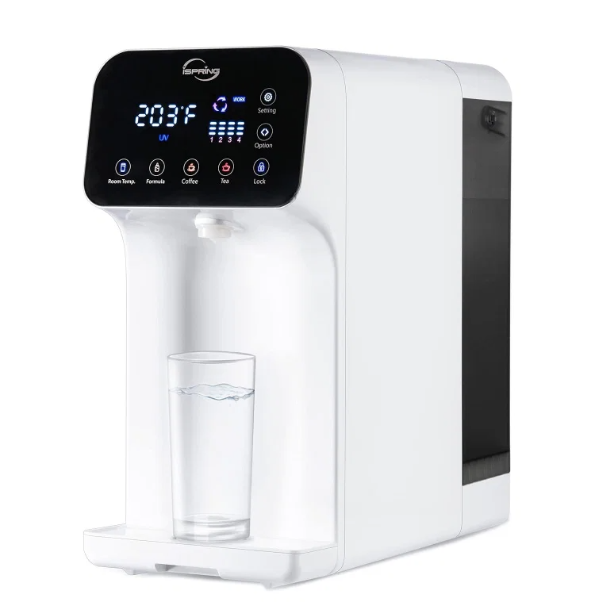
One important distinction is that the RCD100 provides ambient and heated water options, not cold water. It therefore isn’t a direct hot-and-cold equivalent to the Waterdrop A1.
iSpring states an approximate 2.5:1 purified-to-drain water ratio, and independent SGS contaminant testing is available. As with the SimPure, independent SGS laboratory testing shouldn’t be described as NSF certification.
Key considerations: If you specifically want chilled filtered water on demand, this isn’t the model for that job. Its advantage is instant heated water.
Pros
- Multiple heated temperature options
- Near-boiling water available
- Independent SGS testing
- No permanent plumbing required
- UV included
Cons
- No refrigerated cold-water dispensing
- Independent testing isn’t the same as ongoing product certification
Check Current iSpring RCD100 Pricing
How Countertop Reverse Osmosis Works
Countertop RO systems push water through several treatment stages, typically including activated carbon filtration followed by reverse osmosis. Purified water is then stored in a separate tank or carafe.
Activated carbon commonly removes chlorine, improves taste and odor, and helps protect chlorine-sensitive RO membranes. The RO membrane then reduces the concentration of a broader range of dissolved substances as water passes through it.
If you want a deeper explanation of the process, see our guide, What Is Reverse Osmosis and How Does It Work?
How to Choose a Countertop RO System
Choosing a countertop reverse osmosis drinking system comes down to matching the equipment to your household and water concerns rather than chasing the highest filtration-stage count.
Start With Certification and Verified Performance
Look for third-party certification and read the actual performance sheet.
NSF/ANSI 42 addresses aesthetic effects such as chlorine taste and odor for specified claims. NSF/ANSI 53 covers specified contaminants with health effects. NSF/ANSI 58 is specifically for reverse osmosis drinking-water treatment systems and includes required RO performance criteria and optional contaminant-reduction claims.
NSF/ANSI 401 covers certain emerging or incidental compounds for specified claims. NSF/ANSI/CAN 372 addresses lead content in a product’s wetted materials. It doesn’t prove that a system removes lead already present in drinking water.
WQA and IAPMO are legitimate third-party organizations that can certify products to applicable NSF/ANSI standards. Independent laboratory testing from organizations such as SGS can also provide useful evidence, but testing and certification aren’t interchangeable terms.
Match the System to Your Water
If lead, arsenic, fluoride, nitrate, chromium, PFAS, or total dissolved solids are concerns, check the exact performance or certification documentation for the model you’re considering.
Don’t assume that every RO system reduces every contaminant equally simply because it uses reverse osmosis.
Compare Water Efficiency Carefully
All RO systems produce a concentrated reject-water stream as part of the filtration process.
Older or inefficient RO units can use several gallons of water for every gallon of treated water produced. Modern high-efficiency systems can substantially reduce that amount.
When comparing manufacturer-stated ratios such as 2:1, 3:1, or 4:1, check which way the ratio is expressed. A 3:1 purified-water-to-reject-water ratio means something very different from a 3:1 reject-water-to-purified-water ratio.
Consider the Real Cost of Ownership
Purchase price is only part of the cost.
Check:
- Replacement-filter prices
- How often each filter needs replacement
- Whether replacement filters are readily available
- Whether different filters have different service intervals
A less expensive RO system can become costly if it requires frequent proprietary filter replacements.
Think About Everyday Convenience
Reservoir capacity, processing speed, countertop footprint, and dispensing options matter more in daily use than they may appear to when comparing specifications online.
A smaller system can be easier to fit into a kitchen but requires more frequent refilling. Hot or cold dispensing may eliminate the need for another appliance but adds mechanical complexity.
Also remember that countertop doesn’t automatically mean off-grid. Most countertop RO systems in this comparison require electricity and may not operate during a power outage without a backup power source.
Don’t Buy Based on Stage Count Alone
A system advertising eight or ten stages isn’t automatically better than one using four or five.
What matters more is what each stage actually does, the quality of the membrane and filter media, the materials that contact your water, the pump and other components, replacement-filter availability, and verified performance.
Certification and documented contaminant reduction tell you far more than stage count alone.
Countertop vs. Under-Sink Reverse Osmosis
Countertop RO isn’t automatically better than an under-sink system. The better choice depends on your home and how much filtered water you use.
Countertop RO tends to make sense for renters and apartment dwellers who can’t or don’t want to modify plumbing. It’s also useful for smaller households, people who value portability, and buyers interested in specialized dispensing features such as instant hot or chilled water.
Under-sink RO often makes more sense for larger households and people with higher daily needs for drinking and cooking water. Because it’s connected directly to the water supply, there’s no reservoir to refill manually. It also keeps the filtration equipment off the countertop.
If you’re deciding between the two formats, see our guide to the Best Reverse Osmosis Systems for Home Use for a broader comparison of RO options.
What About Well Water and Hard Water?
Countertop RO shouldn’t automatically be recommended for untreated private well water.
If your home uses a private well, test the water first. Sediment can shorten filter life, while iron and manganese can create treatment problems. Microbiologically unsafe water may require disinfection or other treatment before a countertop RO system is appropriate.
Depending on the test results, pretreatment may be necessary.
Hardness is related but different. Reverse osmosis can reduce dissolved hardness minerals such as calcium and magnesium, but significant hardness can also contribute to scale forming on the RO membrane. Over time, scaling can reduce performance and shorten membrane life.
If hardness throughout the home is the primary problem, particularly scale affecting fixtures, appliances, and water heaters, a countertop RO system isn’t a replacement for a whole-house water softener. The two systems are designed to solve different problems.
Frequently Asked Questions
Are countertop reverse osmosis systems worth it?
They can be, particularly for renters, smaller households, or anyone who wants RO-filtered drinking water without modifying plumbing. Whether one is worth the cost depends on your water concerns, household usage, available counter space, and maintenance budget.
Do countertop RO systems need plumbing?
The six systems covered in this guide don’t require permanent plumbing. You fill a feed-water tank or reservoir, and the unit processes water into a separate clean-water tank or carafe.
Most powered countertop RO systems still require an electrical outlet.
How much water does countertop RO waste?
It depends on the system. RO produces both purified water and a concentrated reject-water stream. Older or inefficient systems may use several gallons of water for every gallon of treated water, while newer high-efficiency designs can substantially reduce that amount.
When comparing efficiency ratios, always check whether the manufacturer is expressing purified water to reject water or reject water to purified water.
Does reverse osmosis reduce PFAS?
Reverse osmosis can reduce PFAS, but don’t assume every RO system carries the same verified PFAS-reduction claims.
If PFAS is one of your main concerns, check the exact model’s current performance data and third-party certification for the specific PFAS reduction claims it carries.
Can I use countertop RO with well water?
Potentially, but test your well water first. Sediment, iron, manganese, hardness, and microbiological safety can all affect treatment requirements and RO performance. Pretreatment or disinfection may be necessary depending on the results.
How often do countertop RO filters need to be replaced?
Replacement schedules vary by system and by filter. Some prefilters may need replacement roughly every six months, while certain RO membranes can last a year or longer.
Follow the manufacturer’s schedule for the exact model and remember that actual filter life can also depend on water quality and usage.
Is countertop RO better than an under-sink system?
Neither format is universally better.
Countertop RO is particularly useful for renters, smaller households, and people who don’t want plumbing modifications. Under-sink RO usually provides greater convenience for larger households because it connects directly to the water supply and doesn’t require manual reservoir refills.
Final Verdict
The AquaTru Classic is our strongest overall choice because of its third-party certification evidence and practical balance of clean-water capacity and countertop convenience.
The SimPure Y7P-BW is the value-oriented alternative if independent laboratory testing, UV, and lower stated filter costs matter more to you than formal certification.
Choose the Waterdrop A1 if hot and cold dispensing is a major priority. The AquaTru Carafe is a better fit when you want strong certification documentation in a smaller system with a glass carafe.
The Bluevua ROPOT-Lite (UV) deserves consideration if glass and remineralization are priorities, while the iSpring RCD100 stands out for buyers who regularly want instant, heated RO water.
Whichever system you choose, check its current performance data and certification documentation against the specific contaminants you want to reduce. Verified performance, appropriate capacity, reasonable maintenance costs, and a good fit for your household matter more than the number of filtration stages printed on the box.
As an Amazon Associate, BuildSafeHome earns from qualifying purchases
This article may contain affiliate links. BuildSafeHome may earn a commission at no extra cost to you