Affiliate Disclosure: This article may contain affiliate links. BuildSafeHome may earn a commission at no extra cost to you.
Quick Verdict
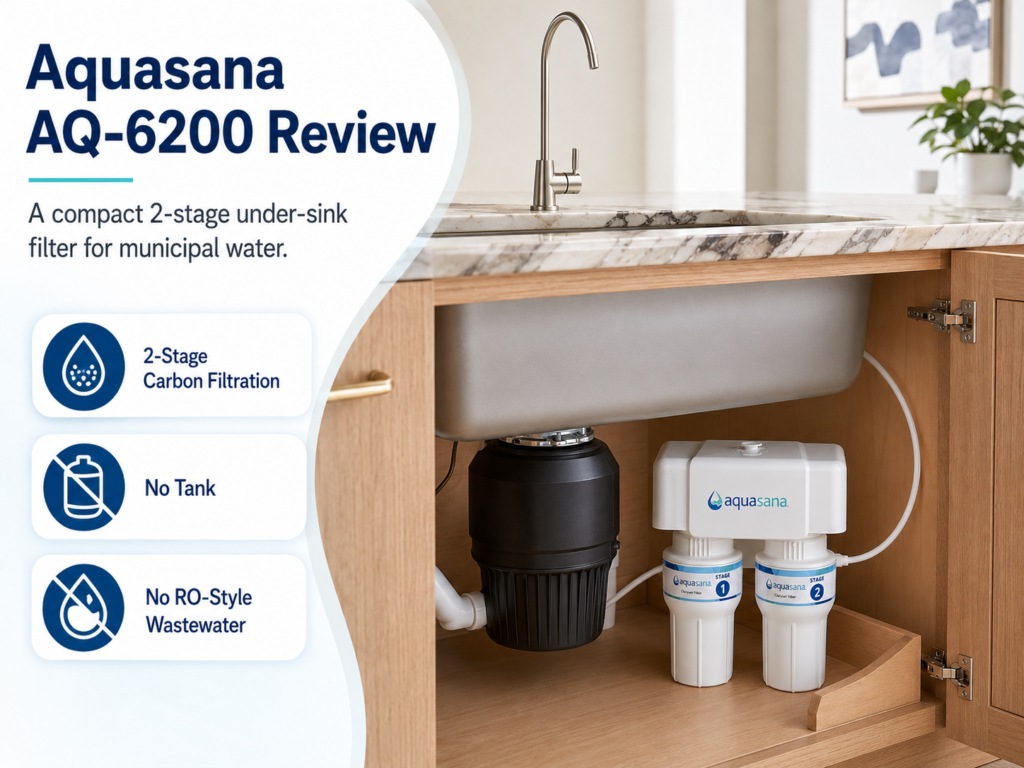
This Aquasana AQ-6200 review looks at filtration performance, installation, filter costs, and who this under-sink system is best suited for. The Aquasana AQ-6200 is a two-stage, under-sink water filter built around Aquasana’s Claryum filtration media. It is WQA-tested and certified to NSF/ANSI Standards 42, 53 (including P473), and 401, and Aquasana publishes contaminant-specific reduction data for chlorine, chloramines, PFAS, lead, microplastics, cysts, VOCs, and asbestos, among the 78 total contaminants it lists.
It requires no electricity, produces no reverse-osmosis wastewater, and retains beneficial minerals such as calcium, magnesium, and potassium.
It’s a strong fit for homeowners whose main concerns are chlorine, chloramines, PFAS, lead, and similar contaminants and who want a compact, low-maintenance system. It’s not the right choice for anyone trying to reduce total dissolved solids, nitrates, fluoride, arsenic, or dissolved salts, since those jobs typically call for a reverse-osmosis system instead.
What Is the Aquasana AQ-6200?
The AQ-6200 is the current model number for Aquasana’s Claryum 2-Stage Under-Sink Water Filter. It installs beneath the kitchen sink and connects to the cold-water line, delivering filtered water through its own dedicated faucet rather than passing through the main tap.
Aquasana offers the AQ-6200 with several faucet finish options, including brushed nickel, chrome, matte black, and oil-rubbed bronze, as well as a no-faucet configuration for homeowners who already have a separate faucet or plan to reuse an existing one. The no-faucet version currently lists around $199.99, though Aquasana’s pricing and promotions can change.
This review is based on Aquasana’s published specifications, certification data, and owner’s manual. BuildSafeHome has not physically or laboratory tested the AQ-6200.
Key Specifications
- Filter capacity: 500 gallons
- Recommended replacement interval: Up to 6 months
- Rated flow rate: 0.5 gallons per minute
- Operating pressure range: 20 to 80 psi
- Operating temperature range: 40 to 90°F
- Dimensions: Approximately 4.25 x 8.25 x 9 inches
- Replacement filter model: AQ-C2-R (also fits the AQ-5200)
- Replacement filter MSRP: About $73.99 (Water for Life subscription pricing may be lower and is subject to change)
- Warranty: 1-year limited warranty
- Satisfaction guarantee: 90 days
The compact footprint is worth noting for anyone with a crowded under-sink cabinet. At roughly 4.25 by 8.25 by 9 inches, the housing is small enough to share space with a garbage disposal, cleaning supplies, or plumbing. However, Aquasana still recommends leaving enough clearance to twist the filter housing free at replacement time.
Check Current Aquasana AQ-6200 Pricing
What Does the AQ-6200 Reduce?
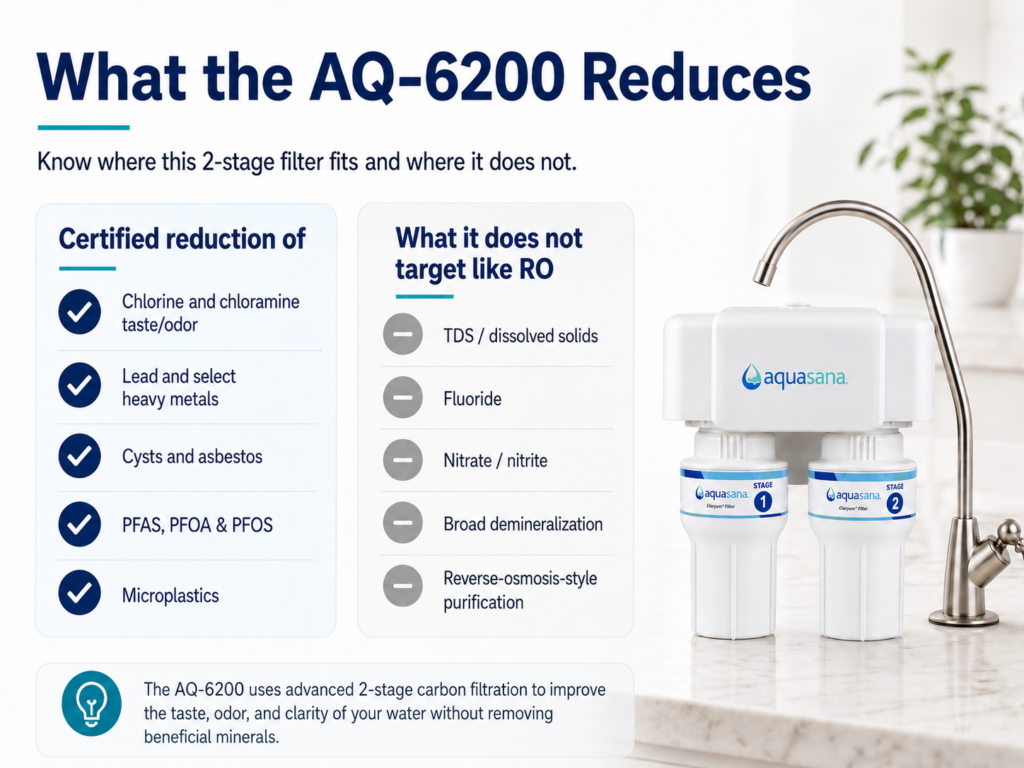
Aquasana states that the AQ-6200 uses Claryum filtration, a combination of activated carbon, catalytic carbon, ion exchange, sub-micron filtration, and an organic adsorbent booster. Together, these stages are designed to target a broad range of contaminants while retaining naturally occurring minerals such as calcium, magnesium, and potassium.
Aquasana currently states that the system reduces 78 contaminants overall. It’s worth being precise here: not every contaminant is reduced at the same rate, and the percentages below apply to the specific substances listed, not to water quality as a whole.
Published performance claims include:
- Up to 99.99% reduction of cysts
- Approximately 99.6% reduction of microplastics and lead
- Approximately 99.7% reduction of PFAS (PFOA/PFOS)
- Approximately 97.3% reduction of chlorine
- Approximately 91% reduction of chloramines
- Approximately 99% reduction of VOCs and asbestos
For households primarily concerned with chlorine taste and odor, PFAS, lead, or waterborne cysts such as Cryptosporidium and Giardia, these figures align well with common filtration goals.
For households more concerned about dissolved minerals, salts, nitrates, fluoride, or arsenic, this system isn’t designed to address these contaminants broadly; this is covered further in the limitations section below.
Certifications and Documented Performance
The AQ-6200 filter and system are WQA-tested and certified to NSF/ANSI Standards 42, 53 (including P473), and 401, specifically for the contaminant-reduction claims that Aquasana publishes.
NSF/ANSI 42 generally addresses aesthetic effects such as chlorine taste and odor. NSF/ANSI 53 covers health-related contaminants, and the P473 designation in that standard specifically addresses PFOA/PFOS reduction. NSF/ANSI 401 covers a set of emerging contaminants, including certain pharmaceuticals, pesticides, and herbicides.
Third-party certification matters because it means an independent organization, in this case WQA, tested the system against the manufacturer’s specific claims rather than simply taking the manufacturer’s word for it.
That said, certification is on a contaminant-by-contaminant basis. A system certified for lead reduction isn’t automatically certified for something like fluoride or arsenic unless that claim is separately tested and listed.
Installation: How Difficult Is It?
Aquasana describes the AQ-6200 as DIY installable, and a plumber isn’t normally required. The included faucet is designed to fit into an existing hole in the sink or countertop that is at least 1/2 inch in diameter.
In many kitchens, an unused sprayer opening or soap-dispenser hole can be repurposed for the filtered-water faucet, which avoids drilling altogether.
If no suitable existing hole is available, Aquasana’s manual strongly recommends having a professional drill the new hole, since countertop materials like granite, quartz, and porcelain vary widely in how they need to be handled.
Once the faucet is in place, the system connects to the cold-water supply line under the sink. Aquasana recommends flushing the system for about 10 minutes after installation to clear any carbon fines before regular use.
Homeowners should also plan for enough clearance in the cabinet to comfortably access and twist off the filter housing when it comes time for replacement.
For many kitchens with an existing spare hole, this can be a manageable DIY project. For kitchens without one, the cost and effort shift toward whatever a professional charges to drill the countertop, which is worth factoring into the overall decision.
Filter Replacement and Ownership Cost
Aquasana designs the AQ-6200’s filter replacement to be a twist-off process that doesn’t require disconnecting hoses, which keeps routine maintenance simple.
Filters should be replaced about every six months, or sooner if the system reaches its 500-gallon rated capacity first. A battery-powered indicator tracks usage and switches to a red light with an audible alert once the filter reaches approximately 95% of its capacity.
The battery is replaced at the same time as the filters, so there’s no separate battery maintenance schedule to track. Aquasana also recommends replacing the filter housing sumps every five years, a far less frequent task than the twice-yearly filter swap.
Regarding cost, the AQ-C2-R replacement filter has an MSRP of about $73.99. Since Aquasana recommends replacement roughly every six months, that works out to an estimated $148 per year at full MSRP if two sets are purchased annually.
Aquasana’s Water for Life subscription may offer a lower per-filter price, though subscription pricing is subject to change and should be checked directly before budgeting around it.
What the AQ-6200 Does Well
- Broad, third-party-certified contaminant reduction across categories that matter to many households, including chlorine, chloramines, cysts, VOCs, and asbestos
- Documented PFAS and lead reduction
- No reverse-osmosis wastewater
- No electrical outlet required for filtration
- Retains naturally occurring minerals like calcium, magnesium, and potassium rather than stripping them out
- Compact under-sink footprint that fits in tighter cabinets than many larger systems
- Battery-powered filter-life alert that removes much of the guesswork around replacement timing
- Twist-off filter replacement that doesn’t require disconnecting hoses
Where It Falls Short
- A 500-gallon filter capacity is modest compared with some higher-capacity alternatives, meaning more frequent filter changes for larger households
- The 0.5 gallons-per-minute rated flow may feel slow compared with higher-flow under-sink systems, particularly for households that fill large pots or containers directly from the filtered faucet
- Installing a dedicated faucet may require drilling a new hole if the sink or countertop doesn’t already have a spare opening
- Ongoing replacement-filter costs, estimated around $148 per year at MSRP, add up over the life of the system
- This is not a reverse-osmosis system, and it isn’t designed to reduce total dissolved solids broadly
- Homeowners specifically concerned about nitrates, fluoride, arsenic, or dissolved salts are likely better served by an appropriate RO system rather than the AQ-6200 alone
AQ-6200 vs. Other Options
Aquasana Claryum 3-Stage
For households that want a similar filtration approach with higher flow or additional filtration media, Aquasana’s Claryum 3-Stage lineup is the natural step-up within the same product family.
It builds on the same general Claryum filtration concept while adding capacity or flow-rate improvements, depending on the specific model. Anyone deciding between the two should compare current rated flow, filter capacity, and price directly, since Aquasana updates these lines periodically.
Our separate look at the older AQ-5200 also covers how that model compares.
iSpring RCC7AK Reverse Osmosis
For homeowners whose primary concern is broader reduction of dissolved contaminants, including fluoride, arsenic, or elevated TDS, a reverse-osmosis system such as the iSpring RCC7AK represents a fundamentally different filtration approach.
RO systems use a semi-permeable membrane to remove a wider range of dissolved solids than the AQ-6200’s Claryum media is designed to target. However, RO systems typically produce wastewater and often remove beneficial minerals as well as contaminants unless a remineralization stage is added.
For more on how the two approaches differ, our reverse-osmosis explainer and full iSpring RCC7AK review go into more detail.
View the Current Aquasana Claryum 2-Stage
Who Should Buy the AQ-6200?
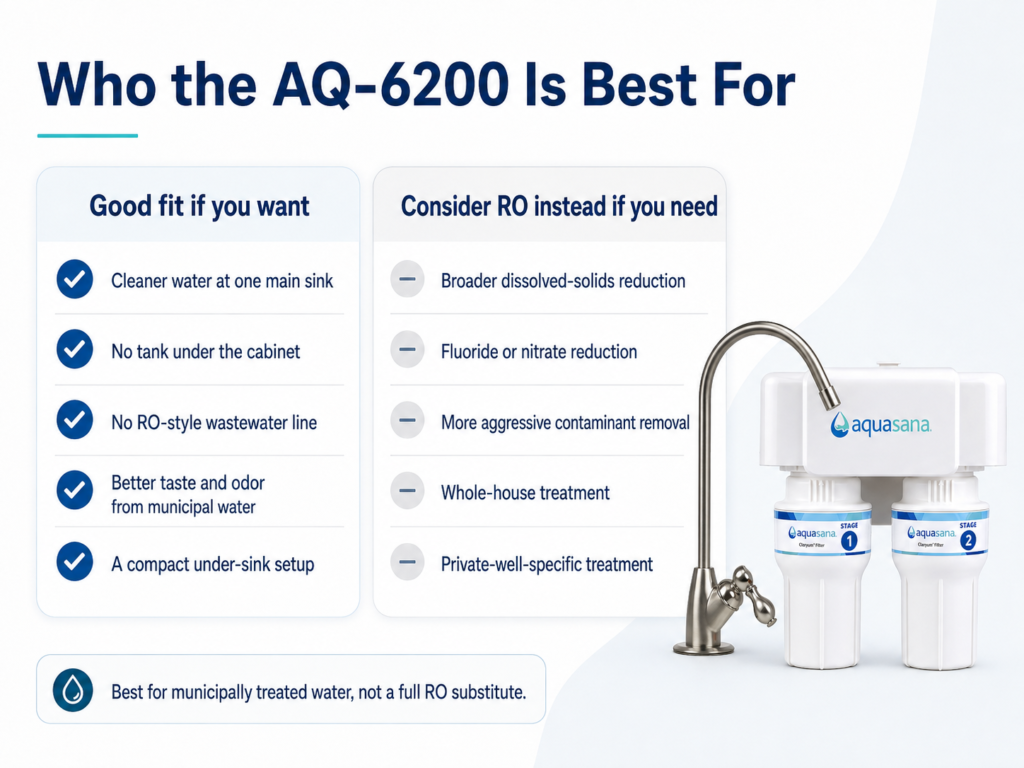
The AQ-6200 makes sense for homeowners whose water quality concerns line up with what Claryum filtration is certified to address: chlorine taste and odor, chloramines, PFAS, lead, cysts, VOCs, and asbestos.
It also suits anyone who wants a filtration system without an electrical connection, without reverse-osmosis wastewater, and without losing naturally occurring minerals from their drinking water.
The compact size and twist-off filter replacement make it a reasonable fit for smaller kitchens and homeowners who prefer low-maintenance upkeep on a predictable schedule.
Who Should Skip It?
Homeowners whose water testing shows elevated levels of nitrates, fluoride, arsenic, or high total dissolved solids should look elsewhere, since the AQ-6200 isn’t designed to address those contaminants.
Larger households that go through water quickly may also find the 500-gallon capacity and 0.5 gpm flow rate limiting compared with higher-capacity systems.
Anyone who already has a whole-house system that addresses similar contaminants may not need a dedicated under-sink unit.
Final Verdict
Within its documented scope, the Aquasana AQ-6200 offers third-party-certified reductions in a meaningful list of common water contaminants, a relatively straightforward DIY installation when an existing faucet opening is available, and low-maintenance ownership centered on a twice-yearly filter change.
It isn’t a do-everything filtration system, and Aquasana’s own performance data makes clear where its strengths lie: chlorine, chloramines, PFAS, lead, cysts, VOCs, and asbestos, rather than dissolved solids, fluoride, arsenic, or nitrates.
Homeowners whose water concerns match that profile, and who value a compact, no-wastewater, no-electricity system that keeps natural minerals intact, are likely to find the AQ-6200 a reasonable fit.
Those with broader concerns about dissolved contaminants should consider a reverse-osmosis option instead.
Check Current AQ-6200 Availability
Frequently Asked Questions
Does the Aquasana AQ-6200 require electricity?
No. Filtration doesn’t require an electrical connection. The filter-change indicator runs on a battery, which is replaced alongside the filters.
How often do the filters need to be replaced?
Aquasana recommends replacement about every six months, or sooner if the system reaches its 500-gallon rated capacity first.
Does the AQ-6200 produce wastewater like a reverse-osmosis system?
No. Unlike RO systems, the AQ-6200 doesn’t produce reverse-osmosis wastewater during filtration.
Will the AQ-6200 reduce fluoride, arsenic, or nitrates?
The AQ-6200 isn’t designed to broadly reduce total dissolved solids, and its published certifications don’t cover the reduction of fluoride, arsenic, or nitrate. Homeowners concerned about those contaminants should consider a reverse-osmosis system, such as the iSpring RCC7AK, instead.
Do I need a plumber to install it?
Aquasana describes the system as DIY installable, and a plumber isn’t normally required. However, if a new faucet hole needs to be drilled in the countertop, Aquasana’s manual recommends having a professional do the drilling.
As an Amazon Associate, BuildSafeHome earns from qualifying purchases
This article may contain affiliate links. BuildSafeHome may earn a commission at no extra cost to you