Affiliate Disclosure: This article may contain affiliate links. BuildSafeHome may earn a commission at no extra cost to you.
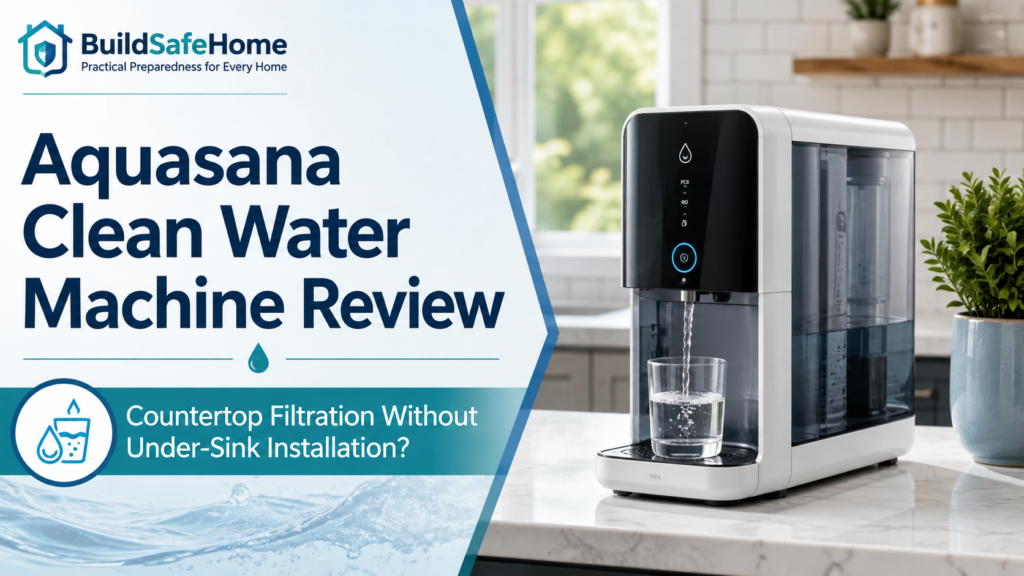
Aquasana Clean Water Machine review: a countertop filtration option for homeowners who want broader certified filtration without under-sink installation.
If you’ve compared water filters recently, you’ve probably run into the same trade-off over and over: pitcher filters are inexpensive and simple, but they may cover a relatively short list of contaminants. At the same time, under-sink and reverse osmosis systems can provide broader filtration but require plumbing changes that renters or some homeowners may not want to make.
The Aquasana Clean Water Machine sits somewhere in between. It’s a powered countertop system designed to provide broader certified filtration than a basic pitcher without the installation commitment of an under-sink unit.
This Aquasana Clean Water Machine review is based on Aquasana’s current published specifications, Performance Data Sheet, and WQA certification information, not on hands-on testing by BuildSafeHome. Our goal is to explain plainly what the system does, what it doesn’t do, and where it fits so you can decide whether the higher price compared with a basic pitcher filter makes sense for your situation.
Aquasana Clean Water Machine Quick Verdict
Before getting into the details, here’s the short version.
| Best For | Renters and homeowners who want certified reduction of a wide range of contaminants without modifying plumbing |
| Not Ideal For | Anyone whose main concern is total dissolved solids (TDS), fluoride, nitrate, hardness, or arsenic |
| Biggest Advantage | No installation—fill the reservoir, plug it in, and it’s ready to use |
| Biggest Drawback | Higher upfront and ongoing cost than a pitcher filter, plus it requires counter space and an electrical outlet |
Check current Aquasana Clean Water Machine pricing
What Is the Aquasana Clean Water Machine?
The current model is the Aquasana Clean Water Machine AQ-CWM2-B, a powered countertop filtration system built around Aquasana’s Claryum filtration technology.
Unlike a pitcher filter, it doesn’t rely on gravity. And unlike an under-sink or whole-house system, it doesn’t connect directly to your home’s plumbing.
Setup is straightforward. You fill the machine’s reservoir with tap water, plug it into a standard electrical outlet, and use the dispenser to draw filtered water on demand.
That simplicity is a major part of the appeal. The Clean Water Machine functions more like a countertop appliance than a permanent plumbing fixture.
Standard product documentation includes a one-year limited warranty on the system and a 90-day satisfaction guarantee. Those terms are separate from Aquasana’s Water for Life filter subscription program, which we’ll cover later.
How the Claryum Filtration System Works
Claryum is Aquasana’s proprietary filtration technology and is used across several of the company’s product lines, including some under-sink systems.
Aquasana describes Claryum as combining multiple filtration methods in a single cartridge rather than relying on a single basic filtration medium.
Because the Clean Water Machine uses a powered pump rather than gravity alone, it can move water through its filtration media quickly while still delivering certified contaminant reduction.
The system has been tested and certified by the Water Quality Association to applicable NSF/ANSI Standards 42, 53, including P473, and 401.
Broadly speaking, those standards address different types of contaminant reduction:
- NSF/ANSI 42 covers aesthetic concerns such as chlorine taste and odor.
- NSF/ANSI 53 covers certain contaminants with health-related effects, including lead and PFOA/PFOS.
- NSF/ANSI 401 covers certain emerging contaminants, including some pharmaceuticals and pesticides.
That gives the Clean Water Machine a broader certified range of contaminant reduction than many basic pitcher filters.
More importantly, those claims are supported by independent certification rather than by Aquasana’s marketing language alone.
What Does the Clean Water Machine Reduce?
Aquasana currently markets the Clean Water Machine as reducing 78 contaminants.
That figure represents Aquasana’s description of the overall scope of its Claryum filtration technology. The more important information for buyers is found in the current Performance Data Sheet, which identifies the specific contaminants for which the system has documented reduction claims.
Certified reduction claims include contaminants such as:
- Chlorine
- Lead
- PFOA and PFOS
- Microplastics
- Cysts
- Mercury
- Volatile organic compounds
- Certain pesticides
- Certain pharmaceuticals
The Performance Data Sheet is the best place to check the complete, up-to-date list because certification information and product documentation can change over time.
Another difference between the Clean Water Machine and systems designed to reduce dissolved solids is mineral retention.
Aquasana states that the system is designed to retain naturally occurring minerals such as calcium, potassium, and magnesium rather than intentionally removing them.
That shouldn’t be interpreted as a health claim. It is simply a difference in filtration approach compared with technologies designed to reduce dissolved solids more broadly.
What It Does Not Do Like Reverse Osmosis
The Clean Water Machine is not a reverse osmosis system, and that distinction matters.
The current Performance Data Sheet does not list total dissolved solids, fluoride, nitrate, water hardness, or arsenic among its certified reduction claims.
That doesn’t necessarily mean the system has been tested and shown not to affect those substances. It means Aquasana does not publish certified reduction claims for them, so buyers should not assume the machine is designed to address those concerns.
The Clean Water Machine also does not produce the reject-water stream associated with reverse osmosis.
RO systems force water through a membrane and typically route a portion of the incoming water to the drain as concentrate. Because the Clean Water Machine does not use an RO membrane, that process does not apply.
If reducing TDS, fluoride, nitrate, or another dissolved contaminant is one of your main goals, a reverse osmosis system or another filter specifically certified for that contaminant may be a better fit.
Setup and Everyday Use
For renters in particular, the appeal of the Clean Water Machine comes down to what it doesn’t require.
There’s no drilling, no tapping into a cold-water line, no dedicated faucet, and no need to find extra room inside a crowded sink cabinet.
You place the unit on a countertop near an electrical outlet, fill the reservoir with cold tap water, and dispense filtered water as needed.
That also makes it attractive for homeowners who don’t want to modify their plumbing.
In everyday use, you refill the reservoir manually rather than leaving the system connected continuously to a water supply.
Aquasana states that the machine can dispense roughly an eight-ounce glass of filtered water in about eight seconds. That makes it substantially different from waiting for a gravity-fed pitcher to refill slowly.
However, it also creates a different daily routine. You’ll need to keep the reservoir filled and leave the appliance on the counter rather than storing a pitcher in the refrigerator.
Because this is a powered countertop appliance, it’s worth deciding where it will live before buying. It takes up more permanent counter space than a simple pitcher and requires access to a nearby outlet.
Filter Life and Ongoing Cost
Each replacement filter is rated for up to 300 gallons, which Aquasana estimates is approximately six months of routine use.
Actual filter life will depend on how much filtered water your household uses and the conditions of your incoming water.
Replacement filters for the current system are model AQ-CWM2-R and sold as a two-pack.
The regular price for a two-pack is currently about $73.49.
Aquasana’s Water for Life program currently provides a 15% discount on replacement filters, bringing the price of the two-pack to roughly $62.47. The program also includes free shipping and additional warranty benefits while enrolled.
For someone planning to use the system long term, the discount can be worthwhile.
However, Water for Life is an automatic filter-delivery program, so it makes sense to consider whether the scheduled replacement frequency matches how quickly your household will actually use the filters.
As for the Clean Water Machine itself, Aquasana currently lists an MSRP of $399.99.
Promotional pricing can vary significantly, so it’s better to check the current price rather than assume a temporary sale will always be available.
Check current Aquasana Clean Water Machine pricing
Clean Water Machine vs. a Basic Pitcher Filter
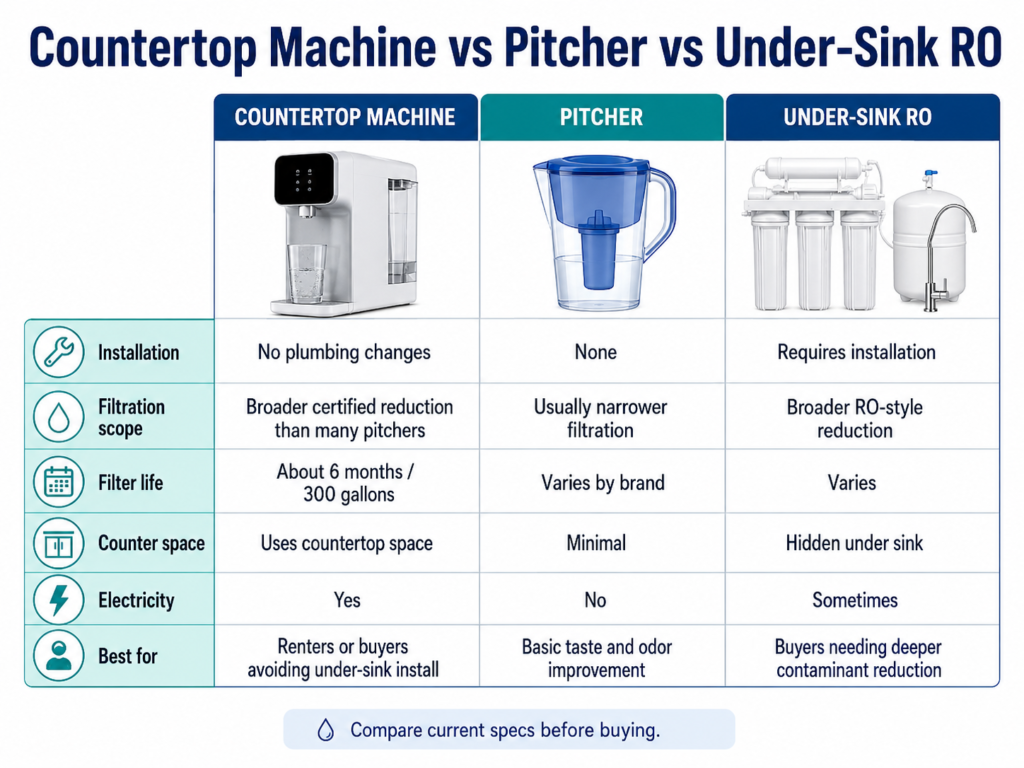
The comparison many shoppers are likely to make is between the Clean Water Machine and a basic pitcher filter.
Both avoid permanent plumbing changes, but they take very different approaches.
Filtration Breadth
Many basic pitcher filters rely primarily on activated carbon and are certified for a narrower set of contaminants.
The Clean Water Machine has certified contaminant-reduction claims that span multiple NSF/ANSI standards and a broader published list of contaminants.
Filtration Speed
Pitcher filters rely on gravity and can take several minutes to filter a full reservoir.
The Clean Water Machine uses a powered pump and can dispense filtered water on demand.
Filter Life
The Clean Water Machine is rated for approximately 300 gallons or about six months per filter under routine use.
Replacement intervals for pitcher filters vary widely by brand and usage, but many require more frequent cartridge changes.
Counter Space and Electricity
A pitcher is simpler. It requires no electricity, can often fit in a refrigerator, and can be moved easily.
The Clean Water Machine requires dedicated countertop space and access to an electrical outlet.
Price
A basic pitcher costs considerably less upfront.
The Clean Water Machine also has higher replacement-filter costs than many pitcher systems.
In other words, you’re paying more for broader certified filtration, faster dispensing, and longer rated filter life than many basic pitcher filters, not simply for convenience.
Aquasana Clean Water Machine vs. Reverse Osmosis
Comparing the Clean Water Machine with reverse osmosis requires a little more nuance.
RO systems use a semipermeable membrane to reduce the concentration of a broad range of dissolved substances. Depending on the specific system and its certifications, that can include contaminants or water-quality concerns such as TDS, fluoride, nitrate, or arsenic that the Clean Water Machine is not certified to address.
If one of those is your primary concern, an appropriately certified RO system may be the better choice.
However, RO usually comes with additional installation requirements.
Traditional systems often require under-sink plumbing connections, a dedicated drinking-water faucet, and a drain connection. Many systems also send some of the incoming water to the drain as concentrate, although efficiency varies substantially across different RO designs.
Reverse osmosis also reduces dissolved mineral content to varying degrees.
The Clean Water Machine takes a different approach.
There is no RO membrane, no dedicated plumbing, and no reject water stream. The system is designed to retain naturally occurring minerals rather than intentionally reducing dissolved solids.
If your priority is certified reduction of contaminants such as lead, PFOA/PFOS, chlorine, and others listed on Aquasana’s Performance Data Sheet without modifying your plumbing, the Clean Water Machine provides a practical middle ground.
If your priority is TDS reduction or another contaminant outside the system’s certified scope, that limitation should be taken seriously.
Potential Downsides
The Clean Water Machine has several advantages, but there are also some practical drawbacks to consider.
Higher Price
Both the machine itself and the ongoing filter cost are higher than what you’ll typically pay for a basic pitcher filter.
For someone whose main goal is to improve the taste or odor of chlorine, the additional expense may not be worth it.
Countertop Footprint
This is a countertop appliance, so it takes up more space than something you can store inside the refrigerator.
That may be an issue in smaller kitchens where counter space is already limited.
Electricity Dependence
The machine needs electricity to operate.
If there is no convenient outlet near the desired location, or if you specifically want a filtration system that works during a power outage, a gravity-fed option may be more practical.
No TDS-Focused Filtration
The Clean Water Machine should not be treated as a substitute for reverse osmosis when your primary concern is reducing TDS, fluoride, nitrate, hardness, arsenic, or another substance outside its certified scope.
Owner-Reported Quality Concerns
Some online owner reports mention pump noise, occasional leaks, cartridge fit issues, customer service frustrations, or issues with the Water for Life subscription program.
These are anecdotal reports rather than universal product defects, and many owners do not report these problems.
Still, they are worth considering alongside the product’s specifications and certification data when deciding whether the system is right for you.
Who Should Buy It?
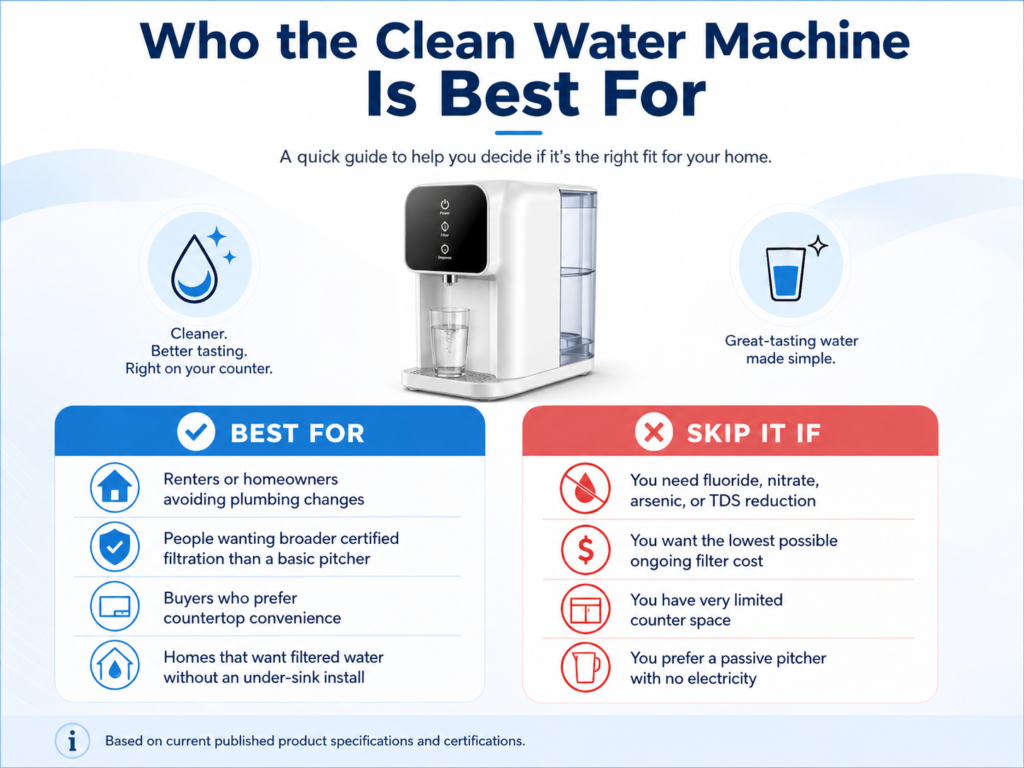
The Aquasana Clean Water Machine makes the most sense for renters and homeowners who want broader certified contaminant reduction than a basic pitcher provides but do not want or cannot make permanent plumbing modifications.
It may be especially appealing if:
- You rent your home or apartment.
- You don’t want to modify plumbing.
- Under-sink cabinet space is limited.
- You want faster dispensing than a gravity-fed pitcher.
- You are concerned about contaminants such as lead, PFOA/PFOS, chlorine, or others included in Aquasana’s certified reduction claims.
- You want independently certified filtration performance.
- You prefer a system that retains naturally occurring minerals.
For those buyers, the Clean Water Machine offers a relatively uncommon combination: countertop convenience and a more extensive certified contaminant-reduction profile than many basic pitcher filters.
Who Should Choose Something Else?
The Clean Water Machine won’t be the right solution for everyone.
If your main concern is TDS, fluoride, nitrate, hardness, arsenic, or another contaminant outside the system’s certified scope, consider a reverse osmosis system or another filtration technology specifically certified to address it.
If you’re mainly looking to reduce chlorine taste and odor and want to spend as little as possible, a basic pitcher filter may meet your needs at a substantially lower cost.
Counter space can also be a deciding factor. If your kitchen is already crowded or you don’t have a convenient electrical outlet, an under-sink or gravity-fed option may fit your space better.
The important thing is to match the filtration technology to your actual water concern rather than assuming the more expensive system is automatically the better one.
Final Verdict
So, is the Aquasana Clean Water Machine worth paying more for than a basic pitcher filter?
For the right household, yes.
If you want strong, independently certified filtration covering multiple NSF/ANSI standards without installing anything under the sink, the price premium buys you something meaningful.
You get faster dispensing, a longer-rated filter life than many basic pitcher filters, no permanent plumbing modifications, and documented contaminant-reduction performance to back the product’s claims.
That combination is especially appealing for renters and homeowners who want more than a basic pitcher but aren’t ready to install a reverse osmosis system.
However, the Clean Water Machine isn’t a universal solution.
If reducing TDS, fluoride, nitrate, hardness, arsenic, or another contaminant outside its certified scope is your primary goal, this isn’t the right filtration technology for the job.
Ultimately, the Aquasana Clean Water Machine makes the most sense when its certified capabilities match the specific concerns you have about your water.
Check current Aquasana Clean Water Machine pricing
As an Amazon Associate, BuildSafeHome earns from qualifying purchases
This article may contain affiliate links. BuildSafeHome may earn a commission at no extra cost to you