Affiliate Disclosure: This article may contain affiliate links. BuildSafeHome may earn a commission at no extra cost to you.
If you’re shopping for a gravity-fed water filter, the marketing can get confusing fast. Certification badges, long filter-life numbers, and lists of contaminants all sound impressive, but they don’t necessarily mean the same thing. Some reduction claims are certified, some are independently tested, and others come directly from the manufacturer.
For most homeowners, the better approach is to start with what you actually want to reduce in your water, then find a system with verified performance that addresses those concerns.
This guide compares four stainless steel countertop systems designed for everyday home use. We looked at current certification information, manufacturer documentation, filter replacement considerations, capacity, construction, and practical usability. This is a research-based comparison, not a report on products we’ve physically tested.
Quick Picks
| System | Best For | Capacity | Certification / Testing Highlights |
| BOROUX Legacy | Best Overall / Berkey Alternative | About 3 gallons | WQA certification to NSF/ANSI 42, NSF/ANSI/CAN 401 and 372 |
| Big Berkey with Phoenix Filters | Best for Buyers Who Want the Berkey Platform | About 2.25 gallons | NSF/ANSI 42 for chlorine and taste/odor with Phoenix filters; 372 material compliance |
| ProOne Gravity System | Best for Broad Independent Testing | Depends on current model | Extensive independent testing to NSF/ANSI protocols; check exact certification by configuration |
| British Berkefeld | Best Ceramic Filter Option | Multiple sizes available | Current NSF listings include specific 42, 53, 401 and 372 claims depending on configuration |
Best Gravity Fed Water Filters for Home Use
BOROUX Legacy: Best Overall / Berkey Alternative
The BOROUX Legacy is a stainless steel gravity system built around 304 stainless steel chambers. Its approximately 3-gallon capacity gives it enough room for regular household use without moving into an unusually large countertop system. BOROUX also offers a smaller Compact version, approximately 1.8 gallons, for buyers with less counter space.
The Legacy uses BOROUX Foundation filters. One particularly useful feature is compatibility. BOROUX states that Foundation filters fit several Berkey systems and other compatible gravity housings. That can matter over the years of ownership because the availability of replacement filters is just as important as the tank itself.
Certification is another reason the Legacy stands out. Current BOROUX documentation lists WQA certification to NSF/ANSI 42, NSF/ANSI/CAN 401, and NSF/ANSI/CAN 372. Those standards need to be interpreted individually. For example, 372 concerns lead content in the materials used in the product. It does not mean the Foundation filter is certified to reduce lead from drinking water.
BOROUX also publishes separate third-party laboratory testing covering additional contaminants. That information can be useful when comparing filters, but independent laboratory testing and product certification are not interchangeable.
BOROUX rates a pair of Foundation filters for up to 12 months of use under its current replacement guidance. Actual life can vary with water quality and usage. Buyers specifically concerned about fluoride should also note that BOROUX offers its Proactive fluoride filters separately rather than treating fluoride reduction as a standard Foundation-filter certification.
From a durability standpoint, the 304 stainless-steel construction is appealing because there isn’t much that can mechanically go wrong with the system. BOROUX currently backs its stainless steel chambers with a lifetime warranty.
There’s also an interesting connection between BOROUX and Berkey. James Enterprise Inc., the company associated with BOROUX, previously operated BerkeyFilters.com as a major Berkey distributor. The companies later separated following business and regulatory disputes. That history helps explain why BOROUX filters are designed to work with a number of Berkey housings.
Best fit: Someone who wants a durable stainless gravity system, strong current certification credentials, and an alternative to the traditional Berkey ecosystem.
Big Berkey with Phoenix Filters: Best for Buyers Who Want the Berkey Platform
Berkey is probably the most recognizable name in this category, but it’s important to distinguish between the familiar Berkey stainless-steel housing and the filter elements inside it.
The Big Berkey holds approximately 2.25 gallons and uses a simple stainless steel two-chamber design. For this comparison, we’re specifically looking at a Big Berkey equipped with Phoenix Gravity New Millennium Edition PGF9-2 filter elements.
That’s important because the current certification picture differs from that associated with the older Black Berkey elements.
Current NSF listings show the Big Berkey featuring Phoenix PGF9-2 elements under NSF/ANSI 42 for chlorine reduction and taste and odor reduction. The listing currently shows a 1,050-gallon service cycle for those certified claims. Phoenix-equipped Big Berkey systems also appear under NSF/ANSI/CAN 372 for lead-content requirements in the product materials.
Again, 372 does not establish that the system is certified to remove lead from drinking water.
That makes two blanket statements about Berkey inaccurate. Saying “Berkey isn’t NSF certified” ignores the current Phoenix-equipped certification. But saying “Berkey is fully NSF certified” goes too far in the other direction.
A more useful way to look at it is that a Big Berkey equipped with the current Phoenix filters has certification for specific claims. Buyers should not assume that certification automatically extends to PFAS, lead reduction, bacteria, viruses, or every contaminant historically associated with Berkey marketing.
The older Black Berkey elements also have a complicated regulatory history involving an EPA/FIFRA dispute. That history is worth knowing, but it doesn’t need to dominate a buying decision about the current Phoenix-equipped configuration.
Another thing to watch is filter-life language. A manufacturer’s maximum gallon estimate is not necessarily the same thing as a certified service cycle for a particular contaminant claim. When comparing replacement costs, look at exactly what the gallon number represents.
Best fit: Someone who already likes the Berkey stainless platform, owns a compatible Berkey system, or wants the familiar Berkey format while using the newer Phoenix filter configuration.
ProOne Gravity System: Best for Broad Independent Testing
ProOne takes a somewhat different approach with its G3.0 filter elements. They combine a ceramic outer structure with proprietary internal filtration media and are used in ProOne’s stainless gravity systems.
ProOne is particularly interesting because the company publishes substantial independent testing information. That can give buyers more detail to examine than a simple marketing claim that a filter “removes hundreds of contaminants.”
The certification language, however, deserves extra attention.
Some ProOne documentation involves component or material certification, while other performance information comes from independent testing conducted in accordance with NSF/ANSI protocols. Those are both useful forms of evidence, but they are not the same thing.
A product being tested to an NSF/ANSI protocol should not automatically be described as NSF certified for that contaminant.
This distinction is especially important when looking at broad contaminant-reduction tables. Rather than focusing on how many substances appear on a list, check which claims have formal certification and which are supported by separate laboratory testing.
The ceramic exterior is another practical difference. Ceramic elements can provide mechanical filtration and, depending on the specific design, may be cleaned according to manufacturer instructions when sediment reduces flow. But ceramic construction by itself does not mean a filter makes microbiologically unsafe water safe to drink.
Because ProOne’s product lineup and naming have changed over time, buyers should also verify the current stainless system and G3.0 filter configuration before ordering rather than relying on older Big+ product pages.
Best fit: Someone willing to dig into detailed independent test reports and who likes the combination of ceramic and additional filtration media.
British Berkefeld: Best Ceramic Filter Option
British Berkefeld may not have the same name recognition in the U.S. as Berkey. Still, it comes from the long-established Doulton water-filtration lineage and brings a different filtration approach to this comparison.
Its stainless gravity systems use Ultra Sterasyl ceramic elements rather than relying solely on a conventional carbon-block-style gravity filter.
The certification evidence is one of the strongest reasons to consider it. Current NSF listings for applicable British Berkefeld Ultra Sterasyl configurations include specific claims under NSF/ANSI 42, NSF/ANSI 53, and NSF/ANSI 401, as well as NSF/ANSI/CAN 372 material requirements.
The exact claim matters more than the number of standards.
For example, current NSF information includes cyst and turbidity reduction under NSF/ANSI 53 for applicable Ultra Sterasyl configurations and microplastics reduction under NSF/ANSI 401. Cyst reduction should not be interpreted as certified bacteria or virus reduction.
That’s an important distinction if you’re considering a gravity system for backup use.
The ceramic format also provides a practical maintenance advantage. Ceramic elements can generally be cleaned according to the manufacturer’s instructions when accumulated sediment begins reducing flow. That’s different from many carbon filter elements that should not simply be scrubbed clean.
British Berkefeld is therefore less about brand recognition and more about a well-established ceramic filtration design with clearly defined certification claims.
Best fit: Someone who specifically wants a ceramic gravity filter and places a high value on clearly documented third-party certification.
How Gravity-Fed Water Filters Work
Gravity filtration is mechanically simple.
Water is poured into an upper chamber. The weight of that water creates head pressure that moves it through the filter elements. Filtered water then collects in the lower chamber and is dispensed through a spigot.
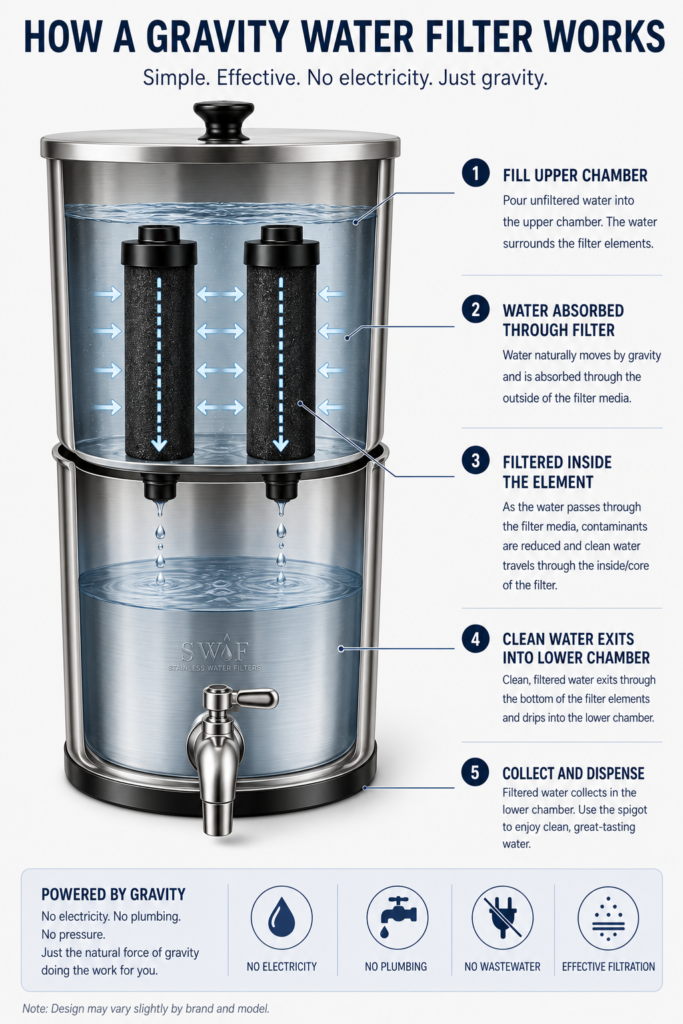
The stainless countertop systems in this guide don’t require a household plumbing connection or electricity to operate.
The filter elements themselves are where the important differences occur. Depending on the system, they may use activated carbon, carbon block, ceramic material, ion-exchange media, or other specialty media.
Activated carbon is commonly useful for chlorine, taste and odor, and certain organic compounds. Other contaminants may require specialty media or a filter specifically tested or certified for that reduction.
That’s why two gravity systems that look almost identical from the outside can have substantially different performance claims.
Flow rate isn’t a reliable shortcut for judging quality either. Gravity-filter flow can vary with the amount of water in the upper chamber, the number and condition of the filter elements, sediment buildup, incoming water quality, and whether the filter has been properly prepared or primed.
A slower filter isn’t automatically a better filter.
What to Look for Before Buying
Start With Verified Contaminant Claims
The first question shouldn’t be, “Which filter removes the most contaminants?”
It should be, “What am I trying to reduce in my water?”
If you’re on municipal water, start with your utility’s Consumer Confidence Report, often called a water-quality report. Then look for a filter with verified performance that matches your actual concerns.
A few certification standards frequently appear in this category:
- NSF/ANSI 42 generally addresses aesthetic effects, such as specific claims for chlorine, taste, odor, and particulates.
- NSF/ANSI 53 covers health-effect contaminant reduction, but certification applies only to the particular claims listed for the product.
- NSF/ANSI 401 addresses specified emerging or incidental contaminants, including claims such as microplastics reduction.
- NSF/ANSI/CAN 372 concerns lead content in the materials used in drinking-water products. It does not mean the filter is certified to reduce lead from the water.
WQA and IAPMO can also legitimately certify products to NSF/ANSI standards. What matters is the exact product, standard, and certified claim.
That gives you three useful categories when researching any water filter:
Certified claims. Independent laboratory testing. Manufacturer claims.
All three may provide useful information, but they shouldn’t be presented as if they mean the same thing.
Consider Filter Cost and Availability
The stainless housing may last for many years, but the filter elements are consumable.
Before buying, check replacement prices, how often the manufacturer recommends replacing them, and whether they’re readily available.
This is also where very large gallon ratings deserve scrutiny.
A manufacturer-rated maximum of several thousand gallons doesn’t automatically mean every contaminant claim has been independently certified for that entire volume. A certified service cycle and a manufacturer filter-life estimate can represent different things.
Choose a Practical Capacity
A compact system around 1.5 to 2 gallons may work well for one or two people or a household that doesn’t use large quantities of filtered water.
Systems around 2 to 2.5 gallons provide more capacity without becoming exceptionally large, while 3-gallon and larger systems can reduce how frequently a family needs to refill the upper chamber.
Don’t rely on capacity alone, though. Check the dimensions, particularly if the system will sit underneath kitchen cabinets.
Also remember that an advertised chamber or system capacity doesn’t necessarily equal the amount of filtered water immediately available from the lower chamber.
Look at Construction and Maintenance
Stainless steel chambers are popular because they’re durable, simple, and have few mechanical parts beyond the filters, seals, and spigot.
Maintenance still matters.
The chambers and spigot need periodic cleaning, filters need replacement, and some elements require priming or flushing before use. Ceramic filters may have manufacturer-approved cleaning procedures, while other filter media should not be scrubbed.
Follow the instructions for the exact filter rather than assuming every gravity system is maintained the same way.
Gravity Filter vs. Reverse Osmosis
Gravity filtration and reverse osmosis solve somewhat different problems.
Gravity systems are appealing because they require no plumbing connection or electricity, produce no reject-water stream, and can be moved relatively easily. Filtered water also remains available in the lower chamber for dispensing.
Reverse osmosis generally provides broader contaminant-reduction capability when the system is appropriately designed and certified. RO can also reduce dissolved solids and is commonly used when contaminants such as nitrate or fluoride are a concern.
If you’re unfamiliar with the process, our guide to What Is Reverse Osmosis and How Does It Work? explains the technology in more detail.
Neither approach is universally better.
Gravity filtration makes sense when simplicity, portability, and avoiding installation are priorities. RO makes more sense when water testing identifies contaminants requiring broader dissolved-contaminant reduction.
For a closer look at installed systems, see our Best Reverse Osmosis Systems for Home Use. Renters or homeowners who don’t want an under-sink installation can also compare our Best Countertop Reverse Osmosis Systems.
Are Gravity Water Filters Safe for Well or Emergency Water?
This is where gravity-filter marketing needs the most careful interpretation.
Most household gravity filters should not be treated as universal microbiological purifiers. A filter certified for cyst reduction, for example, should not automatically be assumed to remove bacteria or viruses.
The same applies to ceramic filtration. Ceramic media can provide useful mechanical filtration, but that doesn’t automatically establish that an entire system can make arbitrary untreated water microbiologically safe.
For lake water, river water, flood water, questionable untreated well water, or water affected by a boil-water advisory, don’t assume ordinary gravity filtration alone makes the water safe to drink.
During a boil-water advisory, follow local public-health instructions. CDC guidance specifically recommends boiling tap water even if it has already passed through a home water filter.
Where gravity systems do have a legitimate backup advantage is that they don’t depend on electricity or household water pressure. If the source water is appropriate for the particular filter, the system can continue filtering when power or normal household services are disrupted.
Private well owners should also start with water testing rather than buying a filter first.
EPA recommends testing private wells annually for total coliform bacteria, nitrates, total dissolved solids, and pH, with additional testing based on local conditions and potential sources of contamination.
Depending on the results, issues such as bacteria, nitrate, arsenic, hardness, iron, manganese, sulfur, or heavy sediment may require treatment beyond what a countertop gravity system can provide.
Common Gravity Filter Buying Mistakes
A few mistakes can make an otherwise good filter a poor fit:
- Buying based on the longest contaminant list. Look at which reduction claims are actually verified.
- Confusing testing with certification. Independent testing can be valuable, but it isn’t the same as third-party product certification.
- Assuming NSF/ANSI/CAN 372 means lead reduction. It concerns lead content in the product materials.
- Assuming all gravity filters remove bacteria or viruses. Check the exact performance claims rather than relying on the filter category.
- Ignoring replacement-filter costs. The long-term cost of filters can matter more than a modest difference in purchase price.
- Treating maximum gallon claims as certified service life. Find out what the rating actually represents.
- Buying too small. Constantly refilling an undersized system gets old quickly.
- Trying to solve a whole-house problem with a countertop filter. These are point-of-use drinking-water systems, not replacements for treatment at the home’s main water supply.
Frequently Asked Questions
Do gravity water filters actually work?
Yes, when they’re used for the contaminants they’re designed and verified to reduce. The key is to match the specific filter’s certified or independently tested performance to your water concerns, rather than assuming every gravity filter provides the same protection.
What are the disadvantages of gravity filters?
The biggest trade-offs are relatively slow filtration, countertop space, manual refilling, and more limited reduction of dissolved contaminants than reverse osmosis. Most household gravity filters also shouldn’t be treated as general-purpose purifiers for untreated water.
How long do gravity-fed water filters last?
It depends on the filter, source-water quality, sediment, contaminant loading, usage, and manufacturer recommendations. When comparing lifespan claims, distinguish between a manufacturer’s estimated maximum gallon rating and a certified service cycle for specific contaminant-reduction claims.
Is a gravity filter better than reverse osmosis?
Neither is better for every household. Gravity filters are simple and portable, requiring no plumbing or electricity. Reverse osmosis generally offers broader reduction of dissolved contaminants. Your water quality and the contaminants you need to address should drive the decision.
Bottom Line
The best gravity-fed water filter isn’t necessarily the system with the longest list of contaminants or the largest advertised gallon rating.
For most homeowners, the better choice starts with understanding what’s actually in the water and matching those concerns to verified filter performance.
BOROUX Legacy stands out as a strong all-around stainless system and a compelling Berkey alternative. A Big Berkey equipped with Phoenix filters offers buyers access to the familiar Berkey platform, with a newer, more clearly defined certification picture. ProOne is worth considering for buyers interested in its extensive independent testing, while British Berkefeld offers a distinctive ceramic approach backed by clearly defined NSF listings.
Whichever system fits your household, look beyond the tank itself. Replacement-filter availability, verified contaminant claims, capacity, maintenance, and realistic filter life are what determine whether a gravity system remains practical years after you buy it.
As an Amazon Associate, BuildSafeHome earns from qualifying purchases
This article may contain affiliate links. BuildSafeHome may earn a commission at no extra cost to you